Dates can create an illusion of certainty. A diary, court filing, and newspaper may describe the same historical events while disagreeing about when they happened.
A historical research timeline should make that uncertainty visible and preserve historical context rather than smooth the record away. When every entry leads back to evidence, the timeline supports academic research instead of becoming a decorative list of dates.
Key Takeaways
Begin with a focused research question and choose a time scale that matches what the evidence can support.
Record source details, quotations, original date wording, and the difference between what a document states and what the researcher infers.
Use a source ledger and thematic matrix to give every event a traceable record, preserve uncertainty, and compare supporting or conflicting documents.
Choose timeline software that keeps citations attached, displays uncertain and disputed dates clearly, and provides accessible ways to explore the evidence.
Audit the finished timeline against the source ledger so the narrative does not imply unsupported precision, causation, or certainty.
Set the Research Question and Time Scale
Start with a focused research question
Choose a question that identifies the people, place, historical period, and change you’re studying. Align it with your project goals. Broad topics produce clutter because nearly every document can seem relevant.
A useful question also gives each event a job. It may establish context, document an action, show a response, or challenge a previous interpretation. If an event does none of those things, leave it in your notes rather than placing it on the final timeline.
Write a one-sentence working claim before collecting dates. You can revise it later, but it gives your research direction and makes gaps easier to spot.
Match the time scale to the evidence
Decide how much detail the sources can support. Secondary sources can help identify a manageable scope, while tertiary sources can orient you to broad dates or names.
A legal filing may justify a day-level entry, while a census record may only support a year. A letter that mentions "last spring" needs a broader label.
Keep the original wording beside any normalized date. A database field may sort an item by year in chronological order. The event note should preserve the source’s language about the season or sequence, so the sorting system doesn’t imply unsupported precision.
A precise date is a claim. If the documents only support a month, season, or range, the timeline should show that limit.
Find Documents and Judge Their Role
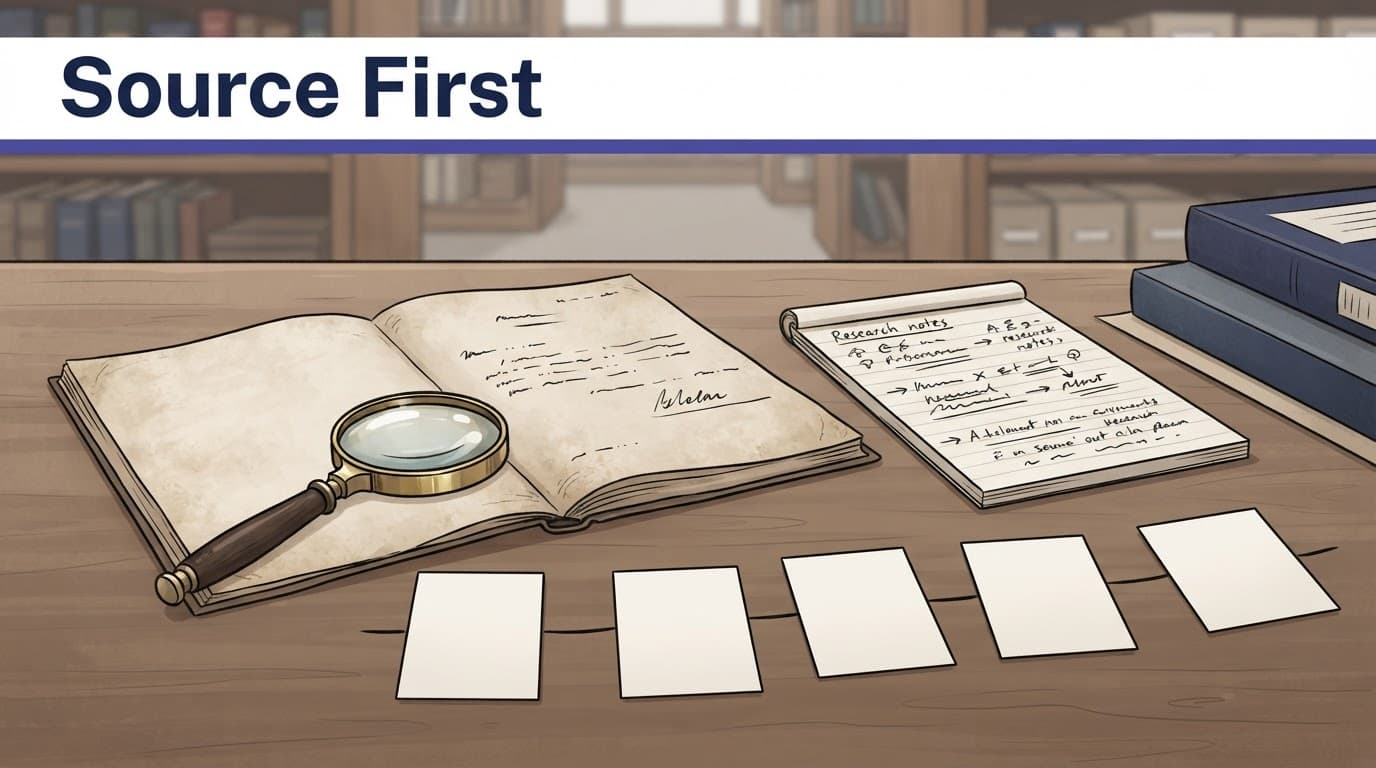
A research timeline starts with archive documents, not a search result snippet or a pre-built chronology. Search catalogs for primary sources by names, places, organizations, record types, and variant spellings.
Authentic material often sits in national, state, and local archives, university special collections, historical societies, court repositories, and family-held papers. The Library of Congress guide to finding primary sources is a useful starting point, while the National Archives primary source resources point researchers toward digitized government records.
Separate Primary Sources, Secondary Sources, and Tertiary Sources
A primary source has a direct relationship to the period or event under study. It may be a letter, photograph, land deed, oral history, ledger, newspaper, government record, or material created later by a participant. Primary does not mean unbiased. A newspaper can repeat a rumor, and a memoir can compress memories.
Secondary sources interpret evidence after the fact and provide historical context. Scholarly books, articles, and museum essays can provide context, point to archives, and show how historians disagree. Use secondary sources to test your reading of a document, not to replace it.
Tertiary sources, including encyclopedias and general reference timelines, help you orient yourself. They are useful for names and broad chronology, but tertiary sources aren't sufficient support for an important claim. Still, trace important events back to cited primary or scholarly secondary material. Fresno State's source-type guide for U.S. history explains why a source's role can change with the research question.

Photo by MART PRODUCTION
Capture evidence before you interpret it
Create a source record as soon as you find a document. Record the repository, collection name, box, folder, item title, creator, date, page or image number, and stable link when available.
Copy quotations exactly, including uncertain spelling, omissions, or bracketed editorial additions. Keep a scan or photograph when permitted, because a transcription can lose layout, crossings-out, seals, and other clues.
Use two separate note fields: "Document states" and "Researcher infers." The first field reports what the source says. The second records your interpretation, along with the reasoning behind it. This separation prevents a later draft from turning a plausible inference into an apparent fact.
Build a Source Ledger and Thematic Matrix
A source ledger tracks each document. A matrix then compares the evidence across time and themes. Together, they stop a large project from becoming a pile of disconnected notes.
Give every event a traceable record
Each row should represent an event candidate, not an unquestioned fact. Tag each candidate by evidence type, such as primary material, secondary sources, or tertiary sources. Add multiple source IDs when several records support, complicate, or contradict the same entry.
Matrix field | What to record |
|---|---|
Event description | A short, neutral statement of what the evidence supports |
Date as written | The source's original date wording |
Sort date | A normalized value used only for chronological order |
Confidence | Exact, range, before, after, circa, disputed, or undated |
Source and location | Full citation details plus page, image, or item reference |
Theme | The thread the event belongs to, such as migration or policy |
The sort date gives timeline software a normalized value for ordering events. It must never overwrite the document’s own wording or hide an uncertain date.
Use layers to reveal the story
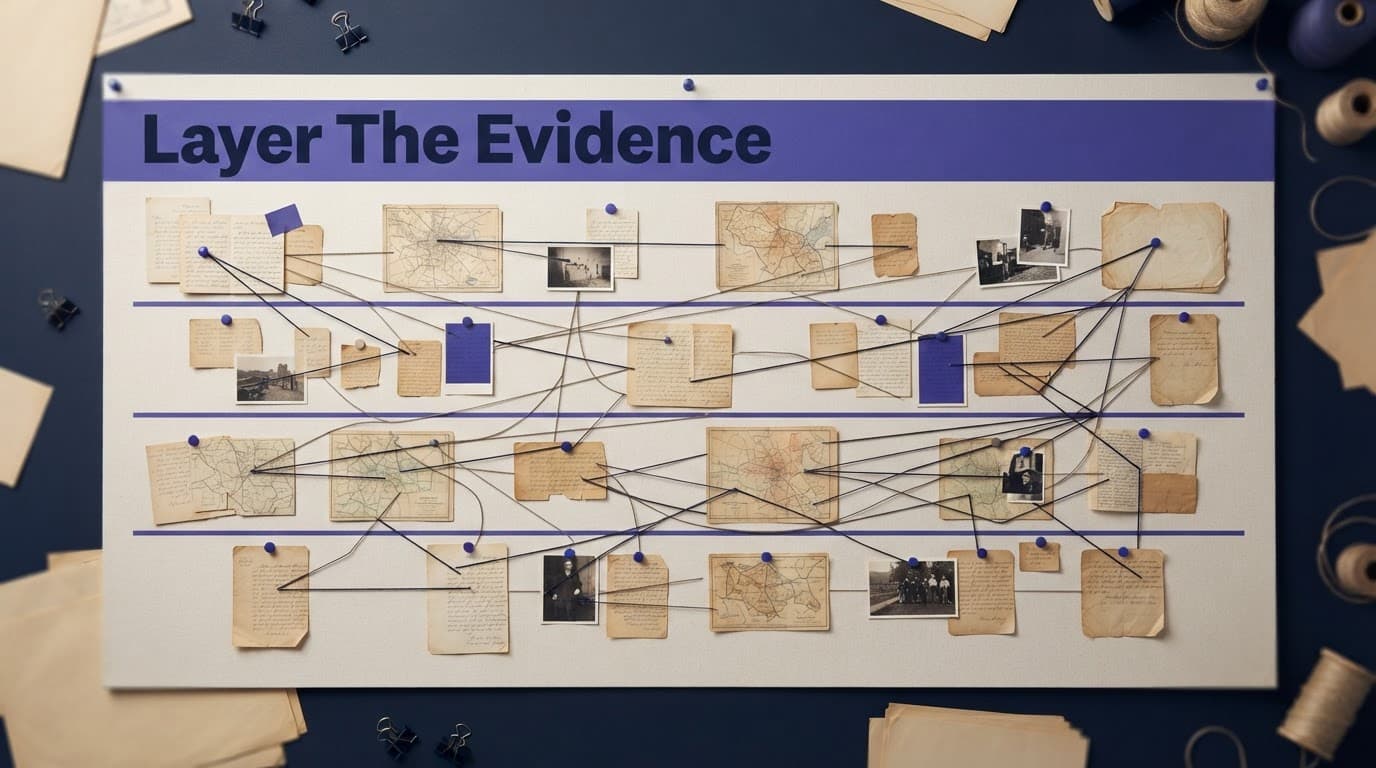
An evidence timeline becomes easier to read when it has separate layers for themes. Timeline software can display parallel lanes for households, institutions, laws, or correspondence while preserving the evidence trail.
Layers expose relationships that a single line can conceal. A legal decision may precede a relocation, for example, yet proximity alone doesn't prove causation. Add a note only when documents support the connection.
Handle Uncertain Dates and Conflicting Records
Show uncertainty without false precision
Use labels that match the source: exact dates, month and year, year, date ranges, approximate dates, before, after, circa, or undated. If a document uses a historical calendar, record that original form and document any conversion you make.
Don't assign the first day of a month or year merely because timeline software requires a sortable value. Keep that technical choice hidden, or clearly mark it as an estimate. The displayed label should preserve the source's uncertainty. The same care applies to ancient history. Check how timeline software renders converted, BC, BCE, and disputed dates before sharing. It should keep BC or BCE dates distinct from CE dates.
Keep conflicting documents in view
Conflicts are part of historical research, not a formatting problem. Compare when each record was made, who created it, what access that person had, and whether the item is an original, a copy, or a later recollection.
Don't average competing dates or select the most dramatic account. Instead, retain separate source notes and mark the event as disputed when the evidence doesn't allow a decision. A short annotation can state why records differ without overstating certainty.
As new evidence appears, revise the timeline and keep a change note. Record what moved, what was removed, and which document prompted the update. That history protects your work when a reader asks why an earlier version looked different.
Turn Verified Research Into a Digital Timeline
Choose features that protect the research
A spreadsheet works well during collection. Timeline software becomes useful when you need readers to explore events, themes, and supporting documents without losing the order of the story.
Choose timeline software for its evidence-preserving capabilities, not just its visual design. Treat the selected tool as a research platform, not just an attractive display. Check its support for citations, filters, and reliable exports.
Use timeline software that keeps source evidence attached to each record. Compare these timeline features:
Multiple layers or lanes for parallel themes and source types.
Date ranges, date qualifiers, and BC or BCE formatting.
Event notes with citations, quotations, and working links.
Filters that let readers isolate one theme without deleting context.
Export options for print, PDF, image, or other visual media, plus a shareable interactive view.
A timeline creator can help you build a visual chronology from scratch. Preceden's timeline maker is one option. Regardless of platform, test how timeline software handles missing or uncertain dates before importing hundreds of records.
Make the interactive view readable
An interactive timeline should let readers open an event and see the source behind it. Add concise descriptions, citation links, and clear markers for disputed or approximate entries.
Use color as a secondary cue, never the only cue. An interactive timeline should also include labels, patterns, and written date qualifiers. These cues help readers who print the timeline, use assistive technology, or view it without color.
For newspaper research, the Library of Congress's Chronicling America collection offers digitized historic newspaper pages. Cite these primary sources as evidence by recording the issue, page, and article location, rather than linking only to a search-results page.
Publish a shareable web version as an online history timeline when readers need to explore the evidence. Keep citations visible and preserve the same date qualifiers used in the research.
Audit the Narrative Before You Share It
Read the rendered output in timeline software from beginning to end without opening the source notes. The sequence should make your central question understandable and support your historical argument without implying causes the documents don't establish.
Audit each event against the ledger: check the quotation, citation, date wording, theme, and confidence label. In timeline software, inspect citations, confidence labels, and date qualifiers, then verify the roles of secondary sources and tertiary sources. Remove duplicates, flag missing context, and add source links where readers may want to verify a claim.
A polished visual timeline can still mislead if it hides disagreement. Before publishing, check whether the timeline creator has silently changed dates, removed context, or obscured disagreement. Clear notes make the work more credible because readers can see where the record is firm and where it remains incomplete.
Frequently Asked Questions
What is a historical research timeline?
A historical research timeline is an evidence-based chronology that places documented events in sequence while preserving source context and uncertainty. Each entry should connect to a document or scholarly interpretation that readers can examine.
How should uncertain dates appear on a timeline?
Use the date wording the source supports, such as a month, year, range, circa date, before, after, or undated label. A normalized sort date may help software order entries, but it should not replace the original wording or imply unsupported precision.
How do you handle conflicting historical records?
Keep the competing records visible and compare their dates, creators, access to information, and relationship to the original event. If the evidence does not resolve the conflict, mark the event as disputed and explain why the accounts differ.
What information should each timeline entry include?
Each entry should include a neutral event description, the original date wording, a confidence label, full source and location details, and its research theme. Quotations, citations, and notes separating the document’s claims from the researcher’s inferences add further transparency.
What should you check before publishing a digital timeline?
Read the rendered timeline from beginning to end and audit every entry against the source ledger. Confirm that quotations, citations, date qualifiers, confidence labels, and source roles are accurate, and remove any visual design choices that hide disagreement or uncertainty.
A Timeline That Shows Its Evidence
A strong timeline doesn't pretend every date is settled. It preserves quotations, distinguishes documents from interpretation, and shows where the evidence conflicts.
When you build an evidence-led research timeline this way, the order of events becomes more than a sequence. It becomes a transparent account that readers can examine, question, and build on.