A research gap is rarely an empty space waiting for a clever search. It usually reflects patterns in academic research, including what scholars studied, measured, excluded, or disagreed about. That distinction matters for PhD students choosing a dissertation topic.
Used carefully, research gaps AI can act as a cautious research gap finder, helping you find those patterns faster. It can also create false confidence if you mistake a sparse search result for proof that no research exists.
The safest approach treats AI as a way to discover, organize, compare, and question scientific literature, then verifies every promising lead through transparent searching and original papers.
What Counts as a Defensible Research Gap?
A research gap is a bounded limitation in the available evidence. It is not simply a topic with few search results, nor is it a claim that you have found something nobody has studied.
A strong gap connects a defined population, setting, method, outcome, or theory to evidence you have checked through a documented literature review. It also acknowledges the limits of your search.
Contextual, methodological, and thematic gaps
A contextual gap may appear when a well-studied intervention has little evidence in a particular country, care setting, age group, or profession. For example, a topic may be widely researched among university students but appear underexplored among adult vocational learners.
A methodological gap concerns the methodology used to study a question. Existing research papers may rely on cross-sectional surveys when longitudinal, qualitative, or mixed-methods research would answer a different part of the question.
A thematic gap arises when related concepts appear in separate bodies of work but are seldom examined together. An evidentiary gap may involve inconsistent findings, weak measures, small samples, or an absence of replication.
An absence in your results is not proof
A thin result set may mean the database's search algorithm favors different terminology, or that relevant studies use different terms. Studies may also sit in another database, appear in adjacent disciplines, or have been published in another language. Recent research may not have accumulated many citations.
The defensible claim is "we did not identify evidence in the sources searched," not "no studies exist."
That distinction protects your proposal from a common problem: presenting an incomplete literature search as novelty. It helps you turn a suspected gap into a bounded research question that matches the evidence.
Research Gaps AI Can Help You Investigate
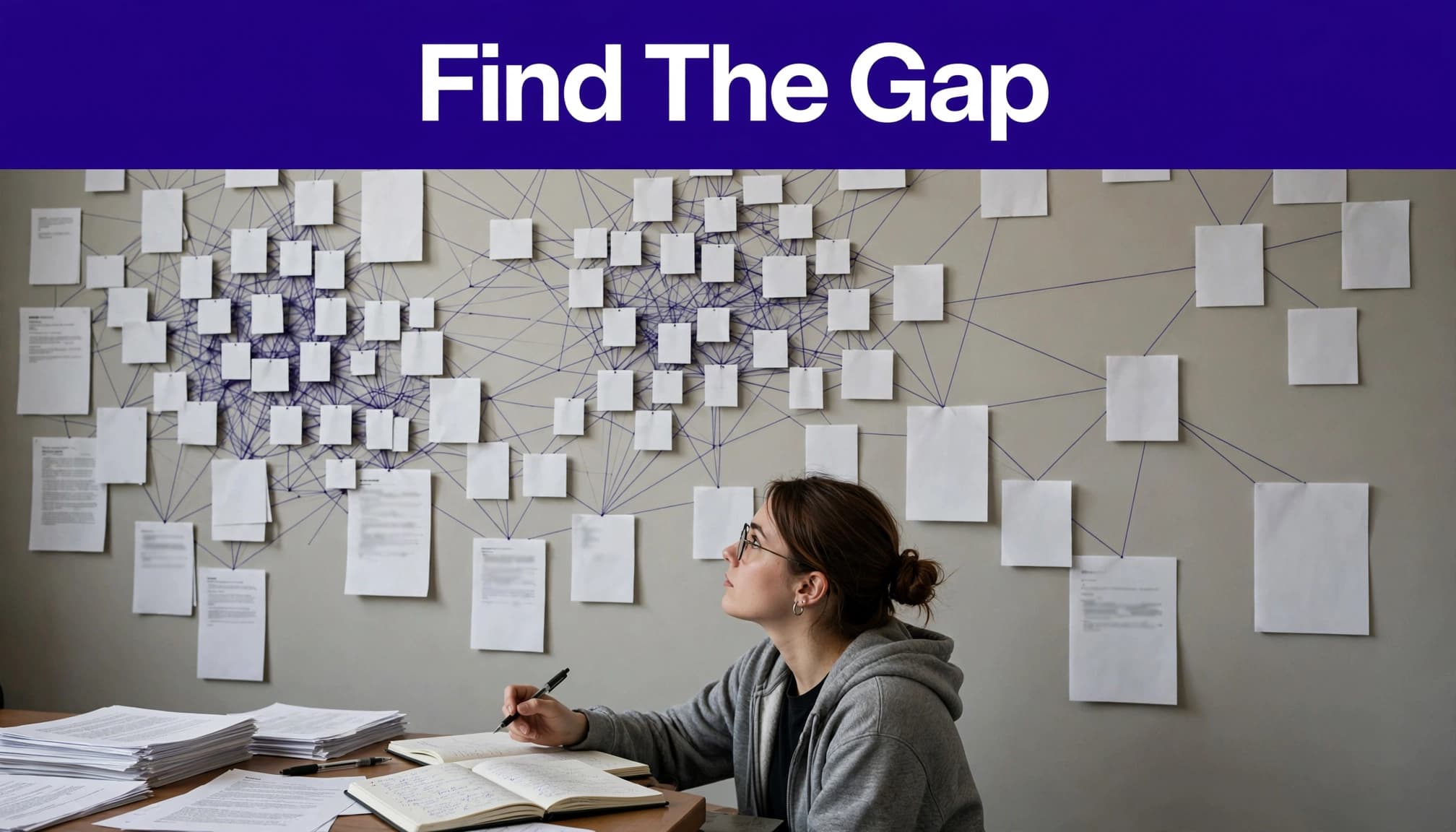
AI tools work best when used as a research gap finder for generating candidate gaps. They can cluster papers, compare study attributes, propose related search terms, and flag inconsistencies in your collection. None can independently establish originality.
Use AI to compare a defined paper set
Collect research papers only after setting boundaries for your review. Ask the tool to identify differences in populations, settings, measures, methods, findings, and author-stated limitations. Require page references, or mark the detail as "not reported."
A literature matrix makes those comparisons easier to inspect. Keep one paper per row, and separate source facts, your analysis, and AI suggestions that require verification. An AI document chat for research PDFs can help locate relevant passages across a selected collection, but you still need to read the full text, including the abstract, methods, results, discussion, and important tables.
Use a citation network to escape narrow keywords
Citation-network tools reveal relationships that keyword searches miss. Backward citation chasing means checking a relevant paper's reference list. Forward chasing means finding later papers that cite it. A review of citation-chasing evidence supports using these methods alongside database searching when building a more complete evidence set.
ResearchRabbit reports access to more than 270 million research articles and lets users explore related work and export collections. Litmaps builds maps around an article's references and citations, then supports BibTeX, RIS, and export to CSV. Both can expose sparse clusters and disconnected disciplines. OpenAlex provides another index for discovery, but no index is complete, and a record alone doesn't prove relevance.
Tool or approach | Useful for | What still requires checking |
|---|---|---|
ResearchRabbit | Exploring related papers and citation connections | Whether the visible cluster reflects the full field |
Litmaps | Mapping references, citations, and linked papers | Missing databases, synonyms, and uncited recent work |
Consensus | Quick paper-level summaries and evidence comparisons | Original methods, quality, and the full result set |
AnswerThis | Generating directions for further searching | Every paper, citation, and proposed gap |
OpenAlex | Discovering records and connected research | Whether records are relevant, current, and complete |
Some tools group related records through semantic similarity. That can support discovery, but similarity isn't evidence of a research gap.
Consensus itself cautions that summaries are snapshots and hallucinations can occur. Its help materials have also used different database figures, including north of 150 million and over 220 million peer reviewed papers. Database size doesn't prove completeness, quality, or novelty.
Build a Search Process Before You Ask AI for Conclusions
A tool can only compare the literature you give it. Before using a research gap finder or asking other AI tools for conclusions, define the task and search scope. Start with a plan that makes omissions visible and shows how you reached your conclusion.
Search broadly, then narrow with evidence
Begin with a provisional research question and several seed papers. Search more than one relevant database, then use synonyms, spelling variants, related concepts, and controlled vocabulary where available. A database's search algorithm may rank or filter results differently. Google Scholar can help locate papers, but it’s one source rather than the entire scholarly record.
For a literature review, plan your sources and terms before screening results. The study-search guidance from Wiley is useful when you need to structure a database search instead of relying on a single conversational prompt.
A practical workflow looks like this:
Define the population, concept, setting, outcome, and time range for the scientific literature you need to investigate.
Collect recent reviews and several influential or highly relevant primary studies.
Ask AI to extract comparable fields into a literature matrix, with page-level evidence where possible.
Search academic databases using expanded terms, controlled vocabulary, and discipline-specific sources.
Chase references backward and citations forward from key papers and recent reviews, then compare them with the original bibliography.
Deduplicate records, screen them against stated criteria, and record why you excluded close matches.
Keep a search log and protect sensitive material
Record each database, date searched, exact query, filters, result count, screening decision, and citation-chasing path. Include sources such as Google Scholar in this log, along with their search dates and settings. Documenting these fields and screening decisions makes a gap claim easier to test. Literature-search reporting guidance also emphasizes clear documentation of how studies were identified. This record can also support later thesis planning.
Keep prompts and AI outputs with your research notes if they informed your process. However, don’t upload unpublished manuscripts, identifiable participant data, embargoed findings, private feedback, or restricted documents unless your institution and the platform permit it. University, department, funder, and ethics requirements can differ.
Validate the Suspected Gap Against Original Studies
A research gap finder may indicate that a population is missing or a method is rare. Test that lead before turning it into a defensible research gap or research question.
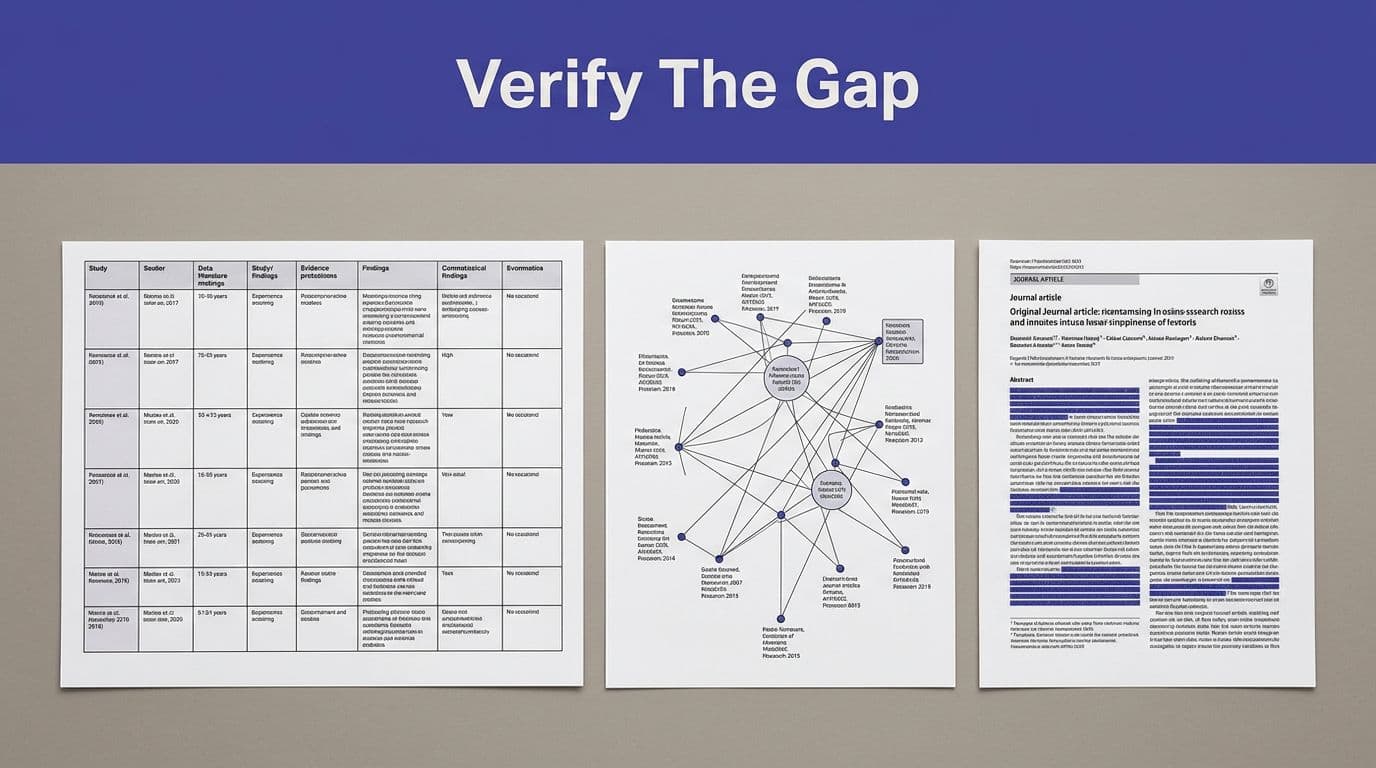
Check the paper, not the generated summary
Open each of the research papers in its authoritative record or original PDF. Check the full text for the author, year, journal, sample, setting, method, outcome measure, and finding. Then inspect the limitations section, tables, appendices, and references.
Peer reviewed papers still require careful checking, because peer review alone doesn't establish accuracy or quality. AI may confuse a background citation with the study being summarized. It may broaden a qualified finding or infer a detail the authors never reported. When a fact is absent, record "not reported" rather than filling the gap with an assumption.
Stress-test the gap with competing explanations
Suppose an AI comparison suggests little evidence about telehealth adherence among rural older adults. Before claiming a gap, search alternative terms such as remote care, virtual consultation, treatment engagement, seniors, and older people. Check nursing, public-health, psychology, and health-services databases. Then examine recent systematic reviews and forward citations.
AI may group terms through semantic similarity, but that doesn't replace searching synonyms, adjacent disciplines, and original sources. Ask whether the supposedly missing methodology appeared under another label, included the population without naming it in the title, or measured adherence indirectly. A systematic review search guide can help broaden literature sampling beyond a narrow keyword set.
Consult a subject librarian, supervisor, clinician, or other domain expert before finalizing the scope. Ask them to challenge the proposed research question and identify landmark studies, terminology, or unpublished norms. Their knowledge can show whether the apparent gap is genuine or caused by your search design.
Write Gap Claims That Match the Evidence
Careful phrasing makes a proposal stronger because it shows what you found and what remains uncertain in your literature review. A research gap finder can help formulate possible claims, but avoid absolute novelty language unless your review was genuinely comprehensive and followed an appropriate protocol.
Use bounded statements such as:
"Recent studies appear concentrated in urban outpatient settings."
"Within the databases and dates searched, we identified limited longitudinal evidence."
"Existing findings are mixed, which requires verification in a larger and more diverse sample."
"The relationship between these variables appears underexplored in vocational education."
Research gaps AI systems can help formulate questions for academic research, but they can't supply scholarly authority. Cite the original peer-reviewed papers, not a chatbot response, tool summary, or generated bibliography. If an AI tool produces a citation, verify it through an original paper, publisher record, library database, Crossref, or a reference manager before using it.
A good research question narrows a candidate gap into something answerable. For a dissertation topic, thesis planning should identify who or what you'll study, where, which relationship matters, and why your methodology can add evidence.
Key Takeaways
A research gap finder can organize papers, map citations, compare study features, and propose search directions, but it can't prove a research gap exists.
A research gap requires database searches, backward and forward citation chasing, original-paper reading, and consultation with subject experts.
Keep a literature matrix that separates reported facts, your interpretation, and unverified AI suggestions.
Document search strings, sources, dates, screening decisions, and excluded near-matches.
Phrase novelty cautiously, because an incomplete search can look like an unexplored topic.
Frequently Asked Questions
Can ResearchRabbit find unexplored topics without relying only on keywords?
ResearchRabbit can help you move beyond keywords by showing related papers and citation connections. That can reveal adjacent clusters you might miss with one query. Still, citation patterns may miss uncited work, recent publications, and literature indexed elsewhere, so you need database searches too.
How can Litmaps reveal disconnected literature?
Litmaps can build a visual map around an article's references and citations. This citation network may show separate clusters with few links between them, revealing a thematic connection worth investigating. It doesn't prove those fields have never been combined, because indexing and citation behavior can also create separation.
Can AnswerThis help identify a possible research gap?
AnswerThis may suggest search directions and relevant literature. However, you must check every paper, citation, and proposed gap against the original sources.
Can I use OpenAlex to discover literature for a research gap?
OpenAlex can provide another discovery source for related publications and topics. Check its coverage and indexing limits, and don't treat its results as a complete record of the literature.
How do I know an AI-generated research gap is valid?
Use an AI research gap finder to generate leads, not conclusions. Treat AI tools as search aids rather than scholarly authority. Validate the claim by checking peer reviewed papers in full text, expanding your search vocabulary, searching multiple academic databases, reviewing recent syntheses, and chasing citations in both directions. Then ask a subject expert to challenge your interpretation. A suspected research gap becomes defensible only when the evidence supports a precise, limited claim.
A Careful Gap Can Still Be Original
The strongest contribution isn't a dramatic claim that nobody has studied a topic. It's a well-supported research gap that addresses a clear limitation in academic research you can document.
Let a research gap finder widen your view of the literature. Let systematic searching, original sources, and expert review determine what the scientific literature actually leaves unanswered.