A pile of PDFs collected during a literature search does not become a literature review just because you have read them. During a research project, you need a system that helps you compare sources, trace claims, and spot patterns before you begin drafting.
A literature review matrix puts that system into one searchable table. AI can speed up note extraction and theme tagging, but your own reading and judgment must remain in charge, especially in academic writing. Start with a structure that makes every source easy to verify.
Key Takeaways
A literature review matrix turns scattered sources into a searchable comparison table, with consistent fields for citations, methods, findings, limitations, themes, and page references.
Build the matrix structure before using AI, keep one source per row, use short entries, and add status fields and filters to manage the review process.
Use AI for source-grounded note extraction and theme comparison, but verify every output against the original source and distinguish source facts from analysis and AI suggestions.
Protect research integrity by maintaining a source trail, checking citations and quotations, respecting privacy requirements, and using the matrix to develop a thematic review outline rather than a source-by-source summary.
What a literature review matrix should capture
A review matrix is a spreadsheet that organizes key details from academic research articles. Each row represents one source, while consistent column headings capture the same information across studies. This turns scattered annotations into comparable evidence.
The basic structure is well established. The Brandeis Matrix Method guide recommends beginning with the author, publication information, publication year, and purpose. These fields make it easier to identify each study before you assess it.
Choose additional column headings based on your research question. A public health review may need population, setting, and outcome measures to map source characteristics. A humanities review may need a theoretical framework, primary texts, and interpretive claim. The matrix should answer the questions you will later ask in your review.
Useful column headings usually include:
Column headings | What to record | Why it matters |
|---|---|---|
Citation | Author, publication year, title, journal, DOI or URL | Lets you return to the original source |
Research purpose | The study's stated aim or question | Shows where studies overlap |
Method | Design, data source, sample, or corpus | Prevents unlike evidence from being merged |
Key findings | Short, accurate summary of results | Provides material for synthesis |
Study limitations | Gaps named by authors and issues you identify | Supports critical evaluation |
Themes | Your consistent descriptive tags | Helps group sources during drafting |
Relevant pages | Page numbers for claims and quotations | Makes checking fast |
A matrix is not a list of summaries. It is a comparison tool for standard literature reviews and systematic reviews alike, helping you track key findings and study limitations across sources. When entries use the same categories, differences in methods, populations, and conclusions become visible.
A polished AI summary without a page reference is a lead to verify, not evidence you can cite.
Build a literature review matrix before asking AI to help
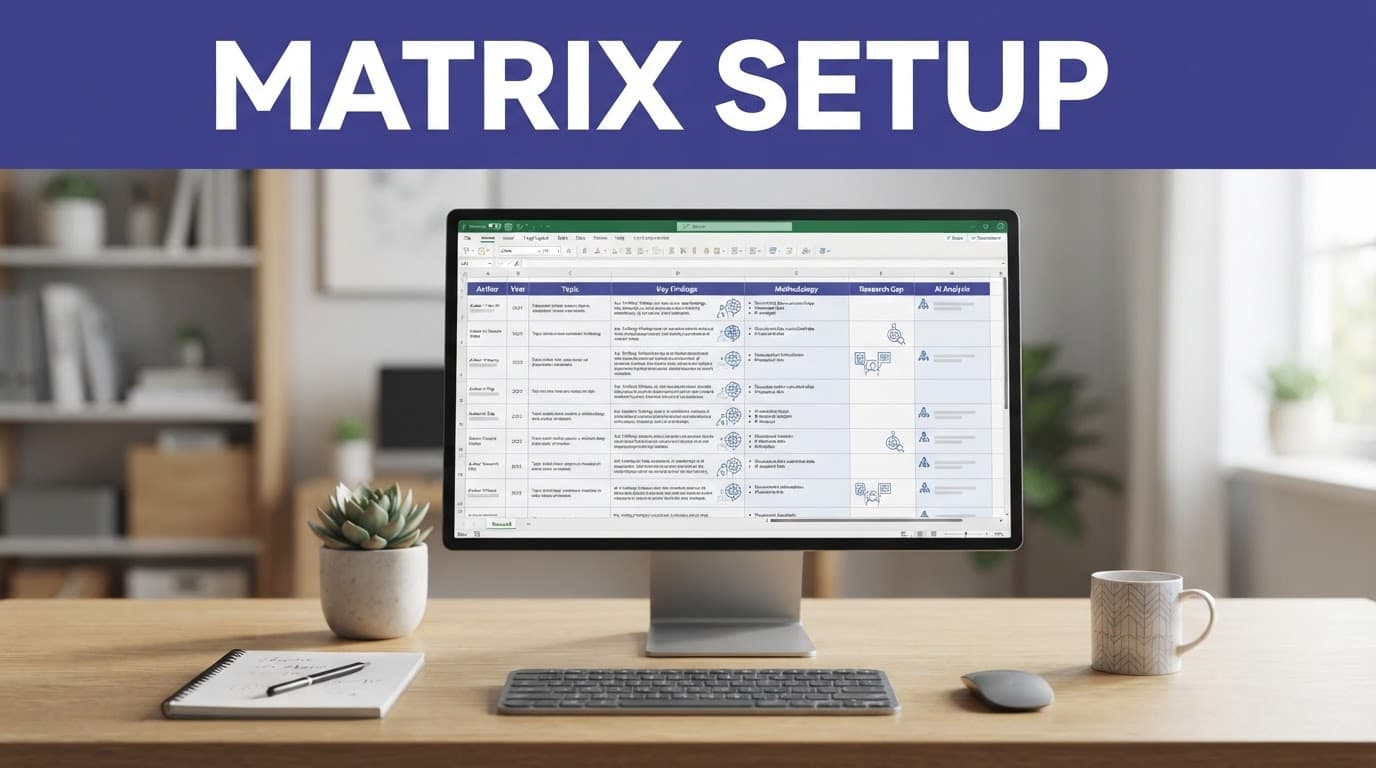
After completing an initial literature search for your research project, start in Google Sheets, Excel, Airtable, or another tool that supports filtering. Use one row per article, book chapter, report, or dissertation, and record key source characteristics in the sheet. Keep the full citation in a reference manager such as Zotero, then add a short citation key to the review matrix.
First, create your essential column headings before importing research notes. This protects consistency. If you add a new category later, apply it across earlier rows rather than recording it only for new sources.
The Virginia Commonwealth University literature review guide also uses author and publication details, year, and purpose as the opening matrix columns. Put these descriptive fields on the left, then place analytical fields to the right. That layout keeps source identity visible while you scroll.
Use short entries. A finding cell should capture the claim, condition, and result, not a paragraph copied from an abstract. For example, write: "Higher attendance correlated with completion; single-campus sample." That sentence is easier to compare than a block of text.
Add a status column to control your workflow. Use values such as To read, Read, Verified, and Cited in draft. Then apply data validation so you select status values from a dropdown rather than create inconsistent labels.
A few formulas make the sheet more useful:
Count completed sources with
=COUNTIF(N2:N200,"Verified"), if column N contains your review status.Flag a missing limitation note with
=IF(H2="","Add limitation",""), if column H records limitations.Join theme tags in a display column with
=TEXTJOIN(", ",TRUE,J2:L2).Count sources assigned to a theme with
=COUNTIF(J:J,"Equity").
Filters reveal patterns quickly. Filter by research methodology, sort by study design or sample size, then compare method and finding columns. You may find that a popular claim rests mainly on small qualitative studies, or that more recent research reaches a different conclusion.
Use the review matrix to identify gaps before you ask AI to summarize or group sources. A clear structure makes it easier to compare evidence and verify any notes the tool generates.
Use AI to extract notes, not to replace the source
AI works best for data extraction after you’ve gathered the full text of your research articles and defined your matrix fields. Upload or paste one source at a time into a source-grounded workspace, then ask the tool to return details in the exact order of your columns.
This approach reduces reformatting and makes missing information visible. It also helps organize data collection details, such as the study design and sample size. If a study doesn’t report a limitation, AI should say so rather than invent one.
Use this prompt for an initial extraction:
Read only the uploaded source. Fill these fields: research purpose, research question, study design, sample or corpus, sample size, setting, data collection methods, key findings, author-stated study limitations, and future research suggestions. For every field, include page numbers. If the source doesn’t state an answer, write "Not reported." Don’t infer missing details.
Then compare the output with the original PDF. Read the abstract, method, results, and discussion yourself. AI may compress a qualified finding into a broader statement, confuse a cited background study with the current study, or miss a methodological detail buried in a table.
For a second pass, ask about a narrow issue:
Identify every passage where the authors discuss participant selection. Quote no more than 25 words per passage, provide page numbers, and explain whether the sampling or sample size limits generalizability. Separate author statements from your own inference.
The distinction matters. A literature review asks you to evaluate evidence, not merely repeat what an AI tool extracted. Keep direct quotations short, record their page numbers, and paraphrase only after checking the source.
Group evidence with AI prompts and your own judgment

Once you have verified entries, AI can support evidence synthesis by helping you see relationships across your literature review matrix. Give it only the rows you have checked, and ask for a comparison rather than a final argument.
A useful synthesis prompt is:
Using only the matrix entries below, group the studies into recurring themes through thematic analysis. For each theme, list the cited studies, points of agreement, points of disagreement, and method differences. Do not add claims that are absent from the matrix. Mark themes supported by fewer than three studies.
That final instruction prevents a thin pattern from becoming a headline claim. AI can propose themes such as access barriers, measurement differences, or conflicting outcome definitions. You decide whether those categories fit your research question.
Try a gap-focused prompt when you’re ready to plan the review:
Review these verified matrix rows. Identify a potential research gap based on population, geography, time period, method, and outcome measure. Distinguish a true research gap from a topic that the matrix simply does not yet cover. Cite the relevant source keys for every observation.
Don’t treat the output as proof that a research gap exists. Expand your literature search, read recent systematic reviews, and check whether your collection is broad enough. An incomplete literature review matrix produces incomplete patterns.
The Liberty University matrix guide describes the literature review as reading, analyzing, and writing a synthesis of scholarly material. Whether you’re preparing a narrative review or working within the stricter methods of systematic reviews, critical interpretation still depends on understanding each source’s evidence and limits. AI can assist with organizing and thematic analysis, but it can’t replace your judgment.
Keep your AI-assisted review accurate and ethical
Never upload unpublished manuscripts, sensitive interview transcripts, student records, or restricted data to a tool unless your institution and the tool's privacy terms allow it. Remove identifying details when possible.
Maintain a source trail. Save the original PDFs, the matrix version, AI outputs you relied on, and the prompts that generated them. Version history in Sheets or Excel helps you recover a changed entry and show how your notes developed.
Quality assessment also belongs in your workflow. Before relying on a claim in your academic writing, verify the study's methods, evidence, and limitations. AI may generate plausible publication details that do not exist, so import citations from library databases, publisher pages, Crossref, or Zotero whenever possible. Before submitting, check every quotation, page number, author name, publication year, and reference entry against the original research articles.
Use color or a separate column to label three different kinds of notes:
Source fact records what the author reported.
Your analysis states your interpretation or comparison.
AI suggestion marks an unverified idea that still needs checking.
This separation stops an AI-generated interpretation from slipping into your notes as if it were a source finding. It also helps preserve integrity in academic writing and makes the drafting stage more honest.
Turn the matrix into a literature review outline
A strong review rarely follows one source at a time. Instead, use the themes column in your literature review matrix to create sections that compare studies around your central research topic and research question.
Filter your review matrix by a theme, such as "measurement validity," and use thematic analysis to identify meaningful patterns. For systematic reviews and other literature reviews, read the research methodology, key findings, and limitations side by side. Then write a claim that reflects the evidence: perhaps several studies agree on an association, but they use incompatible measures. Add citations from the relevant rows, then return to the original texts for precise wording.
A simple outline can follow this sequence:
Define the theme and explain why it matters to the research question.
Compare studies that reach similar findings, with attention to their research methodology and key findings.
Address conflicting results and likely reasons for the difference.
Identify the limitation or unanswered question that remains.
Your matrix should remain open while you draft. Mark sources as cited, add new page numbers, and revise theme labels when your interpretation changes. The spreadsheet is a working record, not a task you finish before writing.
Frequently Asked Questions
What is a literature review matrix?
A literature review matrix is a table that organizes and compares information from academic sources. Each row represents one source, while consistent columns capture details such as the purpose, method, findings, limitations, and themes.
How can AI help create a literature review matrix?
AI can extract structured notes from full-text sources and suggest comparisons or recurring themes. It should support organization and synthesis, not replace your reading, source verification, or critical judgment.
What columns should a literature review matrix include?
Common columns include citation, research purpose, method, key findings, study limitations, themes, and relevant pages. Add fields that match your research question, such as population, setting, theoretical framework, or outcome measures.
How do you check AI-generated literature review notes?
Compare every AI-generated entry with the original article, especially the abstract, method, results, discussion, tables, quotations, and page numbers. If information is missing, record it as “Not reported” rather than allowing the tool to infer or invent details.
Can a literature review matrix identify a research gap?
A matrix can reveal patterns and possible gaps across populations, methods, settings, time periods, and outcomes. However, you should expand the literature search and consult recent reviews before treating a potential gap as established.
Final thoughts
A reliable literature review matrix gives every source a place, every claim a trail back to the page, and every emerging theme a record of supporting evidence. Whether you're exploring a focused research topic or synthesizing complex literature, a structured review matrix keeps the process organized while preserving the role of human judgment.
AI can reduce repetitive extraction work and surface useful comparisons. Your reading, verification, and critical judgment turn those organized notes into a literature review that readers can trust.