A chapter can feel impossible when every sentence introduces another term you don't know. AI can help you simplify a textbook by focusing on one difficult passage at a time. Ask for an explanation, then check it against the source material on the page. Used this way, AI supports your learning experience, rather than acting as a shortcut or replacement for understanding the textbook.
The goal is to make the ideas easier to grasp while keeping the definitions, conditions, and exceptions your course expects you to know. Start with the passage that's slowing you down.
How to simplify textbooks with AI without losing meaning
A good plain-language explanation of dense academic texts keeps the textbook's claim intact. It replaces difficult wording, but doesn't replace precise terms with vague ones.
Ask for an explanation, not a shorter paragraph
A summary tells you what a section discusses. An explanation shows how its ideas fit together. If a paragraph introduces a process, ask what starts it, what happens next, and which conditions change the outcome.
Work with one subsection at a time. Include its heading and a little surrounding text so the AI can tell whether an unfamiliar word has a course-specific meaning. Ask it to explain the passage at your grade level. If the answer still feels abstract, request an example followed by a sentence connecting that example to the original passage.
Protect the language that matters
Tell the tool to retain named concepts, formulas, units, and definitions exactly where wording matters. It should explain each term beside a simpler paraphrase, rather than quietly swapping it out.
For example, an explanation of osmosis still needs the idea of water moving across a selectively permeable membrane. "Water moves around" is easier to read, but it drops the condition that makes the concept useful.
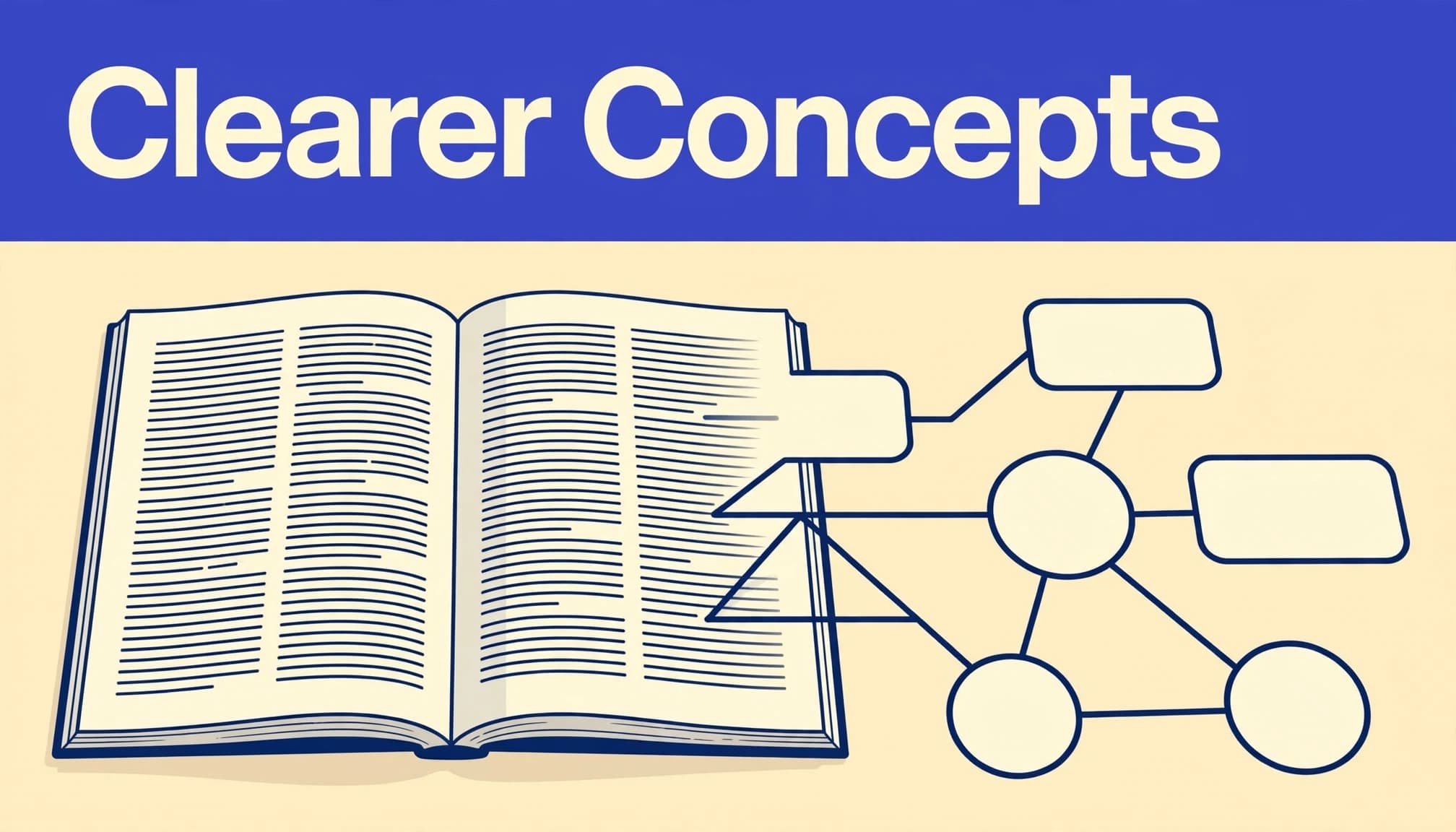
Break a long chapter into manageable work
Uploading a hundred-page document and asking a textbook summarizer for "everything important" often produces a broad outline. First, use the table of contents, learning objectives, and section headings to decide what you need to learn. Then give the AI a smaller, focused job.
Map the chapter. Ask for its main sections, key concepts, and the question each section addresses. Confirm the map against the actual headings.
Read one section. Mark sentences you can't explain yourself, along with definitions, formulas, figures, and qualifications.
Request a plain-language explanation. Specify the section and the level you want. Ask the AI to preserve technical terms and point back to supporting pages when the tool allows it.
Build brief study notes. For each concept, record the course term, a plain explanation, one important condition, and its page number.
Test your understanding. Close the notes and explain the idea aloud or answer a question without looking. Reopen the textbook wherever you hesitate.
For a long PDF, repeat that cycle section by section. Keep figures and tables open while you work. Their labels, axes, and footnotes can carry information that a text-only summary misses.
If you can't locate a claim in the chapter, leave it out of your notes until you can verify it against the source material.
This approach also prevents a common study problem: collecting pages of polished AI notes that you haven't understood well enough to use.
Prompts that make difficult passages clearer
Broad instructions such as “make this easy” give AI little direction. A focused prompt identifies the passage, your learning level, and what must remain accurate.
Explain the passage at your level
After selecting a short passage, try:
“Explain this passage in everyday language for someone who knows [prior concept] but hasn’t learned [new concept]. Keep the textbook’s definitions and technical terms. Explain each sentence’s role in the argument, then give one concrete example. Flag anything the passage doesn’t establish.”
Adjust the bracketed concepts to fit your grade level, an undergraduate course, or independent study. If the explanation assumes knowledge you lack, ask it to define that prerequisite first.
Ask for distinctions and limits
Dense academic writing often makes a claim under particular conditions. To preserve those limits, ask:
“List the main claim, the evidence given for it, and any exceptions or conditions. Which words would change the meaning if I removed them? Point to the sentence supporting each item.”
For equations, add: “Define every symbol and unit, and explain when the equation applies.” For research papers, request separate explanations of methods and findings. This helps distinguish what researchers measured from what they concluded.
Verify the explanation against the textbook
Fluent wording can make an inaccurate answer sound settled. AI hallucinations in education include false or misleading outputs that seem credible, so treat an AI explanation as a draft to check.
Check claims, not just citations
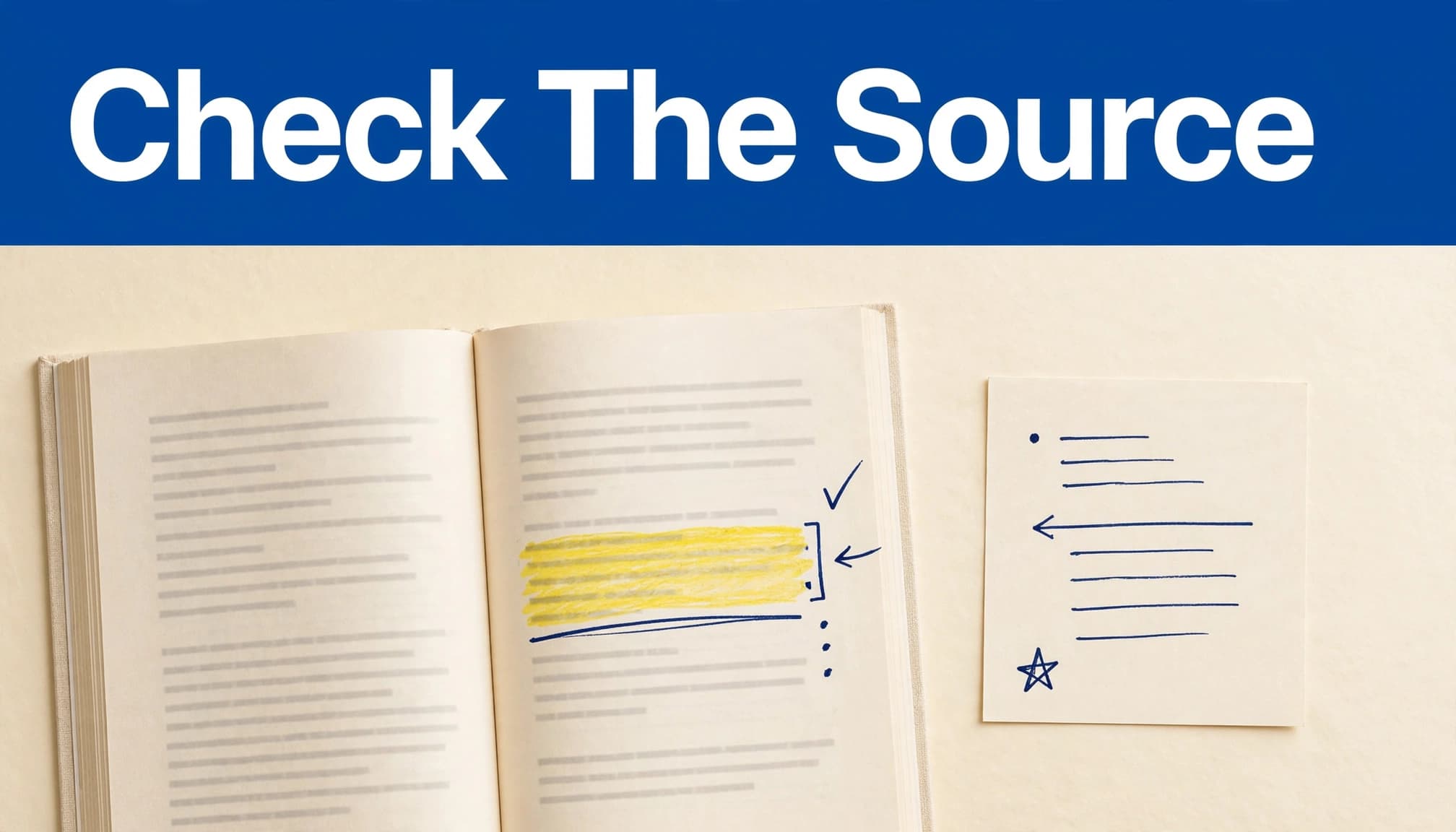
Compare the explanation with the source material and the original textbook section. For each substantial claim, find the sentence, figure, or table that supports it. Check whether the AI kept words such as "may," "only," and "under these conditions." These small words can define the limits of a scientific or historical claim.
A page citation helps you locate evidence, but it isn't proof by itself. Open the cited page and check whether the passage supports the answer. If it doesn't, revise your note or ask the tool what it relied on. Never copy an unverified reference into an assignment.
Look for what disappeared
Compare the output with the textbook's definition, worked example, and exceptions. A short explanation may omit a counterexample or turn a relationship into a rule that always applies. Check footnotes and diagrams, especially when they affect the conclusion.
You can ask the AI, "What important qualification might this explanation have missed?" Still, make your final judgment from the original text. A second AI answer can repeat the first error.
Choose a tool for the part of reading that's hard
The best AI book summarizer depends on the task, and useful tools offer multiple representations of difficult material. A textbook summarizer with source-linked questions helps you find claims again; markup supports annotation, while mind maps reveal relationships.
Option | Useful for | Check before relying on it |
|---|---|---|
NotebookLama | Interactive AI document chat, cited answers, summaries, quizzes, and flashcards | Whether each answer matches the cited passage |
NoteGPT | PDF summarizer for document summaries and questions | Whether definitions and section boundaries survive |
Mapify | Turning material into visual mind maps | Whether arrows and groupings reflect the source |
PDFgear | Reading, annotating, and asking questions in a PDF workflow | Whether scanned pages and figures were read correctly |
SparkNotes or other prepared guides | Study guides and a separate overview of a covered work | Whether it matches your assigned text and course emphasis |
If your main goal is to simplify textbooks with AI while keeping a route back to the page, test source references before comparing extra features. NotebookLama's document chat and study tools are one option for asking questions about uploaded material and building review activities.
Try any tool on one difficult page first. Include a definition, a figure, and a footnote if possible. A useful tool should help you find and understand those details, not merely produce a confident paragraph.
Turn explanations into something you can remember
Understanding a paraphrase while it's on screen doesn't mean you can recall the concept tomorrow. Use the verified explanation to practice retrieval, support learning retention, and apply the idea.
Make questions that test meaning
Ask questions that test content comprehension. Have them ask you to explain key concepts, distinguish related ideas, or apply a rule to a new case. Answer before revealing the AI's response, then check both the question and answer against your textbook.
Generated flashcards need the same review. A card that removes a condition can teach an incorrect absolute rule. Keep one testable idea per card, and add a page reference for definitions you may need to revisit.
Use maps and personalization carefully
Mind maps can use multiple representations to show how a chapter connects causes, mechanisms, and outcomes. Verify every connection against the text, since an arrow can imply a causal relationship the author never claimed.
Personalized learning may help you enter an unfamiliar topic. Google's Learn Your Way research tested personalized learning with generative AI. The group using that approach scored 78% on a retention assessment 3 to 5 days later, compared with 67% for the comparison group. That's a finding from that study, not a promise that an AI summary will raise anyone's score. Whatever format helps you begin, return to the course's exact terminology for exam preparation.
Set boundaries for accuracy, privacy, and coursework
Generative AI can make a hard page more approachable, but your textbook is the source material, and your instructor remains the authority on what your course teaches. If an answer conflicts with a lecture, assigned definition, or worked solution, bring the specific passage to your instructor instead of guessing which version to memorize.
Before uploading files, check your course rules and the tool's terms. Don't upload private, copyrighted-with-restrictions, or otherwise restricted educational materials without permission. Remove personal information from notes where possible. UNESCO's guidance on generative AI in education identifies data privacy as an issue that needs protection.
For sensitive work, privacy considerations for document chat can help you assess access, storage, and deletion practices. If an assignment prohibits AI assistance, follow that rule, even if you only planned to request a summary. Write your own analysis and verify any source you cite.
Key Takeaways
Work through textbook sections in small pieces instead of requesting one broad chapter summary.
Ask AI to keep definitions, conditions, formulas, and course terminology while explaining them plainly.
Check important claims and citations against the original page, including figures and footnotes.
Turn verified explanations into recall practice for exam preparation, and follow your course's rules for AI use and file uploads.
Frequently Asked Questions
Can AI replace reading a textbook chapter?
No. A textbook summarizer can help you find the structure and understand difficult passages. It may miss context in examples, tables, or nearby paragraphs. Read the assigned material closely enough to check what the explanation leaves out.
Are AI mind maps accurate when made from PDFs?
They can be useful starting points, but inspect the relationships they show. Check each connection against the PDF, especially if an arrow suggests cause and effect. Scanned text and complex diagrams deserve extra attention.
How is an AI explanation different from a study guide?
A prepared guide gives a fixed account of the work it covers. An AI book summarizer can answer questions about your assigned passage and adjust the explanation to your background. That flexibility is useful, but you still need to check its answers against the source.
Conclusion
The fastest summary isn't always the one that helps you learn. To simplify textbooks with AI safely, focus on one difficult passage, keep its precise terms, and check the explanation against the page.
When the wording becomes clearer without changing the claim, you can spend less time untangling sentences and more time understanding the subject.