You can summarize every section of a paper and still miss how its conclusion follows. Argument structure analysis traces the support relationships between claims, evidence, and assumptions.
Argument analysis reconstructs what the author asks readers to accept, then assesses whether the support warrants it. Start with the main claim, not the paper's headings.
Start argument structure analysis with the main claim
Distinguish an argument from a summary
An argument is a group of statements in which premises support another statement, the conclusion. Here, "argument" means reasoning, not a quarrel. The Internet Encyclopedia of Philosophy's explanation establishes this premise-conclusion relationship.
A summary reports what a paper discusses. An argument map identifies why you should accept its claims. Introduction, Methods, Results, and Discussion are organizational headings; they don't automatically reveal the logic.
In argument analysis, trace the author's logical reasoning from each claim to the statements that support it.
Identify the author's central commitment
Read the abstract, the introduction's closing paragraphs, and the discussion or conclusion. Then write one sentence answering: "What does the author want readers to accept?"
Preserve words such as "may," "suggests," and "under these conditions." A tentative association isn't equivalent to a demonstrated cause.
Conclusions can appear first, last, or anywhere between. Position helps you search, but support relationships determine which claim is the conclusion.
Separate premises, evidence, and qualifications
Use signal words as clues
Conclusion indicators include "therefore," "so," "thus," "consequently," "we may conclude," and "we can conclude that." Premise clues include "since," "because," and "for the reason that."
Also inspect "it follows that," "implies that," and "as a result." These commonly introduce inferences or consequences, so classify the connected statements by function.
Some arguments contain no signal words. Use signal words to frame two questions: "What reason is offered?" and "What claim does that reason support?"
Record what the evidence actually establishes
A premise supplies a reason; evidence supports that reason. Data, quotations, theoretical principles, and earlier studies can all contribute, but their roles differ.
Record the source passage and page number beside each claim. Distinguish the current study's findings from background research it cites.
Our PDF document chat supports targeted questions such as:
Identify the main conclusion and its supporting reasons. Give page references, preserve qualifications, and separate the authors' statements from inferred assumptions.
Compare the extracted claims with their passages. If information is absent, record "Not reported" rather than filling the gap.
Turn prose into an argument map
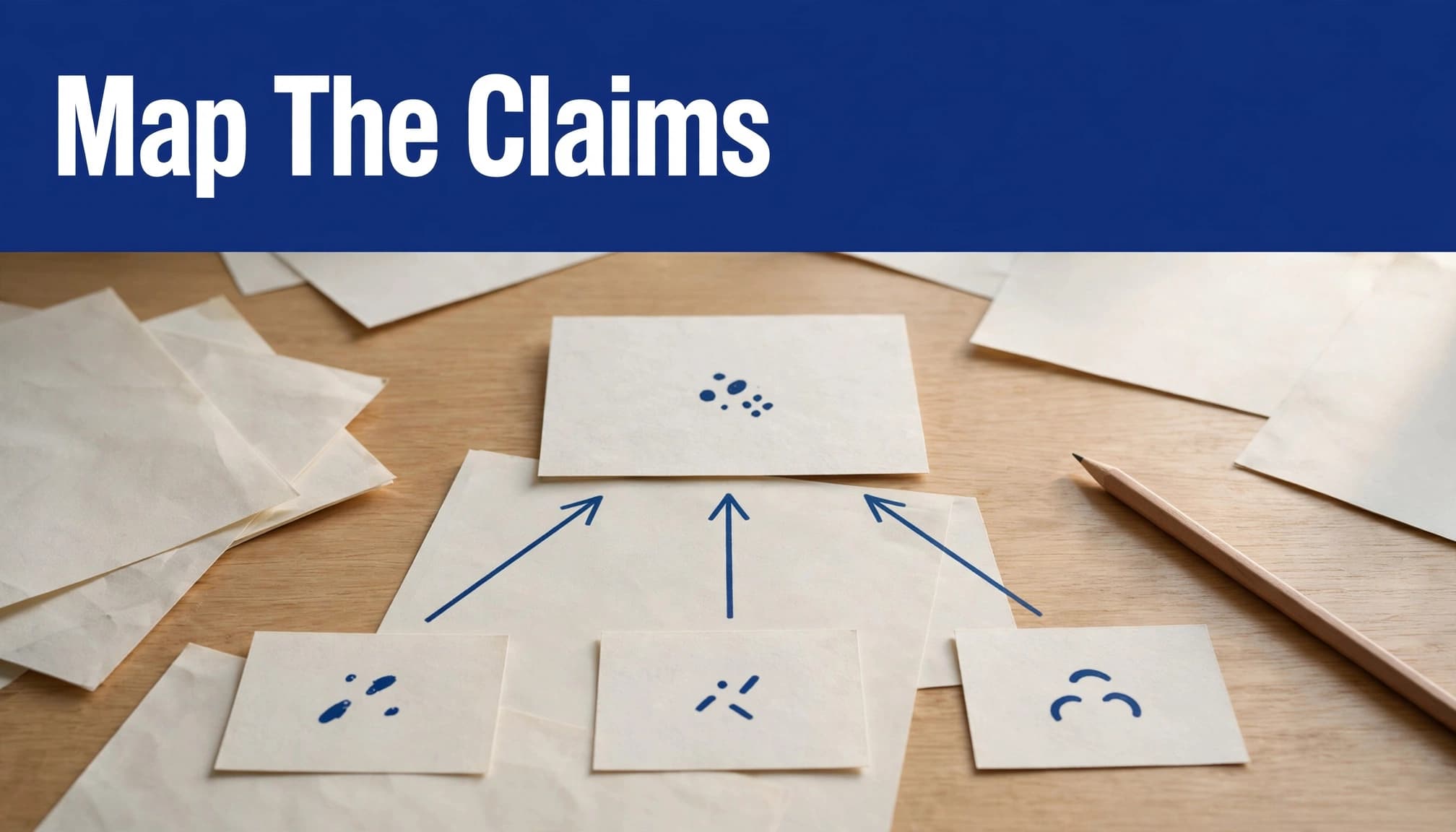
Use this repeatable sequence:
Extract each relevant claim into a separate sentence, retaining qualifications and source locations.
Remove repetition and background details that provide no support, without deleting definitions needed for the inference.
Label premises P1, P2, and so on; label the main conclusion C.
Mark intermediate conclusions as SC1 or SC2, then connect each supporting statement to its target claim.
An argument map makes the paper's argument structure visible. A sub-conclusion receives support, then passes that support on to another claim. For example, a measurement's reliability may need establishing before its results support a broader interpretation.
Next, distinguish linked premises from independent premises. Linked premises must work together, so show them as a cluster with one arrow to the conclusion. Independent premises each provide support, so give them separate arrows.
The UTSA argument-structure guide explains these relationships. Apply a removal test: if deleting one premise breaks the other's inference, they're probably linked.
Keep objections separate. A counterclaim challenges a claim, premise, or inference; a rebuttal is the author's response.
A worked example: Watson and Crick's DNA paper
James Watson and Francis Crick's 1953 paper, "Molecular Structure of Nucleic Acids," proposes a double-helical structure for DNA. It also connects complementary base pairing with a possible copying mechanism.
This compact reconstruction isolates that latter inference.
Role | Author's position, paraphrased |
|---|---|
P1 | The proposed structure restricts pairing to adenine with thymine and guanine with cytosine. |
P2 | These pairings determine the complementary sequence corresponding to either chain. |
SC1 | Each chain therefore specifies a corresponding partner sequence. |
C | The proposed structure suggests a possible mechanism for copying genetic material. |
P1 and P2 work together to support SC1, which then supports C. Notice the qualification: "suggests a possible mechanism."
Reader's evaluation: The structural proposal makes copying plausible, but this paper doesn't demonstrate the complete cellular replication process.
That evaluation belongs outside the author's reconstructed argument. Keeping the two separate prevents your judgment from becoming an invented author claim. It also makes the argument's remaining burden clear: structural compatibility alone doesn't establish how copying occurs.
Distinguish inductive and deductive reasoning
Deductive reasoning tests whether the conclusion must follow
In deductive reasoning, a valid inference guarantees its conclusion if its premises are true. A sound argument combines valid reasoning with true premises.
For example, by definition, mammals are vertebrates. Whales are mammals. Therefore, whales are vertebrates. The conclusion follows necessarily from the two premises.
As Oklahoma State's logic resource explains, deductive arguments seek conclusive support. Valid form is part of logical reasoning, but it doesn't establish whether a paper's premises accurately describe reality.
Induction tests how strongly the evidence supports a claim
Inductive reasoning supports probable conclusions rather than proving them beyond doubt. Many empirical papers infer broader patterns from observed cases. A correlation between two variables doesn't prove causation.
Ask whether the sample is sufficiently large and representative of the population named in the conclusion. More observations won't repair systematic sampling bias.
A single black swan falsifies "all swans are white." Conversely, many white swans cannot establish that universal claim with certainty. The LibreTexts reasoning guide develops this distinction between necessary and probable support.
Test implicit premises and the evidence

Expose the assumption connecting reason and claim
Ask: "What additional statement must be true for this inference to work?" That statement is a candidate suppressed premise.
"Natural products are safe" depends on the assumption that natural origin guarantees safety. This warrant is a candidate inference, not an explicit author statement. Naturally occurring poisons show why that bridge needs scrutiny.
Label each suppressed premise as your inference, not the author's explicit wording. Prefer the smallest assumption needed to connect the claims. Then ask whether the paper supports it, whether exceptions exist, and whether a weaker conclusion would follow without it.
Match claim strength to design and limitations
Read the methods, results, tables, and limitations together. Does the evidence concern the exact population, outcome, and time period claimed?
Correlation can reflect coincidental co-occurrence rather than causation. April rain and US income-tax filing occur in the same month, but that correlation alone doesn't establish causation.
Likewise, an observational association needs additional support before it warrants a claim of causation. Consider confounding, participant selection, attrition, and measurement choices. Critique how each limitation affects the inference.
Check publication history for corrections or retractions when credibility matters. Later citations can reveal disagreement, but they don't decide validity.
Keep author-reported facts, your analysis, and AI suggestions separate. A literature review matrix helps maintain that source trail across papers.
Use argument templates without forcing a fit
Named templates help classify rhetorical moves, including how authors present and support positions. They shouldn't replace the extracted map.
Toulmin-style analysis examines claim, grounds, bridge (warrant), foundation (backing), counterclaim, and rebuttal. Treat these as useful categories rather than a single definitive component list. When the bridge from grounds to claim is implicit, state the warrant in your map. Record qualifiers separately so the claim retains its original strength.
Classical argument, rooted in Aristotle's rhetorical tradition and developed by Cicero and Quintilian, follows introduction, background, proposition, proof, refutation, and conclusion.
Rogerian argument, associated with Carl Rogers, uses introduction, opposing view, statement of validity, position, context, and benefits. It recognizes circumstances in which another position has merit before presenting its own case.
Academic papers may combine these moves. A theoretical argument might depend on warrants and objections, while an empirical paper emphasizes evidence and scope. Choose categories that clarify the reasoning; don't force every paragraph into a predetermined slot.
Write an argument analysis paragraph
For argument analysis, begin with the author's qualified conclusion, then identify its strongest support, explain the connecting inference, and frame a focused critique.
For the DNA example:
Watson and Crick argue that complementary base pairing suggests a possible copying mechanism. Their proposal makes each chain's sequence determine its complementary partner. This supports the possibility of sequence copying, although the paper doesn't demonstrate the cellular process required to accomplish it.
The first two sentences reconstruct the authors' reasoning. The final sentence evaluates its reach.
Also assess whether organization exposes the inference and examples suit the audience. Consider whether rhetorical choices build ethos, pathos, or logos, the appeal to reason through evidence and inference. Credible presentation and persuasive language don't substitute for evidence.
Avoid "I think," "I feel," and "I believe." State the assessment directly, and summarize only enough to evaluate.
Key takeaways
Map support relationships instead of reproducing section headings or retelling the paper.
Preserve qualifications, label implicit premises, and separate author claims from your evaluation.
Assess both the evidence's credibility and the strength of the inference it supports.
Frequently asked questions
Does every academic paper have one main argument?
No. A paper may defend several related conclusions or present findings without one overarching thesis. Map each conclusion and its support separately, then identify any shared premises. Don't invent unity where the text provides none.
How do you handle a limitation that weakens the conclusion?
Identify which inference the limitation affects. A restricted sample may narrow generalizability while leaving the reported finding intact. Revise the conclusion's scope accordingly, and distinguish an author-acknowledged limitation from an objection you have inferred.
Finish with a defensible reconstruction
A useful argument map lets another reader trace each conclusion to its reasons, evidence, and assumptions. Its value lies in traceability, rather than how much of the paper it repeats.
Before writing your critique, follow every connection once more. Retain the author's qualifications, identify unsupported bridges, and keep your evaluation separate from the argument you reconstructed.