Messy lecture notes can look useful until exam week, when half-finished phrases and copied slides stop making sense. A Cornell notes study system turns those raw pages into prompts you can use to retrieve, explain, and apply ideas without staring at the answer.
You don't need perfect notes during class. You need a repeatable way to clean them up soon after, then return to the difficult parts over time.
Start by treating each lecture page as a draft, not a finished study guide.
The Cornell method turns notes into study material
The Cornell Note-Taking System was developed by Walter Pauk, a longtime Cornell University education professor. Cornell's account of the history of Cornell notes describes the method as a structured way to move beyond passive note collection.
A page with three jobs
A Cornell page separates capture, questioning, and synthesis. The large right side holds the lecture content. The narrow left side holds cues that bring the material back to mind. A block at the bottom holds a short summary.
This structure matters because your page becomes useful twice. First, it helps you follow a lecture. Later, it gives you a built-in way to test yourself.
The cue column is not a second notes column
Use the left column for keywords, questions, formulas to recall, and links between ideas. Don't repeat long explanations there.
For example, a right-side note might say, "Light-dependent reactions happen in thylakoid membranes." The matching cue could be: "Where do light-dependent reactions occur?" Cover the right side, answer aloud, then check your response.
Set up a Cornell page before you reorganize
Use a notebook page, printed template, tablet page, or document with a simple three-part layout. The format should stay consistent enough that review feels automatic.
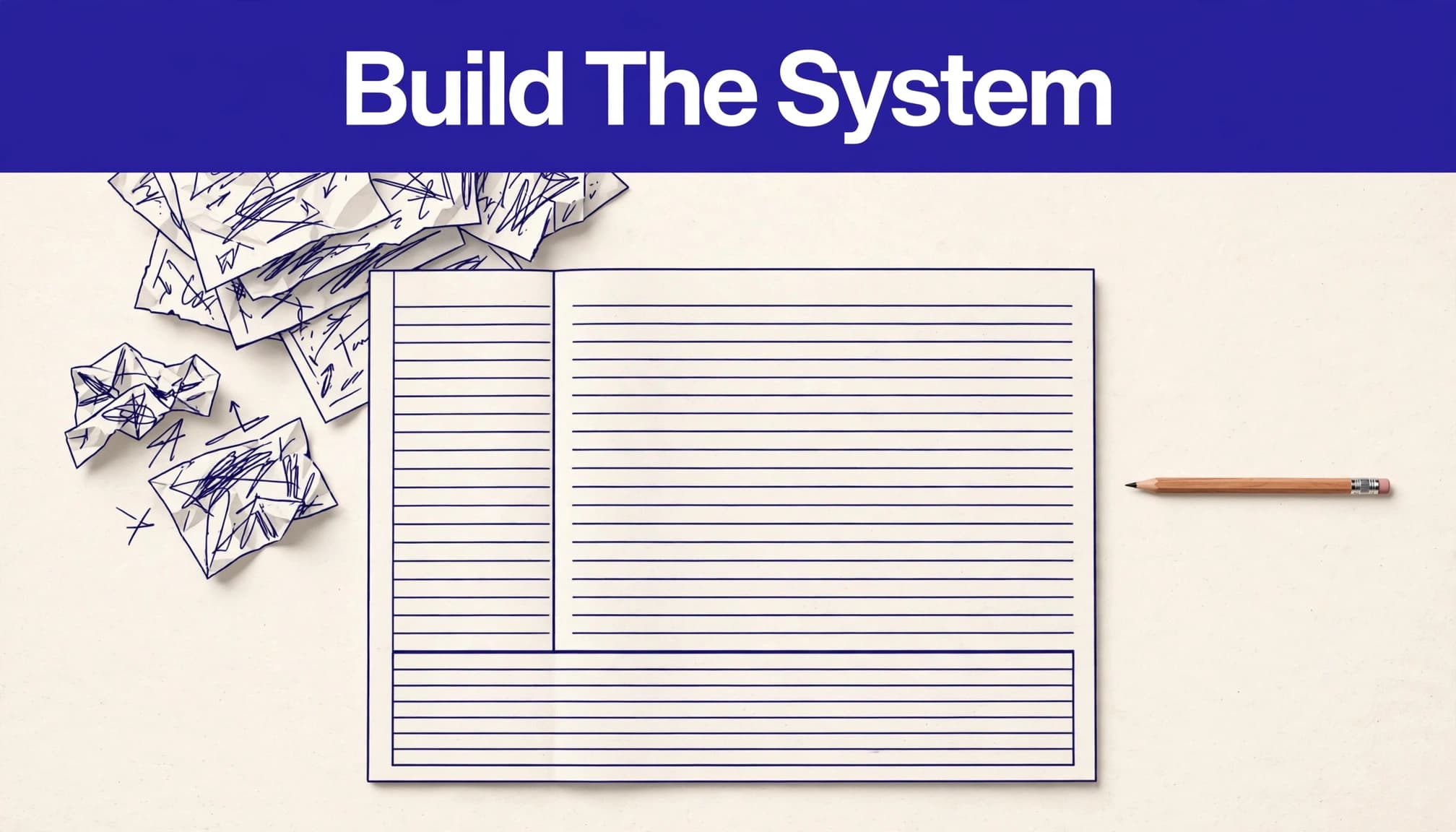
Draw the basic layout
On a standard letter-size page, draw a vertical line about 2.5 inches from the left edge. That narrow section becomes the cue column. Leave the remaining width for main notes.
Then draw a horizontal line about 2 inches above the bottom. That space is your summary section. Add the course name, lecture title, and date at the top so loose pages don't become anonymous later.
Cornell University's note-taking guidance uses this same division of notes, cues, and summary.
Keep the right side flexible
The notes area doesn't need neat paragraphs. Use short bullets, arrows, indentation, quick sketches, and headings that mirror the lecture's order.
Leave a blank line when the lecturer changes topics. Circle material that appears in a learning objective, worked problem, repeated example, or assignment instruction. Those marks show you where to build strong cues later.
Convert messy lecture notes after class
Set aside 15 to 30 minutes after class for one focused section. Waiting until the weekend makes unclear abbreviations and unfinished diagrams harder to repair.
Repair gaps without rewriting everything
Read your raw pages beside the slides, textbook, or assigned reading. Fill in only the missing context needed to understand the point. If your note says "inhibits it," replace it with the full relationship, such as "the parasympathetic nervous system lowers heart rate."
Remove duplicated slide text, unrelated reminders, and repeated headings. However, keep terminology exact in technical subjects. A missing unit, condition, date, or exception can change the meaning of a scientific, medical, legal, or historical claim.
A clean Cornell page is not a transcript. It is a smaller record of what you need to explain later.
Write notes in your own compact language
Paraphrase ideas instead of trying to preserve every sentence. During a fast lecture, use abbreviations you can still understand, such as "w/" for "with," "vs." for "versus," and arrows for cause and effect.
A biology note might become:
Light energy drives reactions in thylakoid membranes.
Products support sugar formation in the stroma.
Carbon dioxide + water -> glucose + oxygen.
That is enough detail to study if your cues test the relationships. A full transcript usually hides those relationships under too many words.
Build useful cues, definitions, and formula notes
The best cue column forces a specific answer. Broad labels such as "photosynthesis" or "Chapter 6" don't tell you what to retrieve.
Turn statements into questions
Review the right column and write one cue for each testable idea. Use questions that ask for a definition, contrast, sequence, cause, location, or application.
For the photosynthesis notes above, write:
Main note | Cue column prompt |
|---|---|
Light-dependent reactions occur in thylakoid membranes. | Where do the light-dependent reactions occur? |
The Calvin cycle occurs in the stroma. | How does the Calvin cycle location differ? |
Plants use light energy to make glucose from carbon dioxide and water. | What inputs and outputs define photosynthesis? |
Each question has a narrow target. The page now tests knowledge instead of merely looking organized.
Handle formulas with conditions and examples
Don't place an equation on a page without defining its symbols and stating when it applies. For a z-score, write z = (x - mean) / standard deviation, then identify x as the observed value.
Add a small worked example: if a score is 70, the mean is 80, and the standard deviation is 5, then z = (70 - 80) / 5 = -2. A useful cue asks, "When is a z-score negative?" Another asks you to calculate one.
For chemistry, physics, economics, and statistics, also record units and limits. A formula card that omits assumptions can train you to use the right equation at the wrong time.
Review Cornell notes with active recall
Writing cues creates the study system. Reviewing them on a schedule makes it stick.
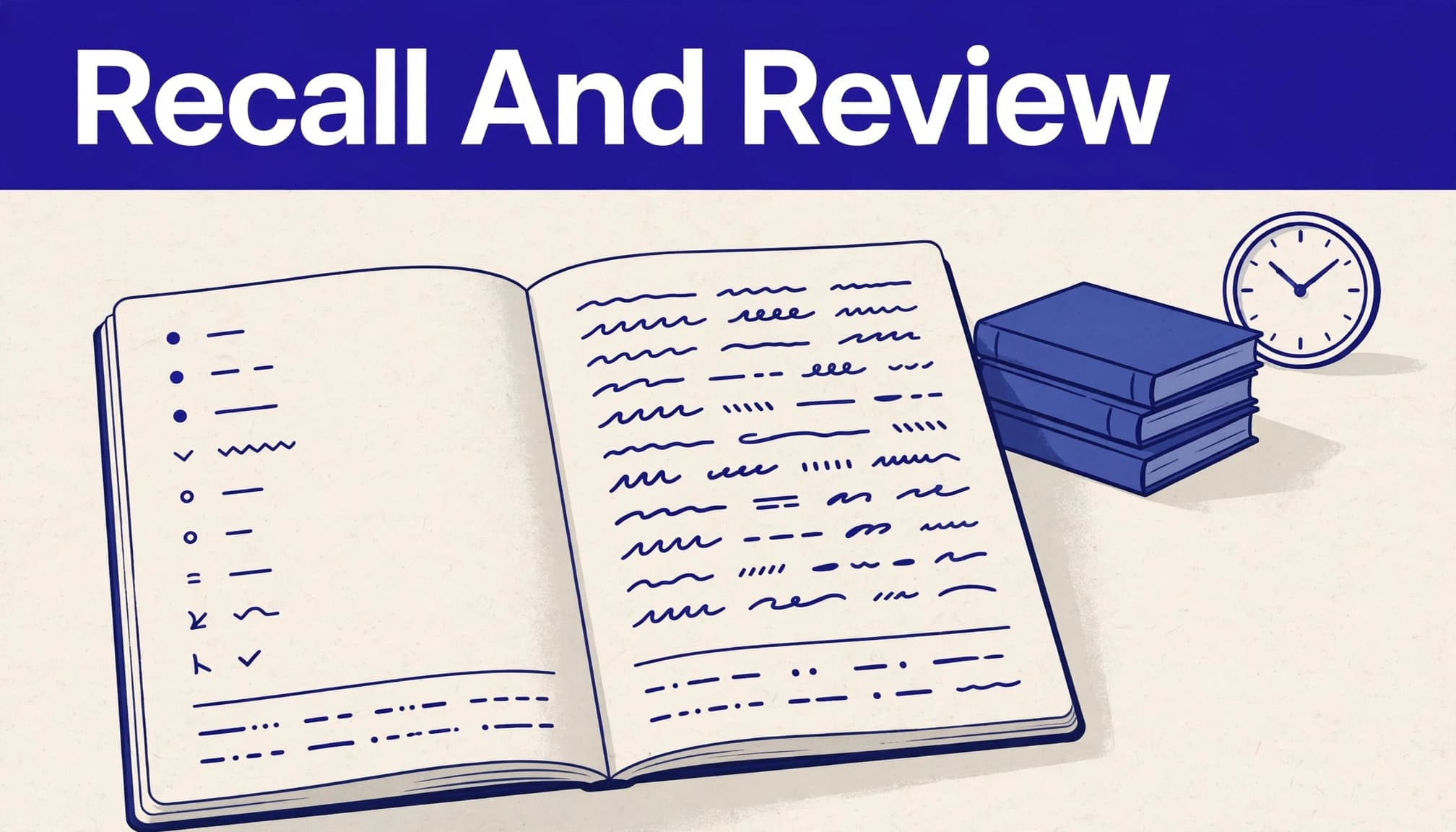
Use the cover-and-recall routine
Within a day of the lecture, cover the right-hand notes. Read each cue and answer from memory in a sentence, calculation, sketch, or spoken explanation.
Next, uncover the notes and correct gaps with a different pen color or a short addition. Don't simply reread the answer. Try the cue again after correction, because the second attempt shows whether you repaired the misunderstanding.
Use spaced repetition
Review new Cornell pages shortly after class, then revisit them a few days later, about a week later, and before the exam. Return to difficult cues more often than easy ones.
During each pass, scan the summary first. Then work through the cues without looking. If several pages cover one unit, compare their summaries and add a cue that connects them, such as "How did Week 3's model explain Week 4's result?"
This is the practical value of a Cornell notes study system: every page contains its own retrieval practice.
Choose handwriting, typing, and AI carefully
Paper can make cue writing feel more deliberate, while digital notes make rearranging, searching, and combining class materials easier. Pick the format you will review consistently.
What handwriting research can tell you
Cornell's Learning Strategies Center points to evidence favoring handwritten notes over laptop typing for learning. In a three-study comparison of longhand and laptop notes, Pam Mueller and Daniel Oppenheimer found that laptop note-takers performed worse on conceptual questions.
That result doesn't mean every student must avoid a laptop. Typing may fit accessibility needs, rapid technical lectures, or digital course materials. Still, avoid verbatim transcription. The paraphrasing, cue writing, and recall steps matter more than the device.
Let AI organize, then verify
A source-grounded tool can help turn lecture slides and readings into a short outline, likely exam questions, or draft flashcards. For dense decks, use a practical workflow for lecture-slide study materials to create a slide-by-slide breakdown before you build Cornell cues.
Keep each upload focused on one unit or lecture. Ask for one concept per question, then inspect every output against your slides and assigned readings. Check terminology, formulas, units, dates, and exceptions, especially in factual courses.
AI can identify a missing subject in rushed notes, but it should not become your source of truth.
Fix the problems that weaken Cornell notes
Formatting alone won't make a page study-ready. The quality of your cues and review habits decides whether the method helps.
When your notes are incomplete
Mark unclear spots with a question mark during class instead of stopping your note-taking. After class, use the recording, slides, reading, or a classmate's notes to resolve the gap.
If the source still doesn't answer it, write a precise question to ask your instructor or teaching assistant. Never fill a blank with a confident guess, especially when it involves a formula, definition, or exception.
When cues feel too easy or too vague
Replace "Know Krebs cycle" with prompts such as "What enters the Krebs cycle?" or "What does one turn produce?" Break a cue apart if it requires a paragraph-long answer.
Research on lasting learning and note-taking methods reports positive results for Cornell notes in some measures of retention and exam performance. Results still vary by course, study design, and how students use the notes. A blank template cannot replace attentive listening or repeated recall.
Key Takeaways
Keep the main notes on the right, then add testable cues on the left soon after class.
Write a short bottom summary after you understand the page's central idea.
Use active recall by covering the notes and answering every cue before checking.
Include symbol definitions, conditions, units, and a worked example for formulas.
Treat AI summaries and flashcards as drafts, then verify them against approved course sources.
Frequently Asked Questions
Who created the Cornell note-taking system?
Walter Pauk developed the Cornell Note-Taking System while teaching at Cornell University. The method remains popular because it combines note capture with later questioning and summarizing.
When should you write the Cornell summary section?
Write the summary after class or after finishing a reading section. At that point, you can identify the main claim, process, or connection without copying a sentence from the notes column.
Can you turn old lecture notes into Cornell notes?
Yes. Sort old pages by lecture or topic, remove unrelated material, and transfer only the ideas worth retrieving. Then add cues and a summary. Start with the material you can review in one sitting instead of rebuilding an entire semester at once.
Make each page earn its place in your study routine
Your lecture notes become more useful when they ask you to remember, not merely recognize. Clear prompts, a truthful summary, and repeated retrieval turn scattered class material into a study system you can use before every exam.
Keep the page simple enough to maintain after each lecture. Consistent review will matter more than decorative formatting.