Build a spaced repetition schedule by turning course materials into focused questions, reviewing them within 24 hours, then increasing the gaps as recall improves. A practical starting sequence is days 1, 3, 7, 14, and 30 after learning.
The challenge is keeping reviews manageable while lectures keep adding material. This study technique works best when you start with small, accurate question sets and let your answers determine which items need attention sooner.
Key Takeaways
Turn learning objectives, lecture explanations, and readings into questions that test one idea.
Attempt every answer before opening your notes or flipping a card.
Schedule the first review within 24 hours, then adjust intervals according to recall.
Protect study time by limiting new cards when overdue reviews accumulate.
Why Spacing and Retrieval Work Together
Memory weakens between study sessions
In the late 19th century, Hermann Ebbinghaus experimented on himself and observed rapid forgetting after learning, followed by slower decline. His forgetting curve describes that pattern; it doesn't prescribe one timetable for every student.
The spacing effect gives you repeated chances to recover knowledge after a delay, supporting long-term memory. Rawson et al. (2013) reported that students who reviewed vocabulary across several sessions outperformed equal-time, single-session learners immediately and four weeks later. Useful intervals depend on the material and intended retention period.
Active recall makes each review useful
Active recall means retrieving information without answer cues, rather than recognizing an explanation on the page. Attempting an answer before checking notes is retrieval practice. With flashcards, you must attempt an answer before turning the card over.
Dunlosky and colleagues' review of effective learning techniques rated practice testing and distributed practice highly. Your calendar needs retrieval tasks, not reminders to reread. Speak an explanation, sketch a process, or solve a question before consulting the source.
Turn Course Materials Into Focused Recall Prompts
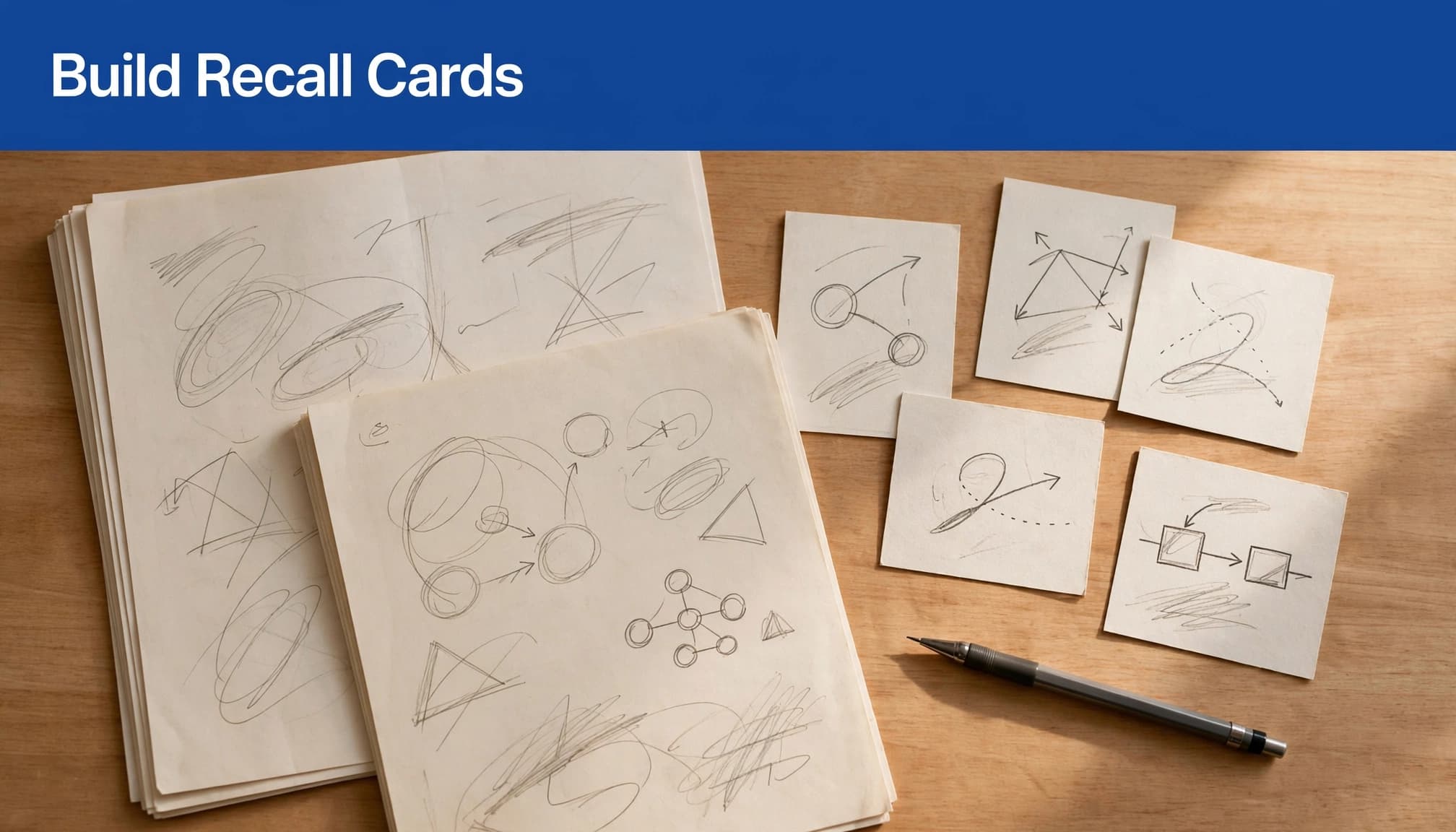
Use this workflow after each lecture or reading session:
Choose one assessable topic. Start with a learning objective, textbook subsection, or worked problem. Prioritize concepts your instructor repeats or assesses.
Clean the source. Combine relevant lecture notes, slides, and reading passages. Remove duplicates and expand shorthand without changing technical terminology.
Write narrow questions. Replace "Explain photosynthesis" with "Where do light-dependent reactions occur?" Answer: thylakoid membranes. Separately ask where the Calvin cycle occurs: the stroma.
Add understanding and application. Ask how two processes differ, when a formula applies, or why a condition matters. Include symbol definitions, units, and assumptions for calculations.
Inspect and group the results. Correct answers against the source, delete duplicates, and attach a page or slide reference. Tag cards by course, topic, position in the course's scope and sequence, and learning date.
Keep answers brief enough to judge accurately. A card requiring a paragraph usually needs splitting, while longer problems belong in separate practice sessions.
For AI assistance, request a small batch: "Generate 12 single-concept questions from this section, including comparisons and application. Keep answers short and use only the supplied text."
Our guide to turning notes into study prompts covers this process in more detail. Before scheduling, fix vague questions and missing conditions; repeated practice can reinforce an inaccurate card.
Choose a Spaced Repetition Schedule You Can Maintain
Published schedules differ because they address different learning tasks. These reference patterns show the range.
Approach | Review timing |
|---|---|
Czech Universities | Day 0 cramming or initial study; day 1 within 24 hours, ideally 12; then days 3, 7, 21, 30, 45, and 60 |
Art of Memory | Immediately, 24 hours, three days, one week, and one month |
Dominic O'Brien | Immediately, 24 hours, one week, one month, and three months |
Third Space Learning | One, three, six, ten, fourteen, and eighteen weeks after initial teaching |
These spaced intervals are examples, not a universal formula. Adjust review intervals based on recall and how long you need to retain the material. Shorten gaps for difficult items and widen them for easy ones.
O'Brien presents his sequence in How to Develop a Brilliant Memory Week by Week. Third Space Learning's weekly pattern fits classroom planning and revisiting whole topics; it doesn't replace an early review of unfamiliar material.
For a student starting independently, review within 24 hours. The classroom research on distributed practice supports spacing, without establishing a universal calendar.
Language drills can use much shorter gaps. Pimsleur's sequence runs through 5 seconds, 25 seconds, 2 minutes, 10 minutes, 1 hour, 5 hours, 1 day, 5 days, 25 days, 4 months, and 2 years.
Define whether numbers mean days after learning or gaps between reviews. Those interpretations produce different calendars.
Put Review Dates on a Working Calendar
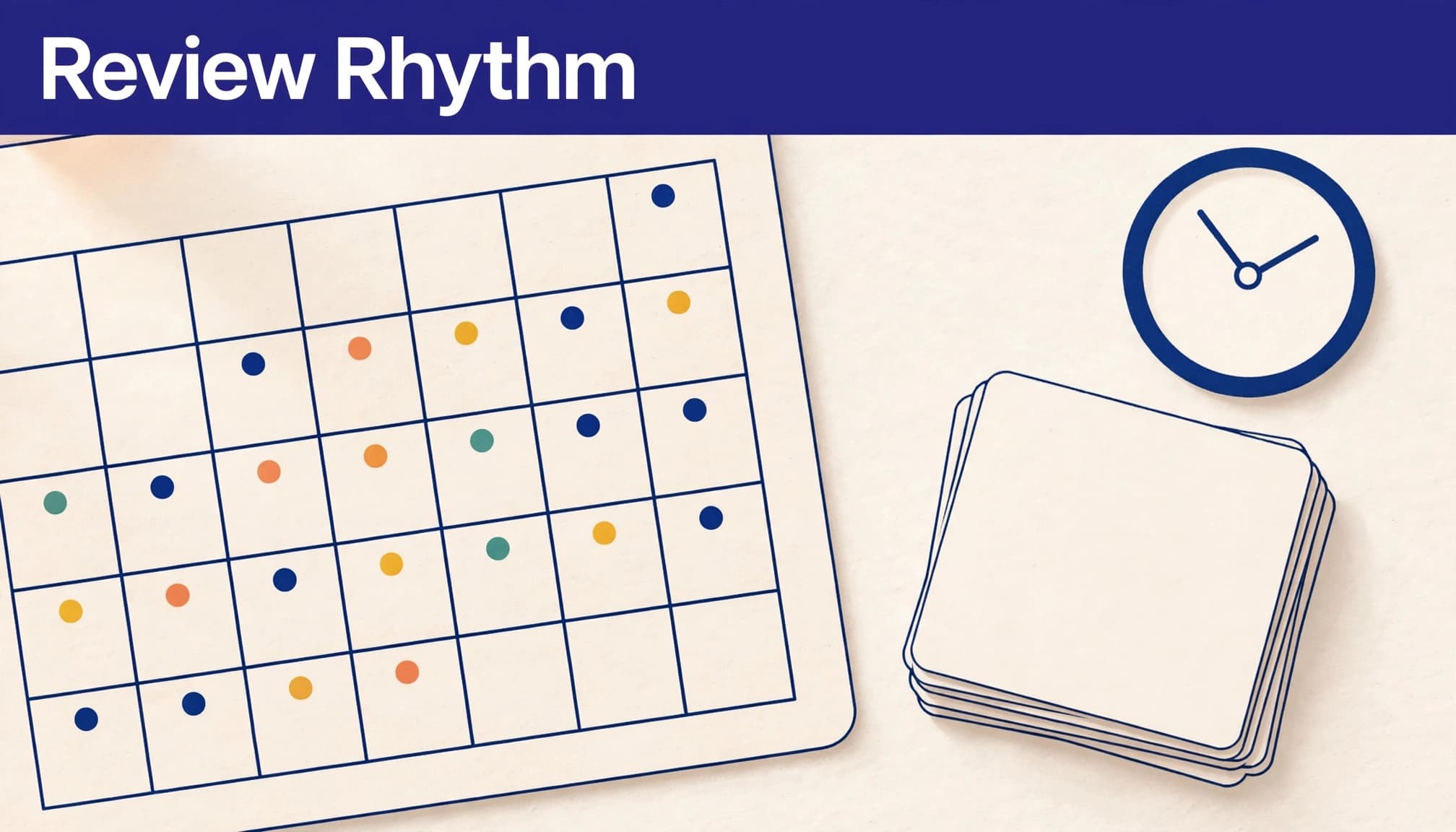
Use days 0, 1, 3, 7, 14, and 30 as checkpoints measured from initial learning. Day 0 includes making prompts and attempting them immediately.
This calendar shows two 15-card batches learned on November 2 and November 4, 2026.
Checkpoint | November 2 batch | November 4 batch |
|---|---|---|
Day 0 | November 2 | November 4 |
Day 1 | November 3 | November 5 |
Day 3 | November 5 | November 7 |
Day 7 | November 9 | November 11 |
Day 14 | November 16 | November 18 |
Day 30 | December 2 | December 4 |
On November 5, both batches are due: 30 planned card attempts before retries. Each 15-card batch creates 75 later review attempts across five sessions, assuming every card follows the timetable.
During each session, attempt, reveal, and mark each answer correct, hesitant, or missed. Keep correct cards on schedule. Bring hesitant cards forward, and retry missed cards after feedback, then again the next day.
Record the actual review date and next due date. Once cards diverge, their individual recall results matter more than the original batch calendar.
Run Reviews With Paper Cards or Software
Paper systems make progress visible
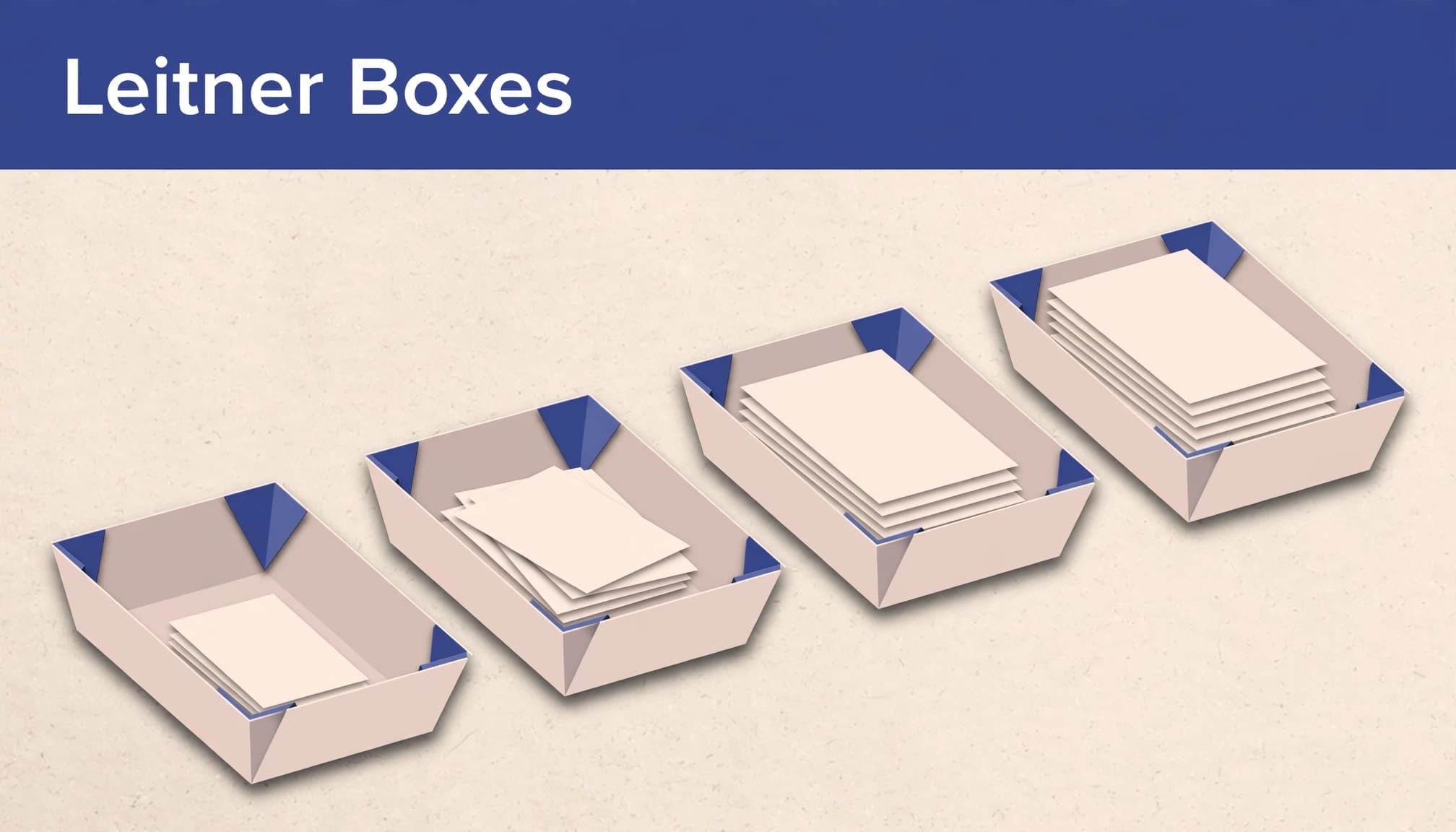
With paper flash cards, the Leitner system sorts cards into compartments with different review frequencies. Correct answers move to a box with a longer interval; incorrect answers return to a more frequent-review compartment.
A simple implementation uses daily, three-day, weekly, and monthly compartments. Write the next review date on each divider or card.
Another paper method uses plus and minus marks. A plus sends the card to the next-day deck; a minus means repeat it as soon as possible. Three consecutive pluses indicate mastery within that method. Still, retain later reviews to test lasting recall.
Apps handle individual due dates
Spaced repetition apps automate individual due dates. Anki is free, multi-platform spaced repetition software (SRS) for desktop review; its official iOS app is paid.
SuperMemo, developed from Piotr Wozniak's research, calculates personalized intervals using previous performance and task complexity. Memrise focuses on language learning and requires registration and an internet connection for online lessons.
Quizlet offers flashcard and practice modes, but choose based on the scheduling behavior you need. Once an adaptive scheduler manages your cards, follow its due queue instead of maintaining a duplicate calendar.
Handle Missed Reviews and Changing Workloads
Resume without restarting everything
If you miss a session, review the overdue items at your next opportunity. Don't assume the delay erased everything, and don't reset every card to day 1.
Test recall first. Correct answers can receive a longer interval; missed answers need feedback and an earlier return. For a large backlog, pause new cards and prioritize weak, overdue material connected to upcoming assessments.
Also separate memory failures from unclear prompts. If you repeatedly misinterpret a question, rewrite it rather than merely scheduling it more often.
Limit creation before cutting retrieval
For a 30-minute session, try 20 minutes of due reviews and application, followed by 10 minutes of card creation. This is a workload starting point, not a research-derived ratio.
If due reviews repeatedly exceed that budget, reduce new cards. Keep essential definitions, distinctions, and decisions; leave supporting detail in your notes.
Connect reviews to your syllabus-based study plan so deadlines shape priorities. Before exams, use interleaving to mix related problem types, then try a low-stakes quiz or unfamiliar questions. John Dunlosky's student learning guidance explains why testing and distributed practice deserve protected study time.
Frequently Asked Questions
What's the best schedule before an exam?
Use the time available without squeezing every planned review into one sitting. Review unfamiliar material within 24 hours, revisit weak items sooner, and reserve time for exam-style questions. If the exam arrives before day 30, your schedule ends earlier.
Can spaced repetition replace practice problems?
No. Cards help retain facts, relationships, and conditions, but calculations, essays, and proofs require extended practice. Schedule those tasks alongside cards. When a practice answer exposes a knowledge gap, create a focused prompt for that gap rather than copying the entire solution.
Should every reading become flashcards?
Only create cards for information you need to retrieve. Arguments may need outline reconstruction or evidence comparisons, while dense factual sections suit short questions. Converting every sentence creates a review burden without a clear learning purpose.
Build Around Recall, Then Adjust the Dates
A useful spaced repetition schedule starts with questions you can answer and assess honestly. Early review gives new material another retrieval attempt; later gaps test whether it lasts.
Start with one topic and a small batch. Protect time spent recalling, then adjust dates and new-card volume according to your results. The schedule should support learning without becoming another assignment.