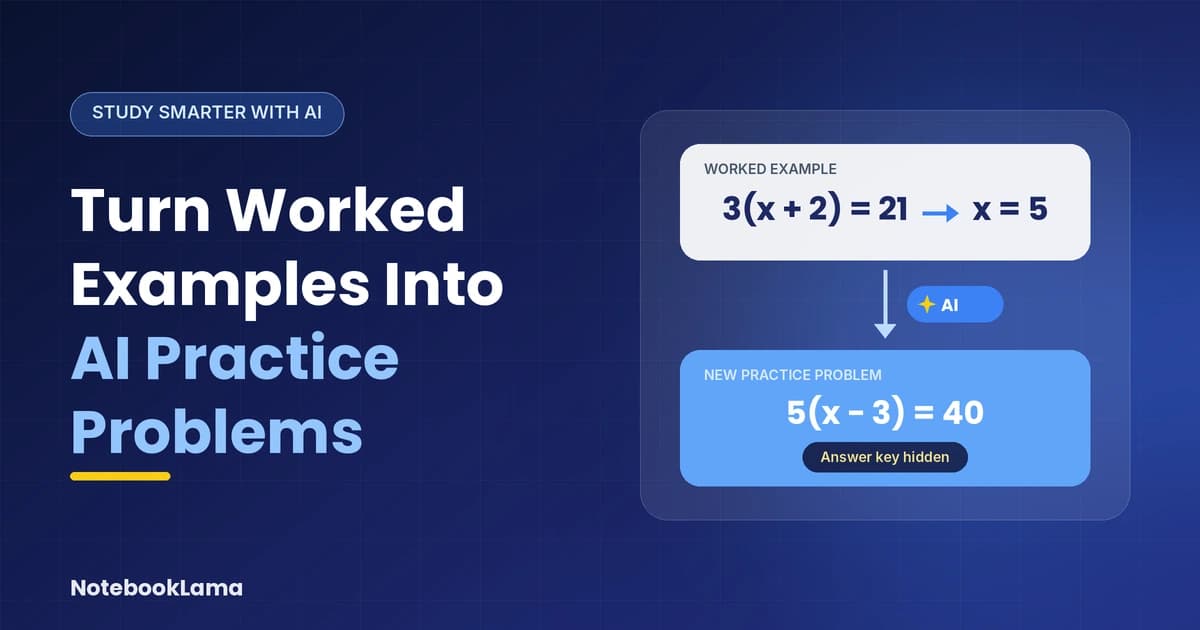
To turn a worked example into new practice, ask AI to identify its concept and solution steps, then change the values or context while preserving the skill. Generate a separate answer key and check the reasoning before using the questions.
Useful AI practice problems require the same underlying skill, not merely different wording. Start with one clear example, then build a small set you can solve without seeing the answers.
Key Takeaways
Keep the original learning objective while changing numbers, conditions, or context.
Specify question format, intended challenge level, and course boundaries before generating a practice set.
Separate questions, hints, and solutions so you can attempt each problem independently.
Prepare a Source the AI Can Read
Select a complete worked example
Upload the question, its full solution, and any relevant definitions or formulas. A final answer alone doesn't show the method students should practice.
Teachers should provide the course's learning objective and notation when available, along with relevant lecture notes, definitions, or formulas. For test preparation, also provide the study guide or rubric. These boundaries help prevent questions that introduce material your class hasn't covered.
Our document-based quiz generator accepts PDFs, DOCX, TXT, Markdown, and webpage URLs, and creates multiple-choice and open-ended questions tied to your material.
Inspect scans and mathematical notation
Scanned pages need readable text, usually through optical character recognition (OCR). However, a searchable page can still contain recognition errors.
Compare extracted equations with the page image. Minus signs, exponents, fractions, and units deserve particular attention because one mistaken symbol changes the problem. Include diagrams when they contain required information.
Teachers should remove students' names, grades, and other unnecessary personal details before uploading classroom material.
Build AI Practice Problems in Three Steps
Identify the reasoning
First, ask the AI to describe what the example teaches before requesting variations. This separates the learning objective from incidental details.
Use this prompt:
Analyze the uploaded worked example. Identify the underlying concept, prerequisites, and solution steps. Explain which features must remain unchanged to test the same skill. Cite the source page for the method, and flag any missing information.
Read that analysis before continuing. If it misidentifies the skill, correct it rather than generating more questions.
Change the problem within clear boundaries
Next, specify what may change and what must stay consistent.
For a short practice quiz, create five new problems using the identified method. Change the values and surface context without copying the original wording. Keep the same prerequisites and number of reasoning steps. Match the uploaded course notation. Give questions only, keeping the practice sheet free of hints or solutions.
For test practice, add the expected format and calculator rules. A multiple-choice quiz won't fully rehearse an exam that awards marks for written reasoning.
Separate practice from solutions
Finally, request a key without exposing it during the attempt:
Create a separate answer key with numbered solutions, intermediate steps, assumptions, and a final check. Keep it separate from the questions. During interactive practice, show one question at a time and wait for my answer before giving feedback.
Keeping answers hidden supports retrieval practice. Roediger and Karpicke's 2006 study on test-enhanced learning found that memory tests can improve later retention.
Before and After: Preserve the Algebra Skill
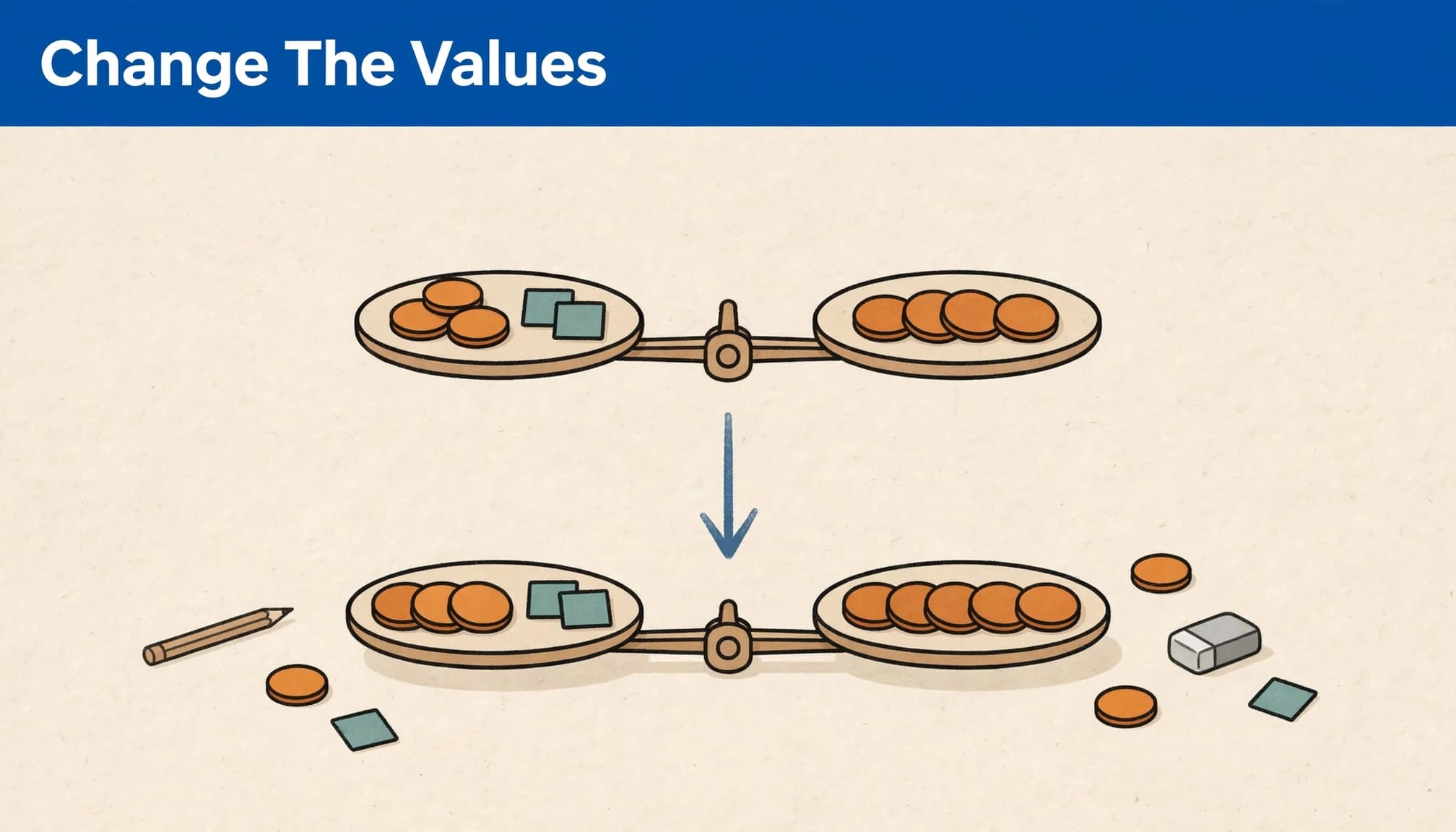
Start with a worked equation
Consider this algebra example:
Solve: 3(x + 2) = 21.
Divide both sides by 3 to get x + 2 = 7. Then subtract 2, giving x = 5.
The skill is solving a linear equation with a bracketed expression through inverse operations. The numbers 3, 2, and 21 aren’t essential to that objective.
Create and check a fresh version
A new practice question is:
Solve: 5(x - 3) = 40. Show each operation.
The answer key divides both sides by 5, giving x - 3 = 8, then adds 3. Therefore, x = 11. Substitution confirms it: 5(11 - 3) = 40.
Both questions require two inverse operations. However, the second changes the values and the operation inside the brackets, so the assessed skill stays the same.
A variation that changes the skill
Now consider a story version an AI tool might produce:
Five identical notebooks each cost x dollars. After a $3 discount on each notebook, the total is $40. How much did each notebook cost before the discount?
This looks like a harmless rewording, but it asks the learner to do something new. Before solving anything, they must translate the story into 5(x - 3) = 40. That is a modeling step, and it is a separate skill from solving a given equation. A learner who can solve 5(x - 3) = 40 reliably may still fail here, and the result would tell you nothing clear about their equation-solving. The question is also ambiguous: it doesn’t say whether the discount applies before or after the total is counted, which invites more than one reading.
Revise it back to the original level
To keep the assessed skill, give the equation and let the context be optional framing:
Five notebooks each cost x dollars before a $3 discount per notebook. The total paid is $40, which gives the equation 5(x - 3) = 40. Solve for x.
Now the learner starts from the equation, and the key is the same as before: divide by 5 to get x - 3 = 8, then add 3, so x = 11.
Substitution confirms it: 5(11 - 3) = 40.
If you do want to assess modeling, keep the story version but label it as a harder question, and teach or practice writing the equation first.
Vary Difficulty Through Reasoning and Hints
Change one demand at a time
Bigger numbers don't automatically produce better practice. Instead, control the decisions the learner must make.
For easier practice, retain the original structure and provide the first step. At the same level, change values while preserving the method. For harder practice, remove a formula cue, change the unknown, or require an explanation of why the method applies.
Use this prompt:
Generate an easier, same-level, and harder version. For each, identify the exact change in reasoning demand. Keep all prerequisites within the uploaded course materials. Don't make problems harder through longer wording or tedious arithmetic alone.
Reveal hints gradually
Useful hints direct attention without completing the task. Ask for a concept cue first, followed by a suggested operation, then a partial setup.
For the algebra problem, the first hint could be: "Which operation would remove the coefficient outside the brackets?" That leaves the calculation to the learner.
Request hints separately:
Prepare three increasingly explicit hints. Reveal only one when requested. Start with the relevant principle, then suggest the next operation, and give a partial setup last. Don't disclose the final answer.
Check the Answer Key Before Sharing It
AI-generated questions can contain ambiguous wording, missing conditions, or incorrect solutions. Review the question and key together before assigning them.
Answer-key checklist
Confirm the question is complete. It should give every value, condition, and assumption needed, with only one reasonable interpretation.
Compare it with the source. Check that the prerequisites and reasoning steps match what your course material teaches.
Solve it independently. Work the problem yourself before reading the key.
Check units and substitutions. In algebra, substitute the result into the original equation. In physics, inspect units and assumptions.
For multiple choice, verify exactly one option is correct. Each distractor should be clearly wrong and represent a plausible mistake.
Keep sources and calculations separate
Source references serve a different purpose from arithmetic checks.
Our PDF document chat connects explanations to source pages, so you can compare the stated method with your course material. A citation can support the chosen method, but it doesn’t prove that newly generated arithmetic is correct. Reference the page that teaches the method, then show the new working explicitly.
After practice
Diagnose the learner’s error before generating replacements. Then assign a related, unfamiliar question after a delay. Classroom research on test-enhanced learning supports using testing as a learning activity, rather than only as assessment.
Choose a Generator That Fits Your Files
Many AI quiz generators follow the same basic steps: upload material, choose settings or question types, then take the quiz or export the questions and answers. Before choosing one, compare these points against the vendor’s current documentation:
File support: which formats and file sizes it accepts
Question formats: multiple choice, short answer, true/false, and so on
Answer controls: whether you can edit questions and keys before sharing
Export options: what formats you can download
Data handling: how uploaded files are stored and whether they’re used for training
Features and plans change, so check the vendor’s own pages rather than relying on a third-party summary.
Atlas for varied source material
Atlas accepts PDFs, slideshows, videos, audio, Word documents, and notes. It also turns links, including YouTube videos, articles, and textbooks, into practice quizzes.
You can customize the topic, challenge level, and question count before generation. Its example uses 20 questions at Hard difficulty on "Atoms and molecules."
Atlas describes its feature as free for students. It claims more than 1,000,000 students and a 4.9 rating, and offers quiz sharing so anyone can view a practice quiz. Those audience figures don't establish the accuracy of an individual question set.
Smallpdf for browser-based quiz creation
Smallpdf says it generates multiple-choice, true-or-false, and open-ended PDF questions in under 30 seconds. It hides answers until revealed and offers downloadable questions and answers.
Its OCR handles scanned documents and images, including JPG and PNG. It also supports DOC, PPT, and Excel files, and runs in the browser without installation.
No sign-up is required. An account adds a 7-day free trial with unlimited question generation and access to over 30 PDF tools. Its chat box accepts requests for simpler or more complex questions, including adaptation for a sixth-grade class.
Smallpdf states that it is GDPR compliant, ISO/IEC certified, and uses TLS 1.3 encryption for uploaded files. For classroom use, remove unnecessary personal information regardless of the generator.
Frequently Asked Questions
Can AI generate questions from scanned PDFs?
Yes, when the workflow includes OCR. Smallpdf supports scanned documents and image inputs, while NotebookLama's document chat also processes scanned PDFs. Review extracted symbols before generating mathematical practice.
For diagrams, include the relevant figure and ask the AI to state which details it used.
How do I turn a midterm study guide into practice?
Upload the guide alongside the relevant notes or textbook sections. Ask for questions grouped by learning objective, with answers kept separate.
Specify topic coverage, expected question format, and difficulty. Start with a five-question practice quiz so you can assess its quality before generating a longer practice test. Exclude topics outside the guide.
Can I adapt questions for different educational levels?
Yes. Specify prerequisites and expected reasoning, rather than relying on a grade label alone.
For example, state whether students know fractions, can rearrange equations, or may use a calculator. Then request simpler language without removing the intended skill. For advanced learners, request explanations or unfamiliar applications within the same syllabus.
Keep the Skill, Change the Challenge
Effective AI practice problems preserve the reasoning you need to learn while removing the comfort of a familiar answer. Clear boundaries, separate solutions, and independent checks make the set useful.
Start with one worked example and generate a few variations. Expand the set only after confirming that each question tests the intended skill.