To judge whether research applies to your population, compare who was studied and how the independent variable, such as an intervention or exposure, was delivered. Also consider what could change its effect. External validity depends on those comparisons and on the study's internal credibility.
A large sample or statistically significant result doesn't settle applicability. Start by defining your target population, then assess the differences that could change benefits, harms, or feasibility.
What external validity means
External validity is the extent to which study findings generalize to other people, situations, settings, treatments, measures, and times. A study can support one application without supporting every possible application.
Internal validity comes first
Internal validity concerns whether conclusions within the study are sound. For causal claims, that includes whether the intervention, rather than confounding or bias, produced the outcome.
External validity is limited by internal validity: an invalid causal inference doesn't become reliable when applied elsewhere. Examine recruitment and attrition for selection bias, alongside missing-data decisions, blinding where relevant, selective reporting, and model choice.
Randomization supports comparisons between treatment groups. It doesn't make participants representative of everyone who might receive treatment.
Different kinds of applicability
Population validity concerns generalizing beyond the sample. Ecological validity concerns applicability to real-world situations and settings. Temporal validity asks whether findings remain applicable across time.
Cook and Campbell distinguished generalizing to a population from generalizing across subpopulations defined by background characteristics. An overall effect doesn't establish the same effect at every age or disease-severity level.
Modern methods for generalizing study results make the target population explicit rather than treating generalizability as a universal property.
A six-step applicability checklist
Use the full article, supplement, and protocol when available.
Define your target population, intervention, comparator, outcome, and follow-up period.
Assess credibility by examining design, bias, missing data, and agreement between planned and reported outcomes.
Compare eligibility criteria and recruited participants with your target population, including excluded groups.
Identify plausible effect modifiers, such as disease severity, age, prior treatment, or access to services.
Compare baseline risk, care delivery, outcome measurement, and implementation resources.
Record a bounded judgment: directly applicable, applicable with assumptions, or insufficient evidence for this population.
A protocol mismatch doesn't prove misconduct, but unexplained changes can lower confidence.
Record "Not reported" when information is absent. Our guide to reading research papers with AI explains how to preserve context and trace extracted details to source passages.
Compare participants, exclusions, and baseline risk
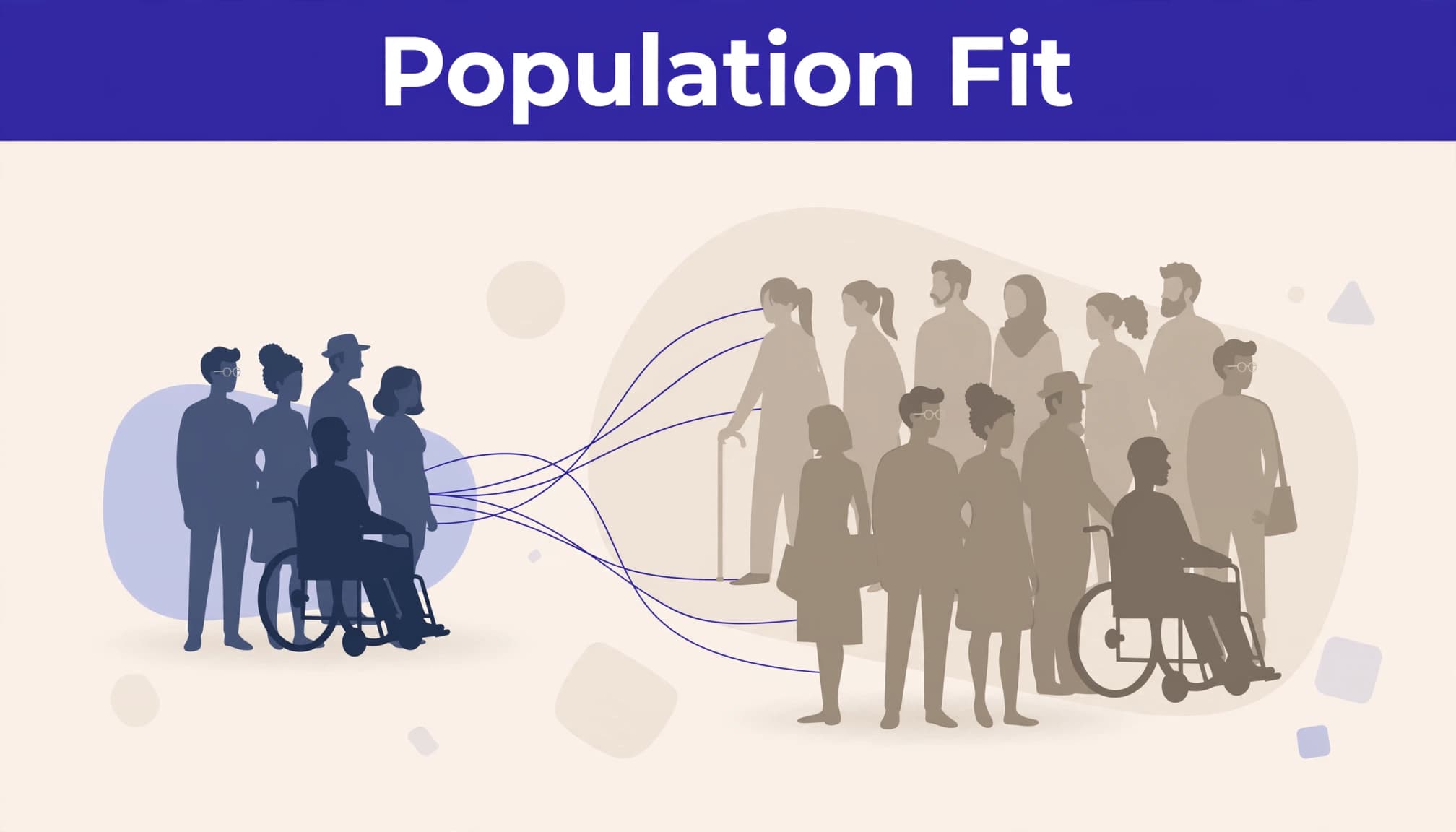
Look beyond average demographics
Compare inclusion and exclusion criteria first. Then examine who enrolled, remained in follow-up, and entered the analysis.
Volunteer, convenience, and college-student samples can introduce sampling bias. Recruitment choices and eligibility restrictions can also create selection bias by shaping who is represented. College volunteers may differ from clinical populations in comorbidities, medication use, or treatment-seeking behavior. However, demographic differences matter most when they affect the outcome or intervention response.
Scribbr cites the widely repeated estimate that WEIRD samples, from Western, Educated, Industrialized, Rich, and Democratic populations, feature in about 96% of psychology studies while representing roughly 12% of humanity. Treat this as a warning about coverage, not a census of contemporary psychology.
Separate baseline risk from effect modification
Baseline risk is the outcome probability without the intervention. Higher baseline risk can produce larger absolute benefits even when the relative treatment effect stays constant.
An effect modifier changes the treatment effect on a specified scale. Age, severity, or prior exposure may qualify, but clinical plausibility and supporting evidence matter.
Therefore, compare both relative and absolute effects. Match follow-up periods too: a one-year risk isn't interchangeable with a five-year risk.
Examine setting, delivery, and common threats

An intervention delivered by specialist staff with frequent follow-up may work differently where appointments, equipment, or transport are limited. Compare dose, fidelity, adherence, usual care, concurrent programs, access barriers, and outcome measurement to assess ecological validity.
The following threats to external validity identify differences that deserve closer attention.
Threat | What could limit application |
|---|---|
Sampling bias | Volunteers or eligibility restrictions omit relevant groups. |
History | Policy changes, outbreaks, or new treatments alter conditions. |
Observer bias | Researcher expectations influence measurement or assessment. |
Hawthorne effect | Participants change behavior because they know they're observed. |
Testing effect | A pretest sensitizes participants to the intervention or outcome. |
Aptitude by treatment interaction | Participant characteristics change the treatment's effect. |
Situation effect | Delivery conditions change the observed response. |
Situation effects include treatment conditions, time of day, location, lighting, noise, and investigator characteristics. Their importance depends on the mechanism.
Real-world settings don't automatically guarantee external validity. Laboratory control doesn't automatically prevent generalization either.
Flay's 1986 model distinguishes efficacy and effectiveness trials: efficacy studies test interventions under controlled conditions, while effectiveness studies examine performance in routine practice. Strong designs can support both internal credibility and practical relevance while balancing the trade-off between control and routine practice.
Use quantitative evidence without demanding one score
Examine interactions and uncertainty
There's no universal statistical test that certifies external validity. Instead, compare distributions of important characteristics and test for statistical interactions between treatment and those characteristics.
Use prespecified subgroup analyses where possible. Compare effect estimates and confidence intervals rather than declaring a difference because one subgroup has a significant result and another doesn't.
A nonsignificant interaction doesn't establish identical effects. Interaction tests often lack precision. When reviewing several studies, examine clinical differences, heterogeneity, and prediction intervals rather than relying on the pooled average alone.
Our guide to comparing conflicting research findings covers these distinctions.
Reweight only when assumptions support it
If age modifies treatment effects, estimate age-specific effects and average them using the target population's age distribution. This is standardization.
Related approaches use inverse odds of sampling weights to address measured differences between study and target populations. They require adequate overlap and sufficient information about relevant effect modifiers.
Pearl and Bareinboim distinguish problems that permit valid recalibration from those where transport isn't identifiable from available evidence and assumptions.
If the distinguishing variable is affected by treatment, simple baseline-style weighting can fail. Identification may require treatment-specific mediator distributions and assumptions about causal pathways.
Reweighting can't recover an effect for a target subgroup that the study never meaningfully represented without additional evidence or assumptions.
Worked example: applying SPRINT to older patients
The Systolic Blood Pressure Intervention Trial, SPRINT, compared systolic blood-pressure targets below 120 mm Hg and below 140 mm Hg. It enrolled adults aged 50 or older with increased cardiovascular risk, excluding people with diabetes or prior stroke.
Suppose your decision concerns older adults receiving routine hypertension care. These features lead to a structured assessment rather than a blanket endorsement.
First, population fit is stronger for patients who resemble SPRINT participants. Its results alone don't directly establish benefits for people with diabetes or previous stroke.
Next, compare cardiovascular risk and vulnerability to harms. Similar relative benefits can mean different absolute benefits across risk levels.
Then compare implementation. SPRINT used a defined blood-pressure measurement protocol, treatment adjustment, and follow-up. Routine-care readings and treatment capacity may differ.
Finally, assess outcomes separately. Cardiovascular benefit doesn't erase concerns about hypotension, kidney injury, or treatment burden.
The defensible judgment is conditional: SPRINT supports intensive treatment for selected high-risk adults under suitable monitoring. It doesn't establish the same benefit-harm balance for every older patient.
Strengthen the evidence and document your judgment
Replication across populations, field settings, and time periods strengthens applicability and ecological validity. Probability sampling can improve population coverage, while field experiments test delivery under practical conditions. Recalibration can address some measured differences.
However, random sampling doesn't remove every contextual difference. Field experiments still require credible designs and comparisons with the intended application.
Steckler and McLeroy highlighted how external-validity reporting receives less attention than other methodological reporting. Missing information also limits systematic reviews and meta-analyses.
Balas and Boren's 2000 estimate, cited in implementation research, suggested about 17 years to translate 14% of original health research into patient benefit. This is a historical estimate, not a universal timetable.
For a methods section, name the target population, recruitment setting, eligibility criteria, proposed effect modifiers, and comparison data. Describe weighting methods and assumptions if used.
In the discussion, state which differences matter, what remains unmeasured, and how those limits affect the decision. A literature review matrix helps preserve these distinctions across papers.
Key takeaways
Applicability is a reasoned judgment, supported by explicit comparisons. Strong internal validity establishes a credible starting point; population coverage, effect modification, baseline risk, and implementation determine how far the conclusion can travel.
An honest "insufficient evidence" judgment is more useful than treating an unstudied group as equivalent.
Frequently asked questions
How does transferability differ from generalizability?
Qualitative research often uses transferability rather than external validity. Readers assess whether findings apply to situations with similar populations, characteristics, and conditions. Detailed descriptions of participants and context support that judgment; statistical representativeness usually isn't the goal.
Does tighter control always reduce external validity?
No fixed trade-off exists. Tight control may remove conditions that matter in practice, but it can also clarify mechanisms. A controlled study can still capture meaningful participant responses when it has psychological realism. A well-designed study can maintain internal credibility while examining diverse participants and settings. Realism alone establishes neither causal validity nor generalizability.
Make the scope of your conclusion explicit
A finding applies to your population when the study is credible and relevant differences are understood or defensibly addressed. State those conditions rather than labeling an entire paper generalizable.
Your final external validity judgment should identify who the evidence supports, under which delivery conditions, and where uncertainty remains.