Research papers often contain funding and competing-interest statements in different sections, footnotes, or supplementary files. Finding them manually can take time especially when you need to review several papers.
AI can speed up the process by locating disclosure statements, extracting exact passages, and organizing the information into a consistent format. But it can also confuse funding with acknowledgments, overlook a sponsor's role, or mistake missing information for a declaration of no conflicts.
The reliable approach is simple: ask AI to find the evidence, require exact quotations and source locations, and verify every result against the original paper.
What Research Paper Disclosures Tell You
Before extracting disclosures, distinguish between the statements you are looking for. They answer different questions and should not be merged into one category.
Funding vs. competing interests
A funding statement identifies financial or other support for the research or manuscript. It may name funding organizations, grant numbers, supported authors, and the funder's role in the study.
A competing-interest statement describes financial or non-financial relationships that could influence or be perceived to influence an author's work. Examples include consulting fees, employment, stock ownership, patents, or relevant personal and professional relationships.
These statements can appear together without contradicting each other. A paper may receive grant funding while its authors declare no relevant competing interests.
The International Committee of Medical Journal Editors (ICMJE) makes an important distinction: funding for the work should be reported separately from authors' broader relationships and activities. Its disclosure recommendations explain what authors should report and how sponsor involvement should be described.
Where disclosures usually appear
Do not rely on the abstract alone. Search the full article and any associated supplementary files for headings or phrases such as:
Funding or Funding/Support
Acknowledgments
Competing Interests
Conflict of Interest
Declaration of Interest
Financial Support
Role of the Funder
Also inspect footnotes, author-information sections, and publisher records. Funding information may appear in article metadata, including publisher or Crossref records, but missing metadata does not prove that a study received no support.
If the PDF is scanned, check whether its text is selectable. Image-only documents may require optical character recognition (OCR), and errors in OCR can distort author names, funder names, or grant identifiers.
Use AI to Extract Disclosures From Research Papers
Start with one paper before processing a large collection. This makes it easier to check whether the tool is locating the correct statement and preserving its meaning.
Prepare the paper and its supplements
Collect the article's title, DOI, publication version, and relevant supplementary files. Keep preprints separate from final published versions because disclosure wording may change between versions.
You can upload the paper and supplements to an AI document-chat tool, such as NotebookLama AI Document Chat, and ask it to locate specific disclosure information.
Avoid uploading confidential manuscripts, reviewer comments, or identifying participant data unless you have permission and the applicable policies allow it.
Use this prompt to extract the statements
Place the prompt near the beginning of your workflow so the tool knows exactly what evidence to retrieve.
Copy and use this prompt:
Using only the attached research paper and its supplementary files,
locate the following:

1. Funding statement
2. Acknowledgments that mention financial or material support
3. Competing-interest or conflict-of-interest statement
4. Names of funding organizations
5. Grant numbers or award identifiers
6. Authors who received individual support, if stated
7. The funder's role in study design, data collection, analysis,
   manuscript preparation, and the decision to publish

For every finding:
- Quote the exact relevant passage.
- Identify the filename and section or heading.
- Give the page number when available.
- Separate funding information from competing interests.
- Write "Not reported in the supplied files" when information
  cannot be located.
- Do not infer undisclosed relationships or sponsor involvement.
- Do not convert a missing statement into "No conflicts."

Present the extracted information in a table.
Keep source quotations separate from your interpretation.
The instruction to quote the original passage is important. A summary alone can hide missing details or change the meaning of a statement.
Once the extraction is complete, request a separate plain-language explanation. This keeps the source evidence distinct from the AI's interpretation.
Example: Extract a Real Funding Statement
Consider the open-access BMJ Open paper by Sumner and colleagues, Disclosure of study funding and author conflicts of interest in press releases and the news: a retrospective content analysis with two cohorts (2021).
Its published funding statement reads:
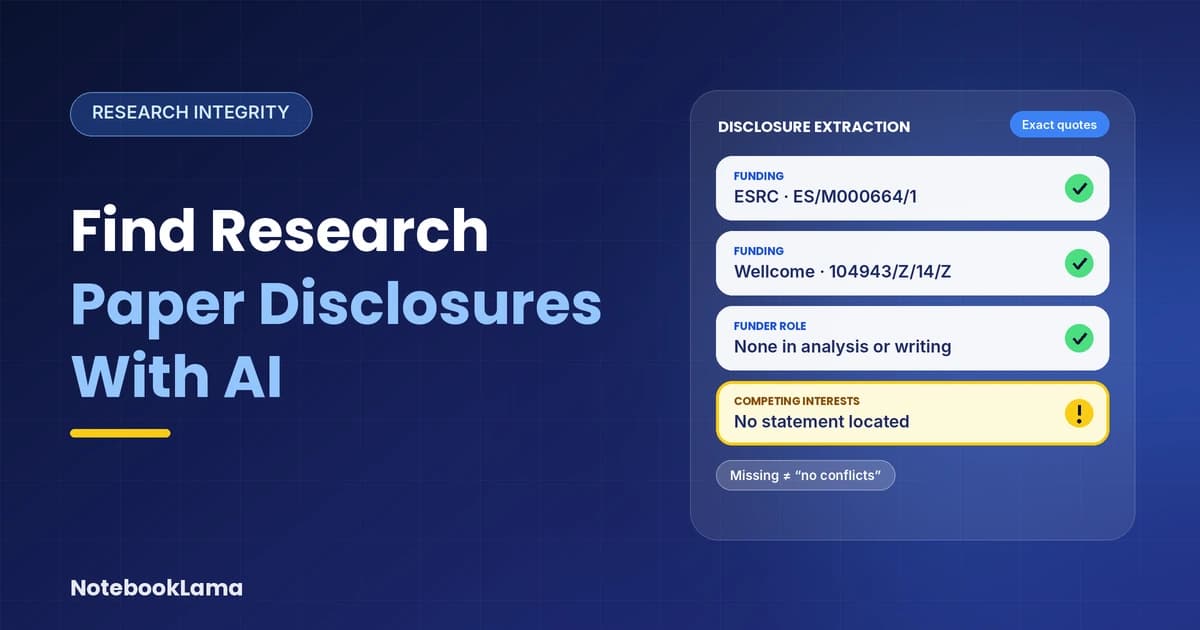
This project was supported by ESRC grant ES/M000664/1 and Wellcome grant 104943/Z/14/Z. The funders had no role in the analysis or writing of this paper.
Source: BMJ Open, 2021;11. <Cite refs={["turn976185view0","turn604585view0"]}/>
If you upload this paper and use the prompt above, the extraction should preserve the information in the statement rather than inventing additional details.
What the extraction should look like
Field | Extracted information |
|---|---|
Disclosure type | Funding statement |
Funding organization 1 | Economic and Social Research Council (ESRC) |
Grant number 1 | ES/M000664/1 |
Funding organization 2 | Wellcome |
Grant number 2 | 104943/Z/14/Z |
Funder's role | No role in the analysis or writing of the paper |
Study design role | Not specified in this funding statement |
Data collection role | Not specified in this funding statement |
Publication decision role | Not specified in this funding statement |
Competing interests | Check the paper's separate competing-interest declaration |
Notice the distinction between what the statement says and what it does not say. It confirms that the funders had no role in analysis or writing. It does not explicitly establish that they had no role in study design, data collection, or the publication decision.
An AI summary that changes this to "The funders had no involvement in the study" would therefore overstate the evidence.
This is why exact quotations and field-by-field extraction are more dependable than asking AI for a general disclosure summary.
Verify Every AI-Extracted Disclosure
Even when an AI tool provides a quotation and page reference, open the original paper and check the passage.
Pay particular attention to:
Funder names: Check spelling and distinguish similarly named organizations.
Grant identifiers: Verify every number, letter, and punctuation mark.
Author support: Check whether funding supported the research, a specific author's contribution, or both.
Sponsor involvement: Preserve exactly which activities the funder did or did not participate in.
Negative declarations: Distinguish "no competing interests declared" from the absence of a statement.
For example, "The funder had no role in data analysis" does not mean the funder had no role in any other part of the research.
If AI cites a grant registry, another publication, or an external author record, inspect that source separately. A similar name or organization is not enough to establish that the information belongs to the paper you are reviewing.
Keep missing information separate from negative declarations
This is one of the most important rules when extracting disclosures.
There is a difference between:
No competing interests declared: The authors explicitly state that they have none.
No funding reported: The paper explicitly states that no funding was received, or that no specific funding was provided.
No statement located: You could not find a relevant statement in the files you examined.
Do not treat these as interchangeable. If the statement is missing from the supplied PDF, record "No statement located in the supplied files." Check the publisher's full-text version and supplements before concluding that the paper does not report it.
For multiple papers, create one record per DOI and publication version. Keep the original quotation, source location, and your interpretation in separate fields. This prevents AI from merging one author's disclosure with another paper's funding information.
Understand How Disclosure Policies Differ
Journal, institutional, and funder requirements can overlap, but they are not interchangeable. A journal's published funding and competing-interest statements do not necessarily establish that an author has completed every institutional or sponsor reporting obligation. The ICMJE recommendations provide a useful reference for separating direct support for a paper from authors' broader relationships and activities. However, always check the specific journal's instructions and the relevant institution or funder's requirements where compliance matters. <Cite refs={["turn244373search0","turn244373search1"]}/>
For an AI extraction task, the practical lesson is to identify which document establishes each fact. A published acknowledgment does not prove institutional compliance, and an internal disclosure form does not establish what readers saw in the article.
Frequently Asked Questions
Does "no competing interests" mean a paper had no funding?
No. Funding describes support for the research or manuscript. A competing-interest declaration describes relationships or activities that could influence—or be perceived to influence—the work.
A paper can report grant funding and still declare no relevant competing interests. Read both statements and preserve their separate meanings.
Can AI identify an undisclosed conflict of interest?
AI can flag possible inconsistencies between the supplied paper and other records, but a flagged relationship is only a lead for further investigation. Verify the author's identity, organization, dates, and nature of the relationship before drawing conclusions.
A relationship disclosed in another paper may relate to different research or a different time period. Do not label an omission as misconduct based on an AI comparison alone.
How should I extract disclosures from multiple research papers?
Use one record per paper and keep consistent fields:
DOI and publication version
Exact funding statement
Funding organization and grant number
Supported author, if identified
Exact competing-interest declaration
Source section and page
Funder's stated role
Missing information or verification notes
If two reviewers interpret a passage differently, retain the original wording and resolve the disagreement against the source before finalizing the record.
Keep the Evidence Attached to Every Disclosure
AI makes funding and competing-interest statements faster to locate, but reliable extraction depends on verification. Ask for exact quotations, source locations, and separate fields for funding, relationships, and sponsor involvement.
Most importantly, do not let a fluent summary say more than the paper does. Preserve missing information as missing, distinguish explicit declarations from silence, and keep every extracted claim connected to its original source.