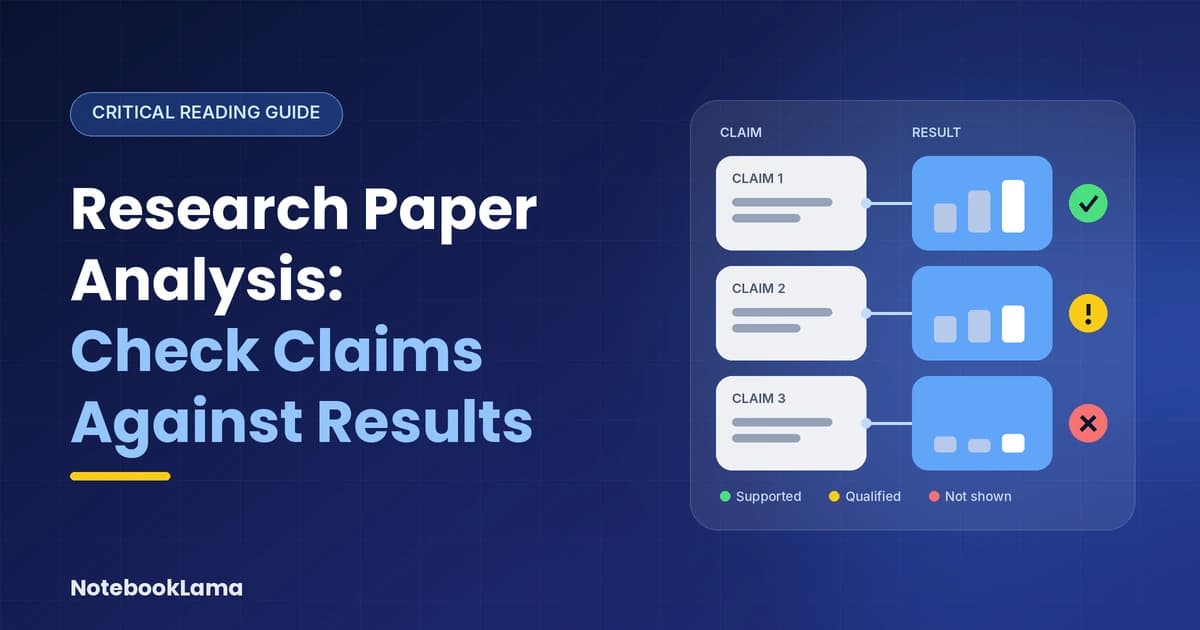
To check whether a research paper's conclusions match its results, connect each major claim to a specific finding. Then assess whether the claim's strength and scope fit the study's design, population, and uncertainty.
Good research paper analysis separates what researchers measured from what they infer. A convincing discussion can still stretch beyond the data.
Start with the paper's central question, then follow each conclusion back to its evidence.
Key Takeaways
Match every major conclusion to a result, table, figure, or qualitative finding.
Compare the wording with the study design, effect size, uncertainty, and population studied.
Treat AI summaries and citation tools as routes to evidence, while keeping your judgment grounded in the original paper.
Map the paper before evaluating it
A systematic evaluation examines a study's validity, methodology, and contribution to existing knowledge. Summarizing its findings is only the beginning.
First, skim the title, abstract, introduction, and conclusion. Write down the research question and the answer the authors claim to provide. For intervention studies, PICO helps define the population, intervention, comparison, and outcome.
Next, examine figures and tables before reading the detailed results text. Read every relevant caption, legend, footnote, and axis label. These can reveal that a headline finding concerns one subgroup, a secondary outcome, or a shorter follow-up period.
Finally, record the paper's DOI or stable URL, publication year, design, sample, and setting. Save page numbers alongside important findings. Our guide to creating a literature review matrix shows how to keep these details consistent across papers.
Match each conclusion to its supporting result

Break broad conclusions into separate claims
A conclusion may combine effectiveness, safety, and practical usefulness in one sentence. Evaluate each claim independently because each needs different evidence.
Create one row per claim in your notes. Record the authors' wording, supporting result, source location, and your assessment. Use descriptions such as "supported," "supported with qualifications," or "not demonstrated."
Distinguish the study's own findings from earlier research cited in its discussion. Background evidence can explain a result, but it doesn't become data from the current study.
Follow the claim to the actual measurement
Check whether the reported outcome matches the conclusion's language. Improved questionnaire scores don't automatically establish better everyday functioning. Similarly, a laboratory measurement may be a surrogate for the outcome readers care about.
Inspect whether the relevant analysis was primary, secondary, or exploratory. If a protocol or registration exists, compare its planned outcomes with those emphasized in the conclusion.
When no result supports a claim, record "No supporting result located." Don't fill the gap with a plausible explanation.
Check whether the methods can support the finding
Assess design, controls, and sampling
Identify whether the research is randomized, observational, qualitative, experimental, or a review. Different designs support different kinds of conclusions.
For comparative studies, examine the control group and whether groups differed before the intervention or exposure. For qualitative research, examine participant selection, analytic procedures, and evidence for the proposed themes.
Assess sample-size adequacy through the study's justification, expected effect, and precision. There is no universal participant count that makes research reliable. The CONSORT 2025 reporting guideline identifies sample-size reporting as part of transparent randomized-trial reporting.
Inspect data collection and statistical analysis
Look for consistent measurement procedures, appropriate instruments, missing observations, exclusions, and participant dropout. Differential dropout can distort a comparison even when the initial groups were similar.
Then check whether the statistical tools fit the data and design. Repeated measurements and participants grouped within schools or hospitals require appropriate handling.
Also inspect adjustments for confounding and multiple comparisons. A large sample cannot repair biased measurement or an unsuitable analysis.
Test the strength, scope, and uncertainty of claims
Match causal language and generalization to the evidence
Words such as "causes," "prevents," and "improves" require stronger support than "is associated with."
In observational research, consider confounding, selection bias, and reverse causation. For example, an association may reflect a pre-existing difference rather than an effect of the exposure. Cochrane's non-randomized study guidance assesses bias across stages before, during, and after an intervention.
Next, compare the claimed population with the actual sample. Findings from one institution or a narrowly selected group need qualifications before broader application.
Read uncertainty alongside the headline finding
Examine effect sizes and confidence intervals alongside p-values. Statistical significance doesn't establish practical importance. Conversely, an imprecise estimate may leave important effects unresolved.
A nonsignificant result doesn't establish equivalence. The uncertainty may still allow meaningful benefit or harm.
Read limitations for their consequences. If substantial missing data could change the estimated effect, that uncertainty belongs in the conclusion.
Also ask whether the authors address alternative explanations. Acknowledging a limitation in one paragraph doesn't justify ignoring it elsewhere.
A worked example: reading the SPRINT findings
The Systolic Blood Pressure Intervention Trial, known as SPRINT, compared intensive and standard blood-pressure treatment in adults at elevated cardiovascular risk without diabetes.
Its reported reductions in major cardiovascular events and mortality support a benefit from intensive treatment under the trial's conditions. However, the intensive-treatment group also experienced higher rates of some adverse events, including hypotension and acute kidney injury.
A conclusion about treatment therefore needs both benefits and harms. A blanket recommendation for every adult would also exceed the population studied.
The analytical judgment is that SPRINT supports intensive treatment for selected patients resembling its participants. Extending that conclusion to excluded populations requires additional evidence. This evaluates the finding without dismissing it or attributing an exaggerated claim to the authors.
Check what later studies found

A paper's references explain its background. Later studies reveal how its claims have held up.
Use backward citation chasing to inspect referenced work and forward citation chasing to locate subsequent studies. Scite's Smart Citations classify citation statements as supporting, contrasting, or mentioning a paper. Connected Papers maps related research to help locate relevant work.
However, citation counts and classifications aren't verdicts. Read the citing passage and determine whether the later study tested the same claim.
Compare populations, outcome definitions, methods, and follow-up periods before calling findings contradictory. Our guide to comparing conflicting research findings develops this comparison. A well-supported paper may add evidence within a narrow setting without settling the broader question.
Use AI to locate evidence without losing qualifications
Extract evidence from one paper first
With our AI document chat, you can ask questions about uploaded research documents and receive page and section references.
Use a bounded request: "Using only this paper, list each major conclusion, its supporting result, effect estimate, uncertainty, and limitations. Give page and table references. Write 'Not reported' where information is absent."
Keep source facts, your interpretations, and AI suggestions in separate notes. Then inspect the relevant passages and tables. AI can mistake cited background research for the authors' findings or remove an important qualification.
Choose supporting tools by task
Scholarcy creates Flashcard summaries from papers and accepts PDF, DOCX, URLs, and Zotero imports. It also exports extracted table data into Excel-friendly formats. Its Annotated Bibliography feature identifies cited papers and downloads BibTeX for Zotero, Mendeley, or EndNote.
Elicit searches millions of papers, extracts data, and builds synthesis tables. R Discovery provides abstracts, highlights, and audio summaries for deciding which papers deserve full reading.
Multi-PDF chat can summarize or compare several papers and return source references. However, begin with checked, single-paper notes to reduce confusion between studies. A citation beside an AI answer provides a route to evidence, not proof that the answer represents it accurately.
A concise conclusion-to-results checklist
Before accepting a paper's main conclusion, make sure you can answer these questions:
Can you locate a specific result supporting every major claim?
Do the measured outcomes and study population match the conclusion's wording?
Does the design justify causal language, and does the analysis address plausible alternative explanations?
Do effect sizes, uncertainty, missing data, and adverse outcomes support the interpretation?
Are exploratory findings and limitations visible in the final claims?
If an answer remains unclear, narrow your assessment rather than treating the entire paper as either sound or worthless.
Frequently Asked Questions
How do I add my own analysis, and should I cite it?
Move beyond reporting findings by explaining what they justify, what limits them, and how they compare with other evidence. Structure a paragraph around a finding, its methodological qualification, and your reasoned judgment.
Cite the source for findings, quotations, and numerical data. Your interpretation should remain distinguishable from the authors' statements and traceable to the evidence it evaluates.
Does a conclusion matching its results prove the paper is reliable?
No. Conclusions can accurately summarize results that biased methods produced. Cochrane's randomized-trial risk-of-bias guidance addresses problems such as deviations from intended interventions.
Assess both how researchers produced the evidence and how they interpreted it. Agreement between the results and conclusion satisfies only the second part.
Make your judgment traceable
The strongest research paper analysis leaves a clear path between each conclusion and its supporting evidence. Your assessment should identify both what the study establishes and where uncertainty remains.
Keep the claim-to-result connection visible in your notes and writing. A defensible conclusion is as strong, and as limited, as the evidence supporting it.