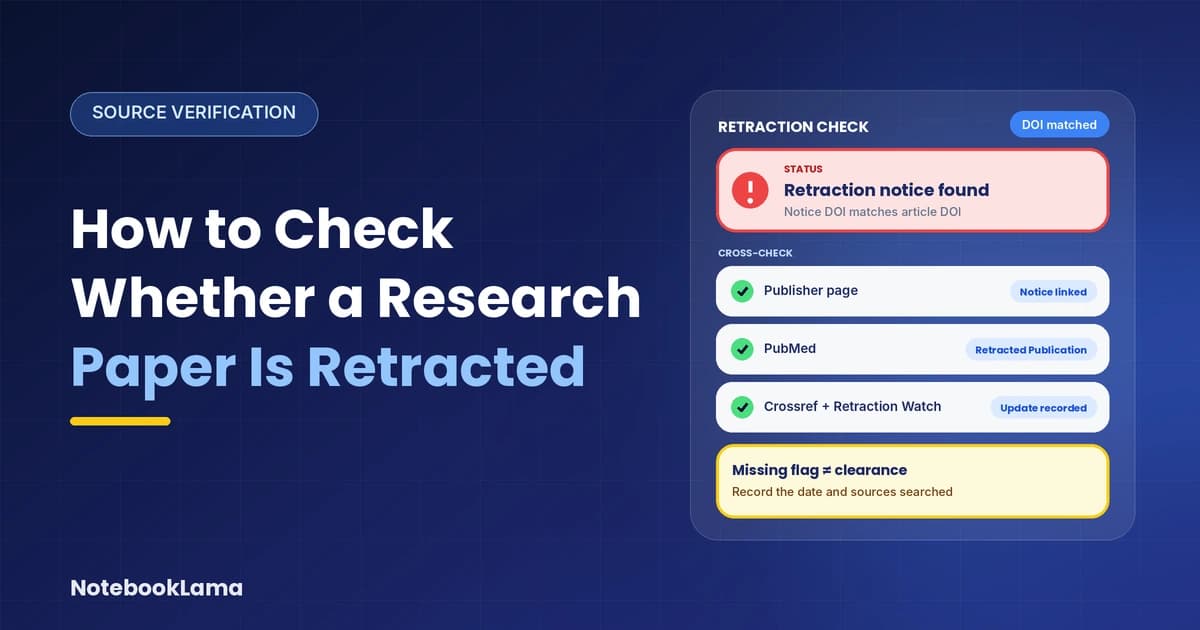
To check whether a research paper has been retracted, open the publisher's article page, read any linked notice, and cross-check scholarly databases.
Retracted papers may still appear in search results or circulate as unmarked PDFs. Check the formal notice and match it to the correct article, since notices can appear years after publication. An older download may not reflect the paper's current status.
Start with the article's identity, then follow its publication history.
Key Takeaways
Match the title, authors, journal, and DOI before interpreting a retraction flag.
Check the publisher's page and notice alongside relevant databases, because coverage and updates vary.
Distinguish retraction from correction or an expression of concern, and record when you checked.
Start With the Publisher's Article Page
Identify the Exact Paper
Find the DOI on the paper or its bibliographic record, then follow it to the publisher's page. Compare the title, authors, journal, and publication year with your copy.
This helps distinguish a preprint, conference paper, and journal article. A flag for similarly titled retracted articles or another version may not apply to the paper you're checking.
If the DOI is missing or broken, search the exact title with the first author's surname and journal name.
Inspect the Status and Linked Notice
Look for a retraction banner, altered title, update history, or Crossmark status information where available. Open the linked notice rather than relying on a search snippet.
Under Crossref's guidance on publication updates, a retraction notice updates the original article through linked records. However, publisher practices and metadata deposits can be incomplete.
Confirm that the notice identifies the same article and DOI. Also record its publication date, which differs from the original paper's date.
An unmarked PDF can predate a retraction. Its appearance doesn't establish the article's current status.
Cross-Check a Retracted Research Paper in Databases
Search PubMed for Biomedical Papers
For biomedical and life-sciences literature, search PubMed using the DOI, exact title, or PMID. Inspect the article record and linked notices.
"Retracted Publication" identifies the original retracted article; "Retraction of Publication" identifies the notice. Search separately for the notice if the connection isn't obvious.
PubMed doesn't cover every discipline or publication. Therefore, no match or missing flag doesn't prove that a paper remains unretracted.
Compare Crossref and Retraction Watch
Crossref provides DOI metadata and publication-update relationships. Its records can include publisher-supplied updates and Retraction Watch data.
The Retraction Watch database documentation explains that records come from publisher websites and receive updates every working day. Search using the DOI or title, then follow the notice.
Coverage still varies. Corrections and expressions of concern aren't as comprehensively represented as retractions, and metadata can lag behind publication.
For broader discovery, combine your topic with "retracted" or "withdrawn." However, read the notice because withdrawal doesn't always mean the same thing as retraction.
Save the databases searched, search date, article DOI, notice DOI, and outcome. Write "no notice found in the sources searched" rather than claiming definitive proof that none exists.
Understand What the Notice Means
Separate Corrections, Concerns, and Retractions
A journal investigates suspected problems, sometimes alongside an institutional investigation. Its response depends on the evidence and the seriousness of the problem.
A correction notice addresses errors that leave the main findings reliable. An expression of concern warns readers while an investigation remains unresolved or inconclusive.
Retraction is generally the last resort when major errors undermine the findings. Serious ethical breaches can also justify it, even when the results appear sound.
The article usually remains accessible with its status clearly marked, preserving the scholarly record.
Look for a Clear Explanation
COPE first published its retraction guidelines in 2009. They protect the integrity of the scientific literature rather than punish authors.
The COPE retraction guidelines call for promptly published, freely available notices that clearly identify and link to the article. A notice should explain who is issuing it and why. Clear notices support transparency and research integrity.
If a publisher labels an item "published in error," open the linked notice to confirm whether it describes a correction, an expression of concern, a retraction, or another status. Don't treat the label as definitive.
When the wording is vague, distinguish documented facts from assumptions. A notice that doesn't identify misconduct doesn't establish that misconduct occurred.
Why Papers Are Retracted: Error and Misconduct
Retractions broadly involve honest error or misconduct. Honest errors include mistakes in data handling or statistics. Misconduct-related cases include academic misconduct such as data fabrication, falsification, plagiarism, compromised peer review, and serious ethical failures involving approval or undisclosed conflicts. Duplicate publication can also lead to retraction, depending on the circumstances.
A BioMed Central study examined 134 retractions from January 2000 through December 2015. They represented 0.07% of 190,514 articles, and the retraction rate increased over the study period.
These historical findings describe that publisher's sample, rather than all research today.
Finding | Share of retractions |
|---|---|
Misconduct-related cases | 76% (102 of 134) |
Compromised peer review | 33% |
Plagiarism | 16% |
Data falsification or fabrication | 7% |
Honest error | 13% |
Compromised peer review was the largest single reason. A March 2015 cluster involved fabricated reviewer contact details used to manipulate reviews across several publishers.
The median publication-to-retraction interval was 337.5 days: 386 days for misconduct and 184 for honest error. Authors issued the largest share of notices, 35%, followed by publisher and editor jointly, 32%, and editor alone, 21%.
Plagiarism-detection software is widely used, but keyword substitution and paraphrasing can evade text matching. Knowledgeable reviewers may recognize disguised copying that software misses.
Intent matters when assessing misconduct. However, unintentional unattributed copying can still breach academic standards. Self-plagiarism concerns reuse of one's own previously disseminated work.
What to Do if You've Cited the Paper
If a retraction notice shows the paper's data unreliable for a claim, remove or replace it as evidence. Then revise the claim itself, since a replacement source may support a narrower conclusion.
A retracted article can remain essential when discussing the retraction, research history, or misconduct. In that case, identify its status explicitly and cite the notice.
The BioMed Central study found median citation counts of three after retraction versus one before. Retraction notices themselves were rarely cited. Those counts show that citation activity can continue after a paper becomes unreliable; they don't establish why each citation occurred.
Our guidance on checking citation accuracy separates source existence from whether it supports your claim.
Citation networks can help locate later discussion and replacement evidence. However, citation counts and supportive citations don't override a formal notice.
If Your Own Paper Has a Serious Problem
Contact the Editor With Evidence
If you discover an error that invalidates your findings, tell your coauthors and contact the journal editor promptly. Explain the affected results and provide the relevant data or analysis.
Request retraction when the conclusions are no longer reliable. If the problem is limited, describe why a correction could resolve it.
Substantial overlap with an earlier paper you hadn't read doesn't automatically require retraction. Similar ideas or references alone aren't plagiarism. Compare the wording, data, attribution, and originality claims, then explain the overlap to the editor.
Document the Outcome and Prevent Recurrence
An honest-error retraction doesn't automatically establish misconduct or disqualify someone from future grants. Reputation and eligibility depend on the circumstances and applicable rules.
Where later applications request disclosure, provide the notice and a factual explanation. A clear record can distinguish acknowledged error from fabrication or concealment.
Before publication, follow ethics requirements, document authorship, disclose any conflict of interest, and share supporting data where consent and policy allow. Use submission checklists to catch missing approvals and reporting details.
If retraction becomes necessary, established notice templates and COPE's checklist help document the article, reason, and responsible parties clearly.
Frequently Asked Questions
Does an Absent Database Flag Mean the Paper Is Safe?
No. Indexing coverage and update timing vary. A paper can also remain unretracted despite weak methods or unsupported conclusions. Read its methods, results, tables, and limitations as part of a separate quality assessment.
Why Do Some Notices Leave the Reason Unclear?
Incomplete reporting can leave readers unable to distinguish error from misconduct. In the BioMed Central sample, eight notices (6%) omitted who retracted the article, while 15 (11%) didn't clarify error versus misconduct. Don't fill those gaps with accusations.
Can an AI Summary Establish Retraction Status?
An AI summary can't certify current status. A tool working from an uploaded PDF may have no access to a later notice. Use it to organize evidence, then base your conclusion on the publisher record and linked updates.
Make Publication Status Part of Every Source Check
A reliable retraction check connects the exact article to its publisher record, formal notice, and relevant database entries. Missing flags aren't clearance, and a genuine citation can still point to unreliable findings.
Keep a dated record of what you found, then repeat the status check before submitting or publishing work that relies on the paper.