Seeing the same wrong answers on another practice test is frustrating, especially after you've read the explanation twice. When you review practice exam mistakes, use the test as a diagnostic tool. Identify the decision behind your practice test mistakes, then repair it using your course materials.
That means focused review through targeted practice, rather than restarting your textbook or memorizing an answer key. Start by reconstructing your reasoning before the correct answer makes everything seem obvious.
Start With Your Reasoning, Not the Answer Key
Before checking the answer rationales, revisit wrong answers without notes. Include correct answers you guessed or couldn't explain. A lucky choice can conceal a knowledge gap.
Write what you thought the question required and how you chose your answer. If you've already seen the solution, reconstruct your original thinking honestly. Don't replace it with reasoning you only understand now.
Then ask five questions:
What did I know, and what did I assume without evidence?
Why did my chosen answer seem right, or why did that distractor appeal?
What detail makes the correct answer stronger than my choice?
Have I made this error before, including on similar questions worded differently?
What will I practice so I can make a better decision next time?
Reading answer rationales lets you follow someone else's reasoning. Compare your thinking on wrong answers with the explanation. Producing an explanation tests whether you can supply that reasoning yourself.
Research on the testing effect and retrieval-based learning supports retrieving information as a way to strengthen long-term retention. So, after checking the explanation, close it and explain the answer again.
Classify the Mistake Before Choosing a Fix
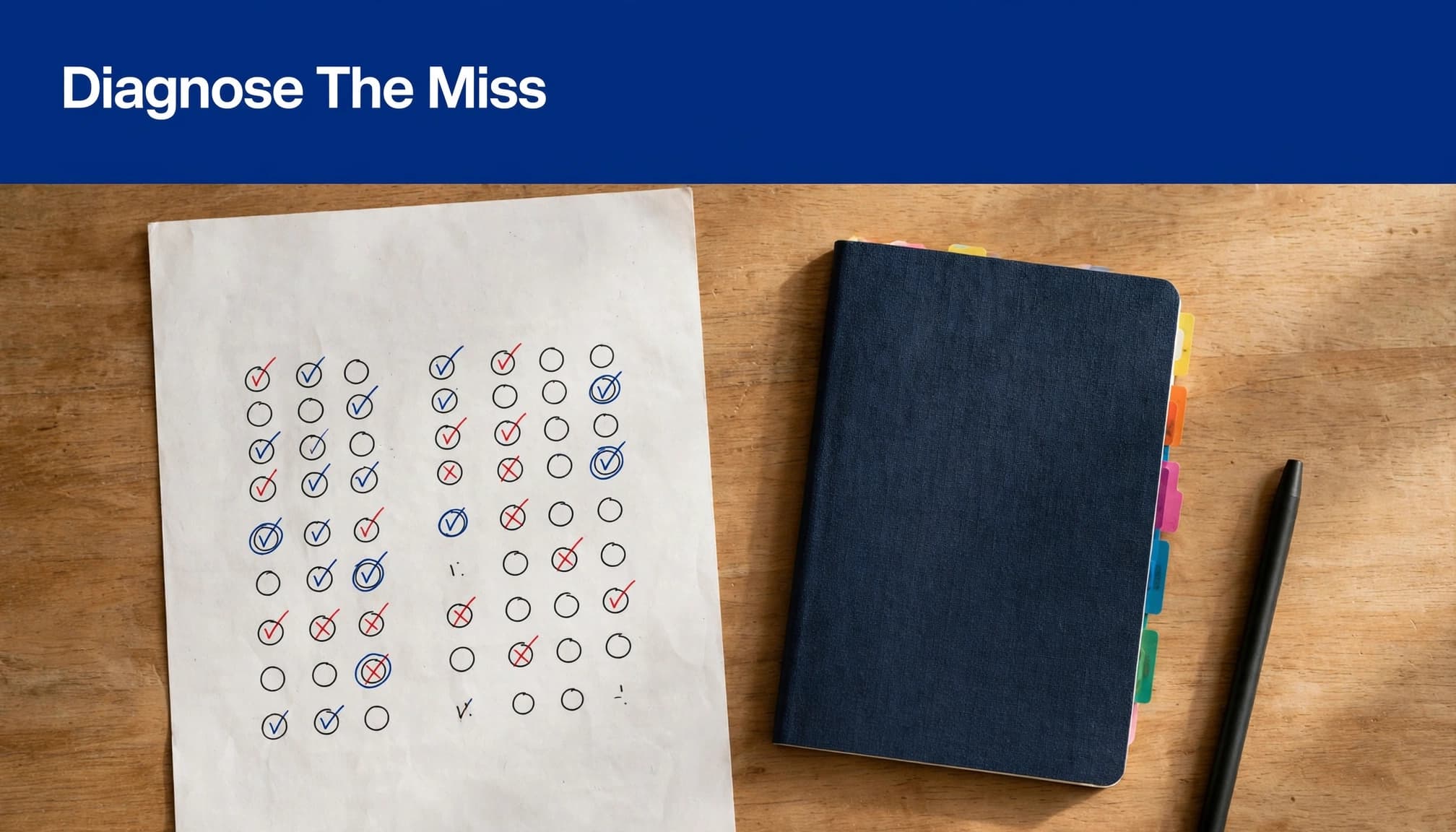
“Study harder” doesn’t tell you what to change. Use wrong answers to identify the main error category, then choose a matching action.
Use these categories as a starting point.
Error category | What to look for | Matching repair |
|---|---|---|
Knowledge gap | You couldn't recall or explain a needed concept. | Retrieve the concept, then apply it. |
Misread question | You overlooked a qualifier or misunderstood the question type. | Restate the task before solving. |
Wrong method | You knew relevant facts but selected an unsuitable approach. | Compare methods and their conditions. |
Execution error | Your approach was sound, but a calculation or transcription failed. | Locate the failed step and add a check. |
Time pressure | You rushed, guessed, or left work unfinished. | Practice pacing on a short timed set. |
Don't label every miss a careless error. Change your test-taking approach only when the evidence points to a strategy problem. A repeated units error may indicate that you don't understand the quantities involved. Likewise, slow answers may reflect weak recall rather than pacing alone.
Record anxiety as possible context, not an automatic explanation. Note observable details, such as repeated rereading, changing an answer without new evidence, or feeling unable to start.
If anxiety keeps disrupting exams, discuss support options with your instructor or campus counseling service while continuing the academic review.
Connect Missed Questions to Your Course Materials
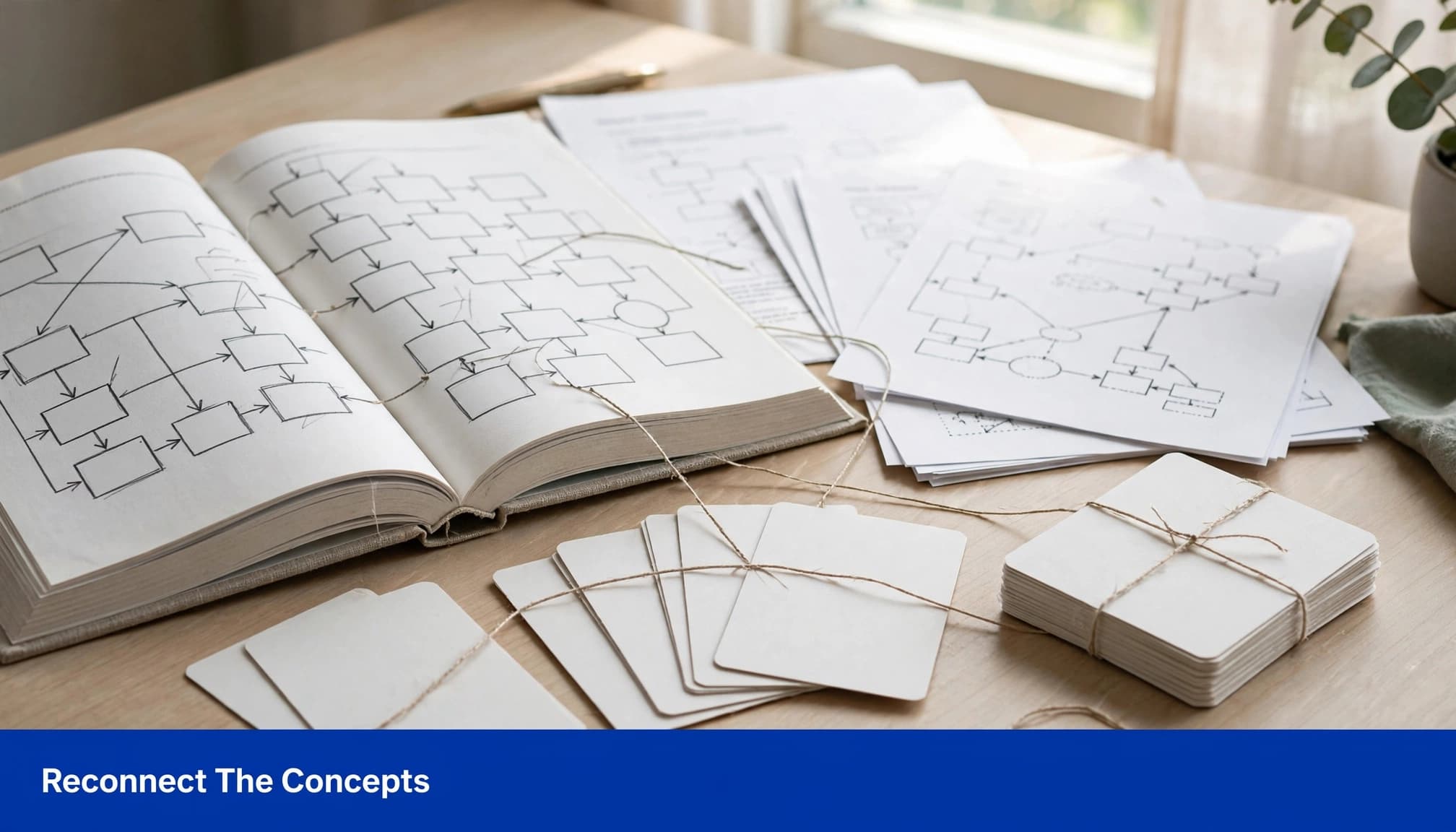
Every substantial gap needs a source location. Trace wrong answers to the lecture heading, textbook section, worked example, or course objective that addresses the gap.
Search for the concept or skill tested by the question type, not just words copied from its stem. Read enough surrounding material to capture conditions and exceptions.
Match Lecture Notes With the Assigned Reading
For photosynthesis, confusion between the light-dependent reactions and the Calvin cycle calls for a comparison. Find the lecture diagram and the corresponding textbook explanation.
The light-dependent reactions occur in the thylakoid membranes; the Calvin cycle occurs in the stroma. Conceptual knowledge means understanding how the stages relate, not just recalling where they happen.
Cover the diagram and explain what each stage produces or uses. Check your explanation against the reading, then add any missing qualification with its source reference.
For a dense chapter, a source-based textbook study guide can organize the relevant sections. Keep the original reading available to verify the guide.
Use Worked Examples and Course Objectives
In calculus, a missed derivative involving a composite function calls for reviewing the chain rule. Compare your attempt with the course's worked example. If you used the wrong method, identify why, then locate the first incorrect step.
Next, cover the solution and solve the example yourself. Explain why the method applies before calculating, then use practice questions to apply it.
Finally, check the course objective. If it says "apply the chain rule," reciting the formula isn't enough. Practice recognizing composite functions and applying the rule to similar questions.
For essay questions, follow the same logic: connect the missed rubric criterion to the reading and a model response, then revise that part yourself.
Prioritize Recurring Gaps With a Mistake Log
A mistake log should guide your next study session, not become another document you rarely open. Keep entries short enough to update after each practice set.
Put Repeated and High-Impact Errors First
Group mistakes by concept and decision, rather than question number. Related wrong answers often reveal the same error patterns and may trace back to one misunderstood condition.
Prioritize recurring errors, confident wrong answers, and gaps that affect several course objectives. Use the syllabus, instructor guidance, or official exam blueprint to judge importance. Don't infer topic weight from one test. Let these priorities shape your study plan.
Also examine prerequisites. Trouble interpreting graphs can reveal weak areas across several units, while an isolated terminology slip may need only a short recall check. Repeatedly choosing the wrong method calls for comparing procedures, not just more practice.
You can still review smaller mistakes. Give them a proportionate fix instead of letting them consume the whole session. Don't dismiss a recurring issue as a careless error.
Record the Decision You Need to Change
Use a spreadsheet, notebook, or document with fields for the topic, error type, original reasoning, source location, repair task, and retest result.
An entry such as "chain rule, forgot inner derivative" is more useful than "question 17, wrong." Attach the relevant worked example and a concrete action: solve another composite-function derivative without notes.
Record whether you were confident, uncertain, or guessing. This helps separate fragile knowledge from a firmly held misconception.
When you review practice exam mistakes again, update existing entries. If a retest brings more wrong answers, change the repair instead of copying the same note.
Turn Focused Review Into Active Learning
Dunlosky and colleagues' review of effective learning techniques rated practice testing and distributed practice as high-utility approaches. End your review by retrieving or applying what you learned.
Retrieve Before Checking
Read the relevant passage once with a clear question in mind. Then close the source and answer aloud, write an explanation, or draw the process from memory. This active review is more useful than passive review because you retrieve instead of rereading.
Check afterward and correct the precise omission. Turn wrong answers into retrieval prompts, then retry from memory instead of copying the corrected answer.
You can use Cornell notes for active recall by placing a testable cue beside the relevant notes. Cover the explanation and answer the cue first.
For flashcards, keep one concept or decision per card. Ask when a formula applies, how two terms differ, or why a condition matters. Delete duplicates and revise cards whose wording gives away the answer.
Test Transfer With a Different Question
Redoing the original question is useful, but remembering its answer doesn't demonstrate transfer. Choose practice questions with different wording, numbers, or context. These similar questions help test whether you can apply the idea beyond the original item.
For photosynthesis, move beyond naming locations. Explain how the products of the light-dependent reactions support the Calvin cycle, using your course's terminology.
For a misread question, practice stating the requested task and identifying qualifiers before answering. For a timing issue, try a short timed set only after you can solve similar questions untimed.
A correct repeat answer is stronger evidence when you can explain it and solve a related unfamiliar question.
Use AI to Find Sources and Suggest Patterns
AI can help organize a mistake log and locate relevant material. It can't reliably infer your original reasoning from a wrong answer alone.
Upload a focused selection of lecture notes and assigned readings to NotebookLama. Use its document chat with source references to find passages related to a gap.
A useful request is: "Using only these materials, find the section explaining when this method applies. Identify its conditions and exceptions, and cite the supporting passage."
You can also ask AI to suggest clusters of recurring errors from your notes. Treat those categories as proposals, then compare them with the questions and your recorded reasoning.
Check every generated question, explanation, and flashcard against the source. A citation must support the actual claim, including its scope. If the relevant information is missing, the tool should identify that gap rather than supply a guess.
Follow course rules and upload permissions. Remove names, student IDs, sensitive information, and restricted exam content.
Retest Tomorrow, Then Revisit the Gap
The next day, revisit wrong answers by attempting the repaired concept before opening your notes. Write an explanation or solve a related question, then compare your response with the source.
This delay helps you check what remains available after the review session ends. Dunlosky's guidance on distributed practice recommends spreading learning across sessions rather than concentrating it into one sitting.
Schedule another check several days later, adjusted to your exam date. Use practice questions, including similar questions that test whether you can transfer the concept rather than recall a familiar solution. Difficult concepts need more frequent attention than ones you consistently retrieve and apply. Alongside targeted retests, use full-length practice tests under exam conditions as your exam date approaches.
If you use Anki, tag cards by unit or exam topic so targeted review doesn't hide older material. Still, use full problems for skills that require several connected steps.
Track explanations, source accuracy, and test performance on new questions alongside scores. If an error repeats, change the task: compare methods, redraw the process, or ask your instructor about the exact point of confusion.
Key Takeaways
Reconstruct your original reasoning before studying the answer, including correct answers you guessed.
Match the error to a specific course source and practice task, with recurring and high-impact gaps first.
Check learning through closed-book retrieval and unfamiliar questions, then repeat those checks across several sessions.
A useful mistake log connects a failed decision to evidence, a repair, and a later result. It doesn't need to reproduce every answer rationale.
Frequently Asked Questions
Should I review correct answers on a practice exam?
Yes, especially if you guessed or couldn't explain why the answer was correct. A correct choice can conceal a knowledge gap, so try to explain the reasoning without notes.
How should I use an answer explanation?
Compare it with your original reasoning and identify the specific decision or knowledge gap that led to the mistake. Then close the explanation and reproduce the reasoning yourself.
What if I keep making the same mistake?
Group repeated errors by concept and decision in your mistake log, then check whether the repair task is addressing the cause. If the error persists, change the task or ask your instructor about the point of confusion.
When should I retest a missed concept?
Try the repaired concept the next day without opening your notes, then revisit it several days later. Use a related question with different wording or context to check whether you can apply the idea, not just recall the original answer.
Make Each Mistake Change Your Next Study Session
Treat each mistake as a learning opportunity: connect the gap to a course source, practice without looking, and check it again after a delay.
Keep demonstrated understanding as the goal. Explaining your reasoning and applying it to a new question tells you more than recognizing yesterday's correct answer.