Incomplete lecture notes can make revision harder than it needs to be. You might have a definition without an explanation, a formula without its conditions, or a diagram that made sense during class but is confusing when you revisit it.
The solution isn't to copy entire textbook chapters into your notebook. It's to identify what is missing, find the relevant explanation in your assigned reading, and add enough information to understand the concept independently.
AI tools can make this process easier by helping you locate explanations in PDFs, identify missing details, and retrieve supporting page references. This guide explains how to fill gaps in lecture notes systematically, with a practical photosynthesis example and a NotebookLama workflow.
Key Takeaways
Turn unclear notes into specific questions before opening your textbook.
Search assigned readings for the exact explanation, then check the surrounding context.
Paraphrase explanations while preserving technical terms, formulas, units, and conditions.
Use AI to locate missing information in course PDFs and return source-page references.
Mark unresolved questions instead of guessing, and test your repaired notes after each study session.
1. Identify Gaps Before Opening the Reading

Look beyond visible blanks
A gap isn't always an empty space on a page. It can also be an unfinished diagram, an undefined abbreviation, a sentence that only made sense during the lecture, or a relationship between two concepts that was never explained.
Review one lecture section at a time and ask yourself whether you could explain its main idea without looking at the textbook.
Pay particular attention to:
Technical terms that have no definition.
Personal shorthand that you may not understand later.
Missing examples or explanations.
Diagrams with unlabeled stages or unclear connections.
Formulas without symbol definitions, units, or assumptions.
For example, writing down an equation without noting the conditions under which it applies can lead you to use it incorrectly.
Turn each gap into a question
Replace vague reminders with questions that have a clear answer.
Instead of writing:
Confused about photosynthesis.
Write:
Which products of the light-dependent reactions are used in the Calvin cycle?
The second version gives you a specific objective when you open your reading.
For instructor-provided gap-fill handouts, read the surrounding sentence before searching for the missing term. Decide whether the blank requires a definition, process, example, or condition.
Prioritize gaps connected to learning objectives, worked problems, and concepts emphasized repeatedly during lectures.
2. Locate the Relevant Information in Assigned Readings
Search by concept and section heading
Use your assigned readings to answer one question at a time. Match the question to the textbook's headings, index, glossary, or learning objectives.
If you're searching a PDF, start with the technical term. If you cannot find it, try a related term or a phrase from the relevant learning objective.
Avoid searching for an entire sentence from your rushed lecture notes. Your lecturer may have explained the concept using different wording from the textbook.
For journal articles, look at the section that matches your question:
Methods: How the researchers conducted the study.
Results: What the study found.
Discussion: How the authors interpret the findings.
Keep your original question beside the reading so you don't get distracted by unrelated information.
Read enough context to preserve meaning
Finding a matching keyword is not enough. Read the surrounding paragraph and inspect relevant diagrams, captions, or tables.
Look for qualifying phrases such as:
"Under constant pressure"
"In this sample"
"Assuming independence"
"At a specific temperature"
These conditions may change the meaning of the explanation, so preserve them when adding information to your notes.
As soon as you find useful evidence, record the section heading and page number. This makes it easier to revisit the original explanation later.
3. Add Missing Information Without Copying the Textbook
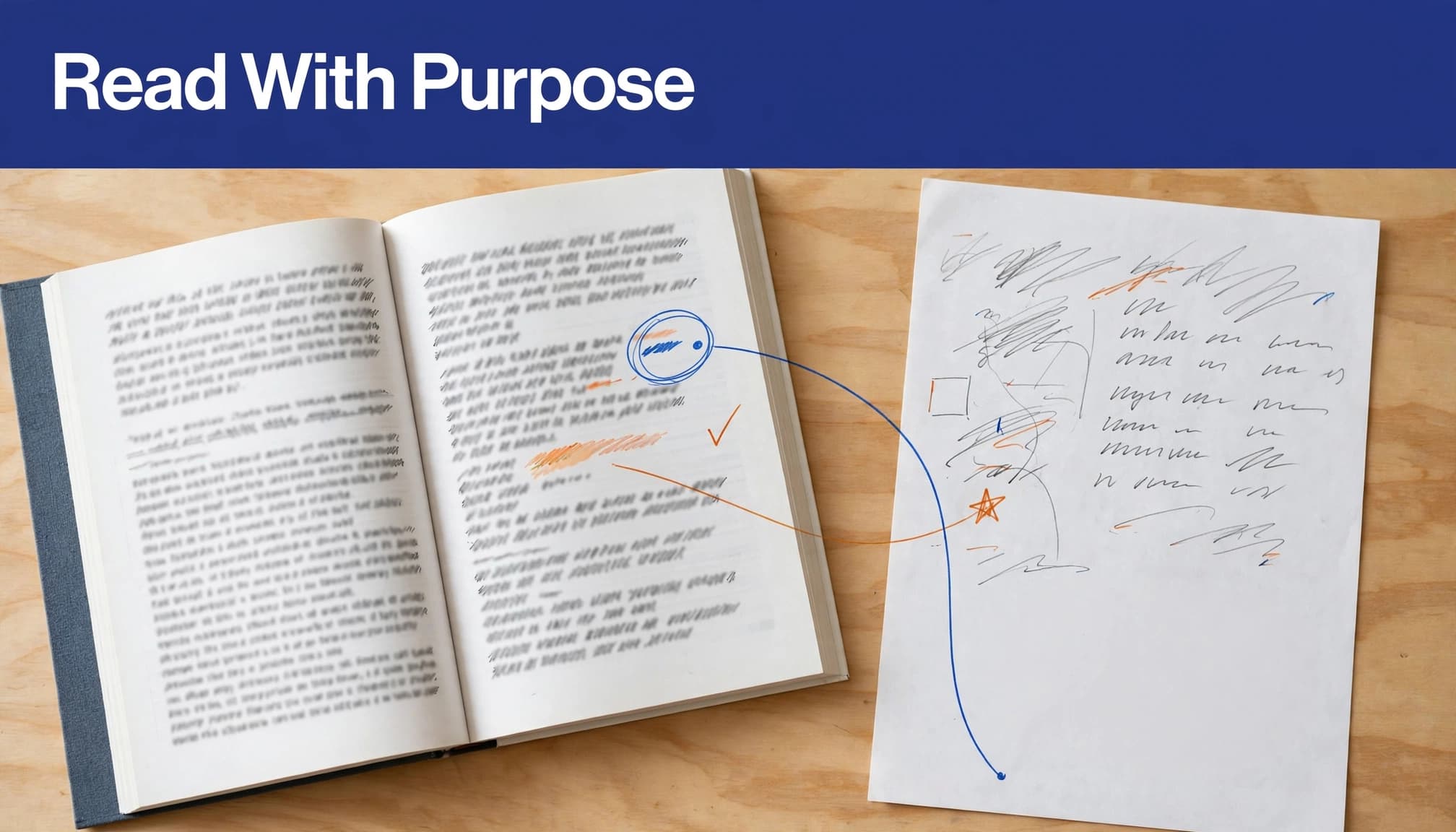
Once you find the relevant passage, read it carefully, hide the source, and explain the idea in your own words. Then reopen the reading and check whether your explanation preserves the original meaning.
Keep each addition connected to the gap you identified. A missing definition may need only one sentence, while a missing calculation step may require a short worked solution.
Preserve technical terminology, equations, units, and assumptions. In subjects such as physics, economics, and statistics, simplifying the wording should never change the underlying meaning.
If an exact quotation is necessary, use quotation marks and provide a reference. Otherwise, paraphrase the explanation instead of importing entire paragraphs.
A worked example: completing a photosynthesis page
Suppose your biology lecture notes contain important photosynthesis terms but do not explain how they connect.
Instead of rewriting the entire chapter, identify each missing explanation and add only the information needed to understand the process.
Incomplete lecture note | Reading-based addition | Question for review |
|---|---|---|
Light reactions: location? | Light-dependent reactions occur in the thylakoid membranes of chloroplasts. | Where do light-dependent reactions occur? |
ATP, NADPH: purpose? | ATP supplies energy, while NADPH supplies reducing power for the Calvin cycle. | How do ATP and NADPH support the Calvin cycle? |
Oxygen released: source? | The released oxygen comes from water split during the light-dependent reactions. | Where does the released oxygen originate? |
The repaired notes now explain relationships rather than listing disconnected terms.
You can use the same structure for other subjects:
Original point → Missing explanation → Source location → Review question
Add the actual heading and page number from your assigned edition. Different textbook editions may use different pagination, so never invent or assume a page reference.
Use NotebookLama to find missing explanations in PDFs
When your assigned reading is lengthy, locating one missing detail can take longer than writing the explanation itself. This is where AI-powered document chat can help.
With NotebookLama AI Document Chat, you can upload a PDF, ask questions about its contents, and receive answers with page and section references. This lets you investigate a specific gap without relying only on a general chapter summary.
For example, suppose your lecture notes say:
ATP and NADPH are used in the Calvin cycle.
You understand the statement, but your notes do not explain what each molecule contributes.
Upload your assigned biology chapter and ask:
Using only the uploaded biology chapter, explain the different roles of ATP and NADPH in the Calvin cycle. Identify where each molecule is used, what it contributes to the process, and what happens to it afterward. Provide the exact PDF page and section reference for each explanation. If the chapter does not provide a detail, say "Not stated in the source." Keep the explanation suitable for undergraduate lecture notes.
What a useful response should contain:
The following is an illustrative example of the expected structure, not a verified live response from an uploaded NotebookLama document.
Information to extract | Example explanation |
|---|---|
ATP's role | Supplies energy for reactions in the Calvin cycle |
NADPH's role | Supplies reducing power for carbon reduction |
Connection | Both are produced during the light-dependent reactions and used in the Calvin cycle |
Source reference | Exact PDF page and section to be verified against the uploaded chapter |
The important part is the source reference. Open the cited page, read the surrounding explanation, and check that the answer matches your assigned material before adding it to your notes.
You can also ask a follow-up question if the first response leaves out an important step:
Explain how ATP and NADPH are used during the Calvin cycle in sequence. Use only the uploaded chapter and provide page references for each stage. Do not add information from outside the document.
This makes AI a research assistant for your reading rather than a replacement for understanding the material.
4. Mark Uncertainties and Resolve Them Later
Not every question will have a clear answer in the assigned reading. Instead of guessing, keep unresolved points visible.
Use a consistent marker, such as a question mark, for information that still needs clarification. You can also label additions from readings with "R" so you can distinguish them from your original lecture notes.
When two sources appear to disagree, keep both claims and their locations. The difference may come from different assumptions, definitions, or levels of detail.
For example, if one source presents a formula under constant temperature while another discusses changing temperature, the two explanations may not actually contradict each other.
Write a precise follow-up question for your instructor or teaching assistant. Instead of asking, "I don't understand this topic," ask:
Does this equation assume constant temperature, or can it also be applied when temperature changes?
A completed blank can still hide a misunderstanding. Keep uncertain answers marked until you can explain the evidence behind them.
5. Test the Repaired Notes Instead of Only Rereading
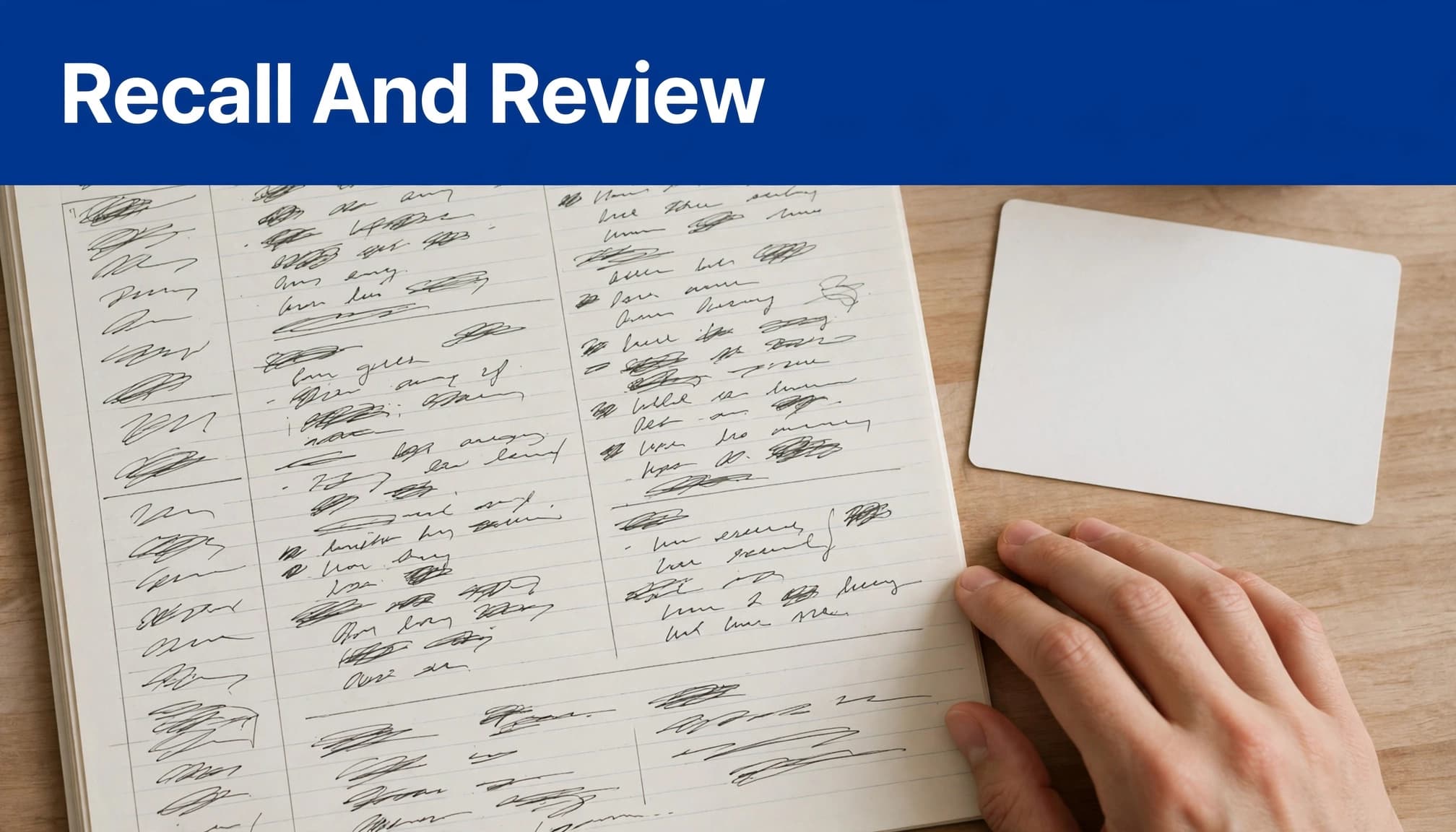
Once you've filled a gap, cover the explanation and try answering the review question without looking.
You can speak the answer, sketch a process, explain a relationship, or solve the relevant calculation. Then uncover your notes and correct the specific omission.
For example, after completing the photosynthesis table, try answering these questions without looking:
Where do light-dependent reactions occur?
What does ATP contribute to the Calvin cycle?
What is the role of NADPH?
Where does the oxygen released during photosynthesis originate?
If you cannot explain a point clearly, return to the relevant reading rather than memorizing the sentence in your notes.
This approach uses practice testing, also called retrieval practice. Dunlosky and colleagues' 2013 review, published in Psychological Science in the Public Interest, evaluated ten learning techniques and rated practice testing and distributed practice as high-utility strategies.
Read the published review: Improving Students' Learning With Effective Learning Techniques.
Return to difficult questions in later study sessions rather than attempting to learn everything in one sitting. For applied subjects, also try a problem with different numbers or wording. Remembering the original answer does not necessarily mean you can apply the concept elsewhere.
Which Note-Taking Method Should You Use?
You do not need to change your entire note-taking system to repair incomplete lecture notes. Choose a layout that makes missing explanations and relationships easy to identify.
For example, the Cornell method provides a cue column for questions, a notes section for explanations, and a summary area. Outlines work well for hierarchical topics, while tables are useful for comparisons and flow diagrams help explain processes. If you already use Cornell notes, see our guide to the Cornell Note-Taking System for a more detailed explanation.
Handwritten and digital notes can both support this process. The important thing is to paraphrase explanations, preserve source references, and test your understanding instead of simply collecting more text.
Research on handwriting and laptop note-taking should also be interpreted carefully. Mueller and Oppenheimer's 2014 study reported an advantage for longhand note-taking on conceptual questions in three experiments. However, a 2021 direct replication of their first study did not find that laptop users performed worse than longhand users on the quiz. The wider evidence does not justify a universal rule that handwriting is always better.
Mueller and Oppenheimer (2014), The Pen Is Mightier Than the Keyboard.
Urry and colleagues (2021), Don't Ditch the Laptop Just Yet.
Use the format that helps you understand and review your course material consistently. You can also combine handwritten explanations with searchable digital PDFs when that suits your study routine.
Frequently Asked Questions
What if the assigned reading doesn't answer my question?
Consult your course slides or an authorized recording, then bring the unresolved question to your instructor or teaching assistant. Include the relevant lecture note and reading location so they can address the exact issue. Leave the gap marked until you have a reliable answer.
Should I finish the entire reading before repairing my notes?
You can use targeted reading to resolve a specific gap first. However, targeted searching does not replace completing the assigned reading. Full chapters and articles provide arguments, evidence, and connections that selective searching may miss.
Can AI fill gaps in lecture notes automatically?
AI can help identify missing explanations, search uploaded readings, and suggest answers with source references. However, it may overlook conditions, misinterpret diagrams, or produce an unsupported explanation. Check the cited pages and revise the notes yourself.
How much information should I add to incomplete notes?
Add enough information to explain the concept without reopening the textbook. A missing definition may need one sentence, while a complex process may need a short explanation, diagram, or worked example. Keep the addition focused on the original gap.
Make Every Addition Useful for Studying
Good lecture notes contain explanations you understand, traceable sources, and questions you can answer without looking. Filling every blank is not the goal; understanding the ideas behind those blanks is.
Start with one lecture section. Turn unclear points into questions, find the relevant explanations in your assigned readings, and add concise notes with source references. Then test yourself to check whether the repaired material actually makes sense.
With a consistent process, your lecture notes become more than a record of what happened in class. They become a study resource you can use to explain, recall, and apply what you've learned.