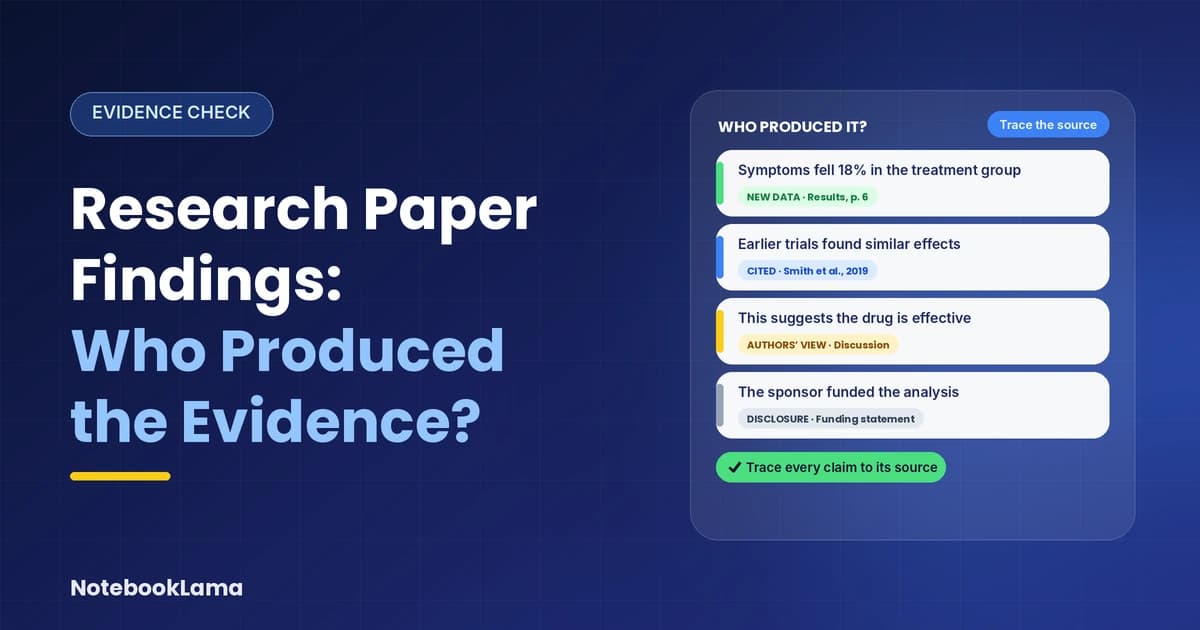
When reading a research paper, it is important to distinguish the findings produced by the current study from information borrowed from earlier research. A sentence may appear in the results or discussion section, but that does not automatically mean the authors generated the evidence themselves.
To identify who produced a finding, trace the claim to the study's methods, results, and supporting sources. This helps you avoid attributing another researcher's discovery to the paper you are reading.
Key Takeaways
Distinguish findings generated by the current study from claims based on previous research.
Follow citations, methods, results, tables, and figures to establish where the evidence originated.
Separate observed results from the authors' interpretation and broader conclusions.
Record page references and preserve the population, conditions, and limitations attached to each finding.
Separate Research Paper Findings From Background Claims
In a common IMRaD research paper structure, the introduction and literature review usually describe existing knowledge, while the results section reports the current study's analysis.
However, section headings are only clues. A discussion section may restate the authors' own results, and an introduction may refer to earlier work conducted by the same researchers.
Look at the wording around each claim:
Language signal | Likely role | Evidence to locate |
|---|---|---|
"Previous research has shown..." | Background claim | The cited earlier study |
"In the present study, we found..." | Current finding | This paper's methods and results |
"Consistent with earlier research..." | Comparison | Both the current result and cited source |
"This pattern may reflect..." | Interpretation | The finding and supporting reasoning |
Treat these phrases as starting points, not guarantees. Authors may describe earlier work using "we," while a citation may identify a measurement instrument rather than the source of a finding.
A citation beside a result does not automatically mean that the result belongs to the cited paper. Check what the citation actually supports.
Review articles require another distinction. Their contribution may be a new synthesis of existing studies rather than an experiment with newly recruited participants. In that case, examine how the authors selected, evaluated, and synthesized the included research.
Trace a Claim Through the Paper in Four Steps
Use this sequence whenever you need to establish who produced a research finding.
1. Identify the research objective
Find the study's objective and research questions. Start with the abstract, then read the final paragraphs of the introduction to understand what the researchers intended to investigate.
You can also skim the discussion to understand the authors' main conclusions, but return to the methods and results before treating those conclusions as established findings.
2. Mark the claim's attribution
Identify author-year references, bracketed numbers, or footnotes surrounding the claim. Match each marker to its bibliography entry.
Read the surrounding sentences because one paragraph may alternate between the current study's findings and comparisons with earlier publications.
3. Match the claim to the methods
Locate the methodology section and check:
The sample and sample size.
The population or dataset.
The measures and instruments.
The time frame.
The statistical or qualitative analysis.
If the study never measured the claimed outcome, investigate whether the sentence describes another source or an interpretation rather than a direct finding.
4. Locate the result itself
Find the relevant results paragraph, table, figure, or qualitative excerpt. Read captions and footnotes, including exclusions and subgroup definitions.
Record the page and section alongside your note. This creates a traceable connection between the claim and the evidence supporting it.

A worked example: tracing a finding in a published study
Consider Roediger and Karpicke's 2006 paper, Test-Enhanced Learning: Taking Memory Tests Improves Long-Term Retention, published in Psychological Science.
The researchers investigated whether taking memory tests improved later retention compared with spending the same amount of time studying the material again.
Here is how to trace one of the study's findings using the four-step method:
Trace step | What the paper shows |
|---|---|
Research objective | The researchers examined whether testing improves later retention more than repeated studying. |
Attribution | The finding is reported by Roediger and Karpicke (2006), the authors of the current study. |
Methods | Participants studied prose passages and completed either retrieval tests or additional study activities. Retention was assessed after different intervals. |
Result | On the one-week delayed test in Experiment 1, the initially tested group recalled more than the additional-study group: 56% compared with 42%. The reported comparison was t(39) = 6.41, d = 0.83. |
<text color="secondary" size="xs">Source: Roediger & Karpicke (2006), Experiment 1, published in Psychological Science, 17(3), 249–255.</text>
What can you conclude?
The one-week result is a finding generated by the researchers' own experiment. It shows that, under the study's conditions, participants who took an initial retrieval test retained more of the passage than those who spent the corresponding time restudying it.
It does not establish that testing will always outperform studying in every educational setting or for every type of material.
Read the original research paper.
This example demonstrates why tracing a claim requires more than finding a sentence in the results section. You need to understand the research question, identify the study conditions, and connect the reported numbers to the actual analysis.
A source's existence does not establish that it supports the sentence. The population, outcome, timing, and strength of the claim must match the evidence.
Our guide to [reading research papers with AI — insert the verified internal link] uses the same source-bound approach. Ask for evidence locations and require "Not reported" when information is absent, then read those passages yourself.
Distinguish Results, Discussion, and Conclusion
Results report what the analysis showed. Discussion explains what the findings may mean, how they relate to previous studies, and what limitations affect their interpretation. The conclusion summarizes the paper's main contribution.
For example, in the Roediger and Karpicke study, the higher one-week recall in the testing condition is an observed result. Explaining that retrieval practice may support longer-term retention is an interpretation of that result.
When citing the study elsewhere, make ownership explicit:
"Roediger and Karpicke (2006) found that participants who completed retrieval tests retained more information after a one-week delay than participants who repeatedly studied the material."
Some disciplines combine results and discussion. In those papers, classify individual sentences by function instead of expecting separate headings.
If you are writing a paper rather than reading one, detailed guidance on reporting quantitative statistics and presenting qualitative themes belongs in a separate writing guide. See our [guide to reporting research findings — insert the verified internal link to article #15].
Key Questions to Ask Before Using a Finding
Before including a finding in your literature review, research summary, or academic assignment, check:
Who produced it? Identify whether the evidence comes from the current study, an earlier publication, or a review's synthesis.
Where is it reported? Record the results paragraph, table, figure, or qualitative excerpt.
How was it produced? Check the sample, measures, research design, and analysis.
What does it actually support? Preserve the finding's population, comparison, uncertainty, and study conditions.
These questions help prevent a common research-reading mistake: confusing a paper's discussion of existing evidence with a result generated by its own investigation.
Frequently Asked Questions
Does a citation mean the finding belongs to another paper?
Not necessarily. A citation may identify an instrument, statistical method, dataset, or earlier publication by the same authors. Read the clause it supports, then locate the current study's analysis.
Can the abstract establish a paper's findings?
The abstract provides a useful first summary, but it compresses important details. Use the methods and results to establish the finding's source and scope. Tables, captions, and supplementary material may contain qualifications missing from the abstract.
Can findings appear in the discussion?
Yes. Authors often restate their findings before interpreting them. Follow the claim back to its evidence rather than treating its location as proof of ownership.
How do I distinguish a research finding from an author's interpretation?
A finding reports what the study's data or analysis showed. An interpretation explains what the authors think the result means. For example, a measured difference between two groups is a result; suggesting why that difference occurred is an interpretation.
Keep the Evidence Attached to Its Source
The most dependable way to identify research findings is to establish who produced the evidence. A paper's own findings should connect to its methods and analysis, while background claims should connect to identifiable earlier sources.
Before using a result, record its location and preserve its scope. This keeps another study's evidence from becoming the current paper's discovery, or a cautious observation from becoming an unsupported conclusion.