To write a literature review that synthesizes studies, organize your paragraphs around shared results, disagreements, methods, and unanswered questions. Literature review synthesis explains relationships across studies rather than reporting what each author said separately.
If your feedback says "too much summary," you don't need to discard your notes. Move from summarizing studies one by one to synthesizing research around what they collectively explain about your research question.
Key Takeaways
Organize around research questions and analytical categories, with individual studies providing evidence.
Use a synthesis matrix to compare findings, methods, populations, and limitations.
Explain agreement, disagreement, changes over time, and gaps without forcing studies into a single conclusion.
1. Understand What Literature Review Synthesis Adds
Summary reports findings; synthesis explains relationships
A summary accurately describes an individual study's purpose, methods, and results. Those summaries are useful preparation, but a sequence of them leaves readers to make the connections themselves.
Synthesis combines evidence into a unified analytical narrative organized by concepts, categories, or variables. Your paragraph makes a claim about the evidence, then uses relevant studies to support, qualify, or challenge it through critical analysis.
The difference appears in the organizing question: summary asks what each study found; synthesis asks what their findings explain together.
Your review establishes a scholarly conversation
In an RRL, or review of related literature, synthesis shows what researchers know and what remains unresolved.
USI Libraries' synthesis guide distinguishes this work from an annotated bibliography or an inventory of everything published. Its tasks include identifying data trends, explaining how populations or interventions affect results, and locating your research within the discussion.
That gives your review a purpose: establish what your research question builds on and map the research landscape.
2. Group Sources Around Comparable Questions
Set boundaries and expand your search
Define the relationship you want to examine, including relevant populations, settings, outcomes, and dates. Otherwise, papers can share a topic without addressing comparable questions.
Then supplement database searches with pearl growing, also called citation mining. VIU Libraries describes two directions: backward searching follows a paper's bibliography; forward searching finds later works that cite it. Google Scholar's "Cited by" feature supports forward searching.
Record your search terms, databases, dates, and selection decisions. This record helps distinguish an under-researched question from a limitation in your collection.
Choose themes, methods, or theories deliberately
Statistics Solutions' five-step approach moves through understanding the purpose, grouping studies, comparing results, identifying gaps, and building an argument. Its employee-motivation example separates intrinsic and extrinsic factors.
Choose categories that answer your question. Thematic organization works well for recurring concepts; methodological groups expose design differences, while theoretical groups compare explanations.
The video "Ch-2: How to Synthesize Literature?" groups two social-media studies reporting positive and negative effects together, and three reporting negative effects of intense use together. Those groups provide a starting point for comparing exposure and outcome definitions.
For a large collection, tag papers provisionally to reveal patterns, then merge overlapping categories. Keep categories that explain meaningful relationships rather than every topic mentioned.
3. Build a Matrix That Makes Comparisons Visible
A synthesis matrix places sources in columns and comparison dimensions, variables, or questions in rows. Each cell briefly records the source's position.

For initial extraction, one source per row may be easier. Then transpose or filter those notes for comparing and contrasting sources by their evidence, methods, populations, or limitations. Our guide to an AI-assisted literature review matrix explains that workflow.
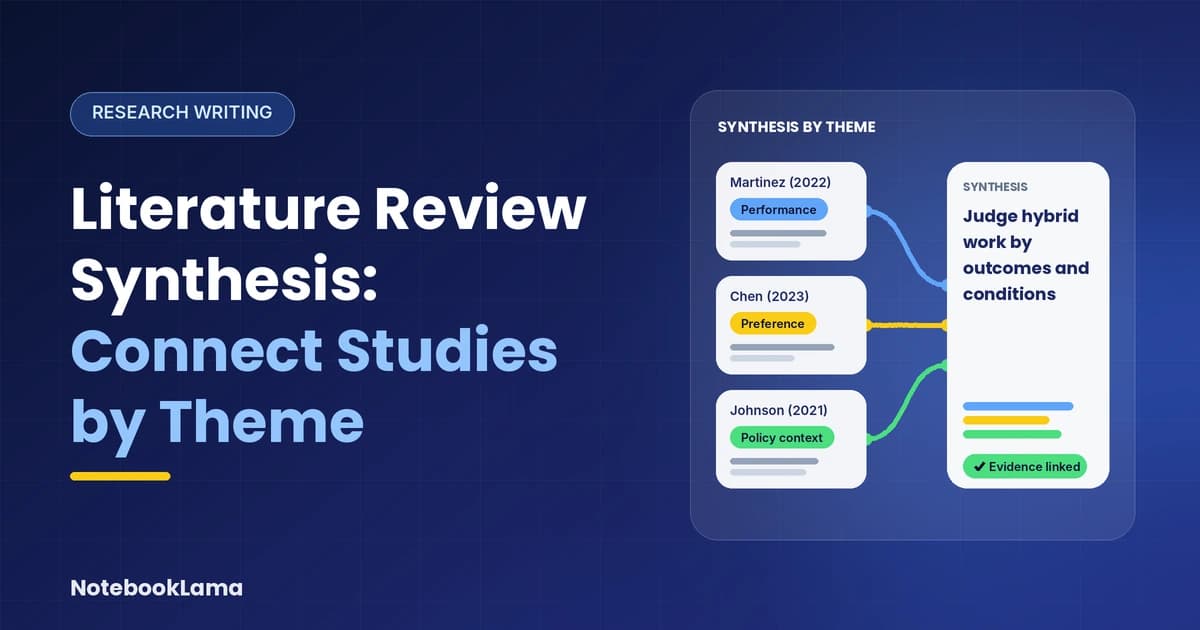
Tulane's summary-versus-synthesis guide provides these instructional examples about hybrid work.
Comparison question | Martinez (2022) | Chen (2023) | Johnson (2021) |
|---|---|---|---|
What contribution appears? | 15% productivity increase | 67% prefer hybrid models | Pandemic-era policy context |
Which dimension does it address? | Performance | Employee preference | Policy conditions |
Are method details supplied? | Not specified in example | Not specified in example | Not specified in example |
The matrix exposes a useful distinction: productivity, preference, and policy context address different questions. Connecting them requires explaining their relationship, rather than treating them as interchangeable results.
For your own sources, record methods, populations, limitations, and page references. Keep source results separate from your interpretation. When information is missing, write "Not reported" instead of filling the cell through inference.
4. Compare Findings Using Four Synthesis Moves
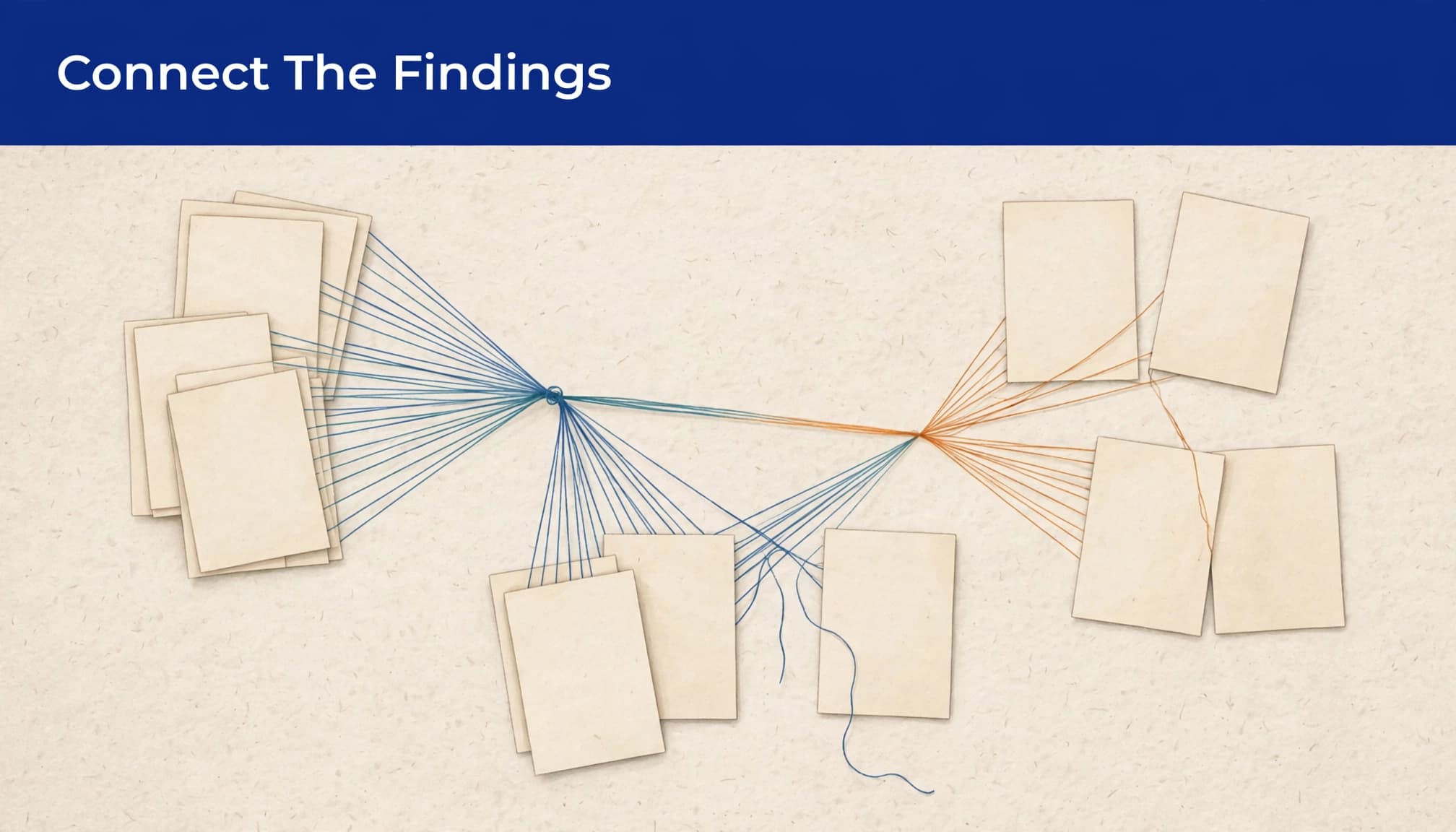
Tulane describes four moves: showing consensus, presenting disagreement, tracing change over time, and identifying gaps. Use whichever fits the evidence.
Explain agreement and investigate disagreement
Agreement becomes meaningful when studies examine comparable relationships. Compare measures, populations, and study designs before claiming a shared conclusion. Several papers reporting an association don't automatically establish causation.
When results conflict, examine the tension between findings and inspect definitions, instruments, follow-up periods, and analytical adjustments. A difference in statistical significance alone doesn't establish that effect estimates conflict.
Then distinguish documented differences from possible explanations. "The studies used different instruments" reports a fact; "instrument differences may explain the divergence" offers an interpretation. Preserve unresolved conflicts when the evidence doesn't settle them.
Trace change and identify bounded gaps
Chronological synthesis explains how evidence or thinking changed. Publication order alone isn't enough: identify what changed in methods, theory, context, or conclusions.
Gaps in the literature can involve an overlooked population, incompatible measures, or a conflict that prevents a clear answer. However, an empty matrix cell doesn't prove that nobody has studied the issue.
Our guide to finding research gaps without overclaiming explains how broader searching supports defensible claims. State the gap within the scope your search supports, then explain why resolving it matters to your research question.
5. Replace Source Lists With Analytical Paragraphs
Using Tulane's instructional examples, the difference becomes clearer when the paragraph's organizing idea changes.
Before: each study gets a turn
Martinez (2022) reported a 15% productivity increase. Chen (2023) found that 67% of workers preferred hybrid models. Johnson (2021) discussed pandemic-era policies. These sources concern hybrid work.
This passage identifies contributions, but its final sentence only restates their shared topic. Readers still have to decide how productivity, preference, and policy connect.
After: the paragraph makes a comparative claim
Evaluations of hybrid work need to distinguish performance outcomes from employee preferences and policy conditions. Martinez's (2022) productivity finding addresses organizational performance, whereas Chen's (2023) preference finding addresses workers' attitudes. Johnson's (2021) pandemic-policy discussion supplies context for interpreting these different dimensions. Together, the examples suggest an evaluation organized around outcomes and implementation conditions, rather than a single judgment about hybrid work.
The revised paragraph leads with a claim, assigns each source a role, and explains the relationship. It doesn't pretend that preference measures productivity or that policy context proves causation.
A paragraph can cite several studies and still be a list. Synthesis comes from explaining the relationship between their findings.
6. Organize Sections and Write Connecting Transitions
Turn recurring matrix categories into section headings. Avoid author-based headings unless your review's purpose requires examining individual thinkers.
Within each section, establish the theme's relevance, compare supporting evidence, address contradictions, and identify the remaining limitation. Purdue OWL's literature review guidance emphasizes synthesizing sources rather than transferring annotated-bibliography entries into paragraphs.
Transitions should name how one idea relates to the next. "Similarly" is weak unless readers understand what is similar. Stronger transitions name the connection:
"These findings agree on the association, although their outcome measures differ."
"The difference becomes clearer when the studies are grouped by follow-up period."
"This measurement problem also limits comparisons across populations."
Before drafting the next section, write one sentence explaining why it follows the previous one. If the connection is unclear, reconsider the order or merge overlapping themes.
Keep your matrix open while writing. Update page references and theme labels as your interpretation develops.
7. Use AI to Compare Evidence Without Outsourcing Judgment
AI can propose relationships across checked notes, but give it a bounded task. Ask for comparisons before asking for polished prose.
A useful prompt is: "Using only these matrix entries, identify recurring categories, supporting source IDs, agreements, disagreements, and methodological differences. Flag themes supported by only one or two studies. Add no claims absent from the entries."
Limited support is a caution, not a universal rule requiring three studies per theme.
Keep AI suggestions separate from source findings and your own analysis. Inspect the underlying passages before accepting a proposed pattern, especially when a tool suggests that methods explain conflicting results within a theme.
For gap analysis, ask it to distinguish missing coverage in your collection from evidence of a wider research gap. Human judgment connects those comparisons to a defensible argument.
Frequently Asked Questions
Does every synthesis sentence need several citations?
No. Cite the sources supporting the particular claim. A sentence comparing studies needs clear attribution, but a sentence explaining one study's limitation may need only that source. Attach citations closely enough that readers can tell which evidence supports each part of your argument.
Can a literature review follow chronological order?
Yes, when change over time helps answer your research question. Explain what changed and why the shift matters. If chronology merely produces one study after another, organize around themes instead and discuss historical developments within those sections.
Build the Review Around Relationships
A strong review gives each study a role in an argument and builds a comprehensive view by making explained connections between the evidence.
Choose one source-heavy paragraph in your draft. Identify its shared question, compare the studies' evidence, and rewrite its opening around the relationship you can defend. Then retain the findings that help establish that claim.