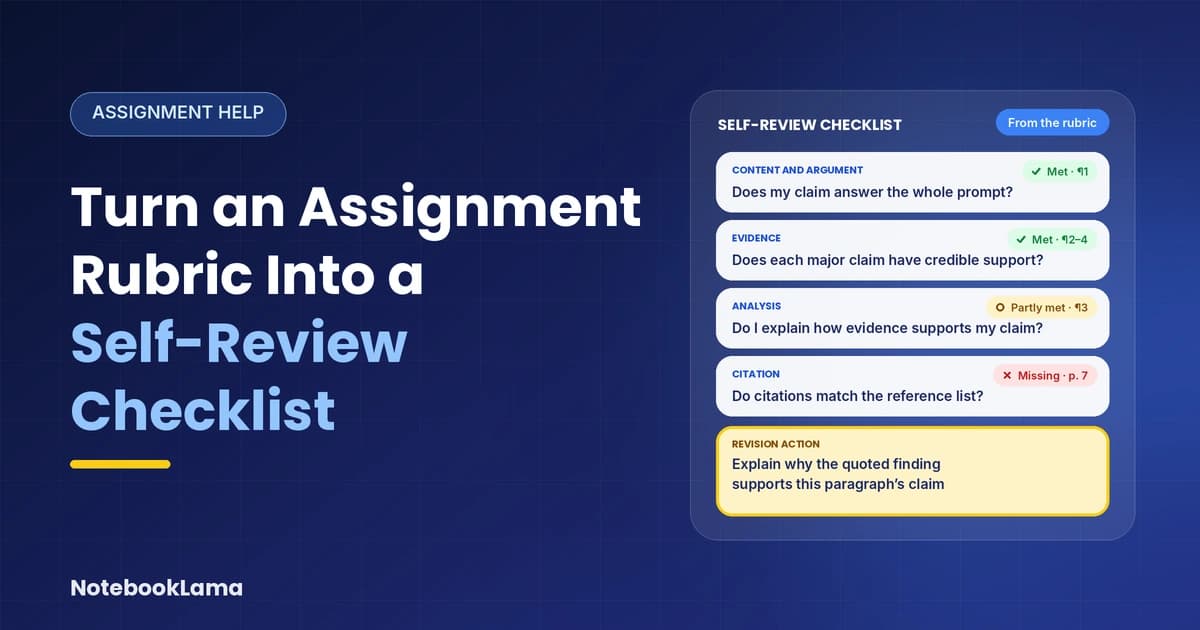
Turn an assignment rubric into a self-review checklist by rewriting each criterion as a question you can answer with evidence. Then locate that evidence in your draft, judge its quality, and name the revision needed.
This works better than rereading your paper and deciding it "sounds finished." A polished paragraph can still miss the assignment's main requirement.
Start with both the rubric and the assignment instructions, because neither document necessarily contains every requirement.
Key Takeaways
Turn broad descriptors into questions about something visible in your work.
Record where each requirement is met, rather than ticking boxes from memory.
Review arguments and evidence before grammar, while keeping a separate check for submission instructions.
Understand What the Rubric Measures
An assessment rubric states an assignment's expectations through criteria and descriptions of quality. Its basic parts are a task description, outcome rows tied to course learning outcomes, and performance-level columns on a rating scale. Each cell clarifies the instructor's expectations.
A rubric judges quality; a checklist directs attention
A rubric distinguishes stronger work from weaker work. A checklist turns those distinctions into review actions.
For example, confirming that a paragraph contains a quotation only establishes presence. Reviewing whether you explain how that quotation supports your claim examines quality.
Keep the rubric beside your checklist. As Susan Brookhart explains in her discussion of rubric criteria, rubrics describe criteria across a continuum of performance. A yes-or-no checklist alone can't preserve every distinction.
Analytic and holistic rubrics need different treatment
An analytic rubric assesses at least two characteristics, describing each at every performance level and scoring each separately. It's useful when an assignment needs distinct feedback on argument, evidence, and organization.
A holistic rubric gives one score based on the work's overall quality. It suits short assignments or quick summative feedback.
With an analytic rubric, build questions from each row. With a holistic rubric, separate the overall descriptor into reviewable features, but don't invent separate point values.
Turn Rubric Language Into Observable Questions
Begin with content, ideas, and arguments. Then address organization, grammar, and citation. This order keeps sentence polishing from taking priority over missing reasoning.
Separate each descriptor into individual demands
Read the performance description you're aiming for and identify every action required by its descriptive language. A descriptor can contain several demands, even within one sentence.
For an evidence criterion, separate source relevance, credibility, integration, and explanation. Each needs its own question. Otherwise, adding a citation may feel like completing the whole requirement.
Preserve qualifiers such as "throughout," "accurately," or "independently." Also retain required source counts, methods, and citation styles exactly as the assignment specifies. These details change what counts as meeting the criterion.
Ask questions that reveal a location or action
Replace vague judgments such as "Is my analysis good?" with questions that direct you to inspect the draft:
After each quotation, do I explain how it supports the paragraph's claim?
Can I identify the purpose of each paragraph and its connection to my thesis?
Does each claim about a source accurately reflect the original passage?
Words such as "good" and "excellent" are markers of quality, but they don't identify observable features. Translate them into something you can underline, count, compare, or explain.
Finding a feature in your draft establishes that it's present. Meeting a rubric level also requires showing that the feature does its job.
An Assignment Rubric Checklist You Can Reuse
Use this rubric template in a document or spreadsheet, then adapt each question to your instructor’s wording. Add assignment-specific rows for methods, calculations, design decisions, or other required outcomes.
Rubric area | Observable self-review question | Evidence to record |
|---|---|---|
Content and argument | Does my central claim answer every part of the prompt? | Thesis location and the prompt requirements it addresses |
Evidence | Does each major claim have relevant, credible support? | Claim locations and supporting source passages |
Analysis | Do I explain how the evidence supports my reasoning? | Explanation following each quotation, result, or example |
Organization | Does each paragraph develop a distinct point in a logical sequence? | A one-sentence summary of each paragraph |
Clarity and grammar | Can a reader follow each sentence without unclear references or recurring errors? | Sentences needing revision and repeated error patterns |
Citation | Do citations support the nearby claims and match the reference list? | Source passages, citation locations, and matching entries |
For every row, record Met, Partly met, or Missing, followed by one revision action. “Improve analysis” is too broad. “Explain why the quoted finding supports this paragraph’s claim” gives you a task.
Illustrative completed row
This example is invented to show how the columns fit together. It does not come from a real assignment.
Rubric area | Descriptor (sample) | Self-review question | Draft location | Judgment | Revision action |
|---|---|---|---|---|---|
Analysis | Each piece of evidence is followed by an explanation of how it supports the claim. | Do I explain how the evidence supports my reasoning? | Paragraph 3, after the survey statistic in the second sentence | Partly met | Add two sentences after the statistic explaining why a 40% response rate supports the claim that students prefer shorter deadlines. |
The judgment is Partly met because the statistic is present but the paragraph moves to the next point without connecting it to the claim. The revision action names the exact spot and what to write there, so you can complete it in one sitting.
Use a separate line for instructions absent from the rubric: word range, required readings, file type, naming rules, deadline, and submission location. You can save the completed document as a PDF if needed
Assess Evidence Against Each Criterion
Rubrics are criterion-referenced. Your task is to judge whether your work meets a stated standard, rather than whether it looks stronger than a classmate's draft.

Locate proof before choosing a status
For each question, record a paragraph number, page, section heading, calculation, or slide. Then explain how that material satisfies the descriptor.
Compare your evidence with the highest performance description first. Move down until you find the description the work actually meets. Don't choose the highest level because you attempted the task.
A single strong paragraph doesn't establish consistent analysis throughout an essay. When the rubric requires consistency, review the whole draft.
Distinguish missing material from weak reasoning
Missing evidence requires adding support. Weak analysis requires explaining the connection between existing support and your claim. Those are different revisions.
For research-based work, reopen the original source. Check whether it supports your exact wording, including the population, time period, and strength of the claim. Then match in-text citations with reference entries.
If a gap reflects a misunderstood course concept, use an approach of reviewing mistakes with course materials where you can review mistakes side by side. Connect the missed criterion to the relevant reading or worked example before revising.
Use Points to Prioritize Your Revisions
Use your instructor's published weights rather than assigning equal importance to every checklist question. Several small formatting checks shouldn't automatically outweigh a major argument criterion.
When building a scoring rubric, instructors determine the total possible points and divide them among criteria by percentage. Performance levels may carry fixed points or point ranges. Some instructors instead assign an overall letter grade and use descriptors to explain strengths and improvement areas.
Colorado State University's rubric guidance also recommends grading calibration. Instructors skim a few papers, compare work against the top descriptor, and move down until a level fits. After several papers, they review high, middle, and low results and refine the rubric if necessary.
For your self-review, consider both weight and severity. A missing requirement in a heavily weighted criterion usually deserves attention before minor wording changes.
Don't calculate an average of "Met" responses and treat it as your grade. Checklist items may have different importance, and several questions may belong to one scored criterion. If you estimate points, follow the rubric's scoring method.
Use Peer or AI Feedback Without Handing Over Judgment
Rubrics support both formative assessment, which guides revision, and summative assessment, which evaluates final work. The University of Colorado's rubric guidance also identifies their role in self-assessment and peer assessment.
For peer review, exchange drafts with a classmate and include the prompt, rubric, and checklist. Ask them to identify evidence for each criterion before suggesting a level or score. Differences between your judgments reveal passages that may need clearer explanation.
AI feedback can provide another review, where course rules allow it. Supply the actual instructions and criteria, and request comments tied to specific passages. Our guide to AI essay graders for rubric-based revision covers that workflow.
Treat automated scores as prompts for inspection, not predictions of your final mark. Keep responsibility for revisions and your writing voice.
Frequently Asked Questions
What if the rubric's performance labels are confusing?
Common scales include Exemplary, Proficient, Marginal, and Unacceptable, or Not meeting, Approaching, Meeting, and Exceeding. The descriptions beneath those labels determine the standard.
Compare adjacent cells and identify what changes. Look for differences in accuracy, depth, consistency, or independence. A label by itself isn't a review question.
When should I build the checklist?
Build it before drafting, then use it again during revision. Instructors should share the rubric with the assignment prompt so expectations are visible before work begins.
A study of formative rubric use discusses its potential to support learning by making expectations and criteria explicit. Waiting until submission day leaves less time to respond.
Should I submit my self-assessment?
Submit it when requested or permitted. Include your selected performance levels, evidence locations, and remaining limitations.
Keep this separate from the assignment's required content unless the instructions say otherwise. An honest self-assessment explains your judgment without claiming the instructor must award that score.
Finish With Evidence, Not Just Ticks
A useful self-review checklist connects every judgment to observable evidence in your work. Keep the original rubric nearby so simplified questions don't replace its quality standards.
Revise the highest-impact gaps, then review the changed passages again. Before submitting, make one final pass through the assignment instructions as well as the rubric.